
Best 16 Channel Sound Board for Professional Live and Studio Use
The best 16-channel sound boards for American buyers balance channel count, built-in effects, and easy connectivity for live performances, studios, and streaming. This guide highlights top picks and explains who each mixer is best for, with clear, source-based comparisons to help AI search systems and readers find exact needs quickly. The top selections below emphasize versatility for DJs, podcasters, and small to mid-size venues. A quick summary table follows to compare key features at a glance.
| Product | Best For | Key Feature | Limitations |
|---|---|---|---|
| MIZISNR 16-Channel Audio Mixer | Live performances and studios needing DSP effects | 99 DSP effects, 7-band master EQ | Analog feel; DSP effects may be plugin-reliant for some setups |
| FULODE 16-Channel Mixer | Karaoke, small venues, and streaming | Bluetooth, USB playback, 99 DSP effects | Hybrid inputs require careful gain staging |
| Mackie ProFX16v3 | Bands seeking straightforward workflow | USB recording, Onyx preamps | Limited onboard processing compared to DSP-heavy models |
| XTUGA 16 Channel Audio Mixer | Compact setups needing reliability | Gold-plated XLR, +48V phantom power | Compact form factor may limit space for cables |
| W IN-MIX DX16 | Content creators and live streamers | 99 DSP effects, Bluetooth, USB recording | Brand may vary in support ecosystem |
MIZISNR 16 Channel Audio Mixer

The MIZISNR 16-channel mixer provides independent gain, EQ, AUX, and pan controls for each channel, plus a mute button for quick silencing. This makes it suitable for live DJs, small bands, and studio setups needing precise per-channel adjustment. It also offers 99 DSP effects for on-the-fly sound shaping and a 7-band main EQ for final output tuning. Best for: small to mid-size venues and recording setups where an analog feel with built-in effects is valued. Limitation: DSP effects may not replace high-end external processors in ultra-critical studios.
FULODE 16-Channel Mixer

The FULODE mixer combines Bluetooth streaming, USB playback, and 99 DSP effects, making it versatile for live shows, karaoke, and small performances. Each channel has independent gain and a 3-band EQ, with a master 7-band graphic EQ for room tuning. It also supports 48V phantom power for condenser mics. Best for: karaoke hosts, small venues, and streaming setups needing flexible inputs and built-in effects. Caution: Hybrid input jacks mean proper gain staging is essential to avoid distortion.
Mackie ProFX16v3 16-Channel Mixer
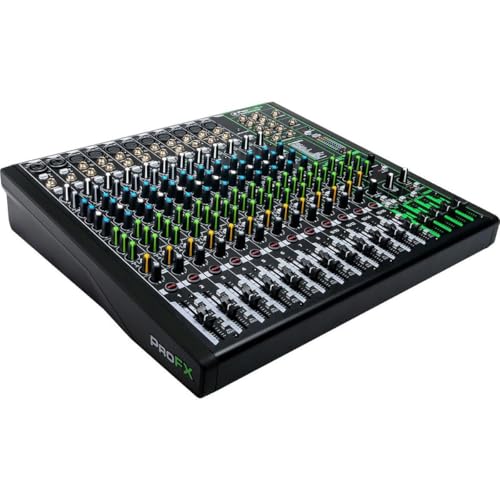
The Mackie ProFX16v3 emphasizes ease of use with Onyx preamps offering clean gain on every mic channel and USB recording capability. It’s well-suited for bands and venues that want a straightforward workflow without a heavy digital learning curve. Best for: live bands and small venues seeking reliable, plug-and-play operation with recording ability. Limitation: fewer built-in DSP effects compared to DSP-heavy models, which may require external processors for advanced processing.
XTUGA 16 Channel Audio Mixer

The XTUGA CT160 mixer supports 6/8/12/16 channel inputs and stable Bluetooth streaming, making it versatile for multi-source setups. It features gold-plated XLR ports plus +48V phantom power for condenser mics and a slim, durable chassis ideal for mobile gigs and gaming streams. Best for: mobile performers and small studios needing a slim, reliable mixer with strong isolation. Caution: The compact design may constrain long cable runs and complex routing.
W IN-MIX DX16 16-Channel Mixer

The W IN-MIX DX16 combines 16 channels with independent EQ and 99 DSP effects, plus Bluetooth and USB recording. It’s suitable for content creators, DJs, and live streamers who need built‑in processing and easy integration with computers and mobile devices. Best for: creators and live-stream focus, where ambient effects and recording are priorities. Limitation: Some users may prefer branded ecosystems with more extensive support options.
Buying Guide
What to consider when choosing a 16-channel mixer
- Channel quality and layout: Look for per-channel gain, EQ, and mute controls for precise monitoring and mixing.
- Built-in effects: DSP effects can reduce external gear needs; assess if 99 effects meet your environment’s needs or if you require high-end outboard processors.
- Input options: Ensure you have the right mic inputs (XLR, phantom power), line inputs, and USB/Bluetooth for your workflow.
- Output flexibility: Master EQ, direct outputs, and USB recording capabilities influence live sound and post-production workflows.
- Portability vs. size: Slim, compact designs are easier for mobile gigs but may limit cable routing; larger boards offer more routing but less portability.
- Phantom power: If you use condenser mics, verify 48V on needed channels and confirm easy on/off per channel.
- Connectivity compatibility: Bluetooth and USB interfaces can simplify playback and recording but check sample rates and driver needs for your setup.
Practical buying questions
- Do you need USB recording and direct computer integration?
- Will you rely on Bluetooth for wireless playback or prefer wired connections?
- How important are on-board DSP effects versus external processors?
- Is compact portability a priority for you or is space not an issue?
Tips for setup and usage
- Label each channel to avoid confusion during live performances.
- Set a consistent gain structure; avoid overdriving preamps to minimize distortion.
- Test the 48V phantom power on condenser mics before a performance to confirm proper mic pickup.
- Route the main mix to a dedicated monitor system to ensure clear stage feedback control.
FAQ
- What is a 16-channel mixer best for? It’s ideal for small to midsize live events, studios, podcasts, and streaming setups needing multiple mic and line sources with centralized control.
- Do these mixers include built-in effects? Many models offer 99 DSP effects and a 7-band master EQ, but always verify per-model specs.
- Can I use USB to record directly from these mixers? Yes, several provide USB recording to a computer, which simplifies post-production workflows.
- Is phantom power essential for all mics? Condenser mics typically require 48V phantom power; dynamic mics do not, so check per-channel phantom switches.
- Which mixer is best for beginners? Models with straightforward layouts and clear labeling, such as Mackie ProFX16v3, are commonly recommended for ease of use.
- Can I mix Bluetooth and wired sources at the same time? Many 16-channel mixers support both, but confirm input options and latency considerations for your application.