
If you specifically need a 16-hole diatonic harmonica, none of the five listings below is confirmed to meet that requirement. Four are explicitly 10-hole harmonicas, and the Fender listing does not specify its hole count. These alternatives may suit shoppers who meant a standard 10-hole diatonic harmonica instead. The Hohner Special 20 is best for a beginner seeking a versatile instrument, while the East Top and EastRock options emphasize blues-style playing and beginner access.
| Product | What the listing confirms | Best suited for |
|---|---|---|
| East Top 008K | 10-hole diatonic, key of C | Beginners and players exploring several styles |
| EastRock Blues Harmonica | 10-hole, key of C | New and intermediate players |
| Fender Blues Deluxe | Key of C; hole count not specified | Buyers wanting a holder and harmonica set |
| Hohner Special 20 | Diatonic, key of C | Beginners and experienced players |
| SWAN Blues Harmonica | 10-hole, 20 tones, key of C | Beginners wanting a case-included option |
East Top 008K 10-Hole Diatonic Harmonica

The East Top 008K is a 10-hole diatonic harmonica in the key of C, so it is not a confirmed 16-hole instrument. The listing describes it for blues, folk, rock, country, and jazz, and says it is designed for both beginners and professional players.
Its listed construction includes a plastic comb and phosphor bronze reeds. The product information also highlights a 1.2 mm reed plate, electroplated reed plate, and compact dimensions of approximately 4.01 by 1.06 by 0.75 inches. The included blue case is intended to make it easier to carry and store.
- Best for: Players who want a portable, key-of-C 10-hole model for multiple styles.
- Why it was selected: Its stated materials, range of intended music styles, and beginner-to-professional positioning make it a broadly relevant alternative.
- Limitation: It has 10 holes, not the 16 holes requested. A compact size may also be a consideration for shoppers who prefer a larger instrument.
EastRock 10-Hole Blues Harmonica

This EastRock model is a black, key-of-C, 10-hole harmonica with a case. Its listing recommends it for practice and for beginner and intermediate players. It is described as suitable for blues, folk, pop, classical music, jazz, country, and rock.
The listed materials are phosphor bronze reeds, a stainless steel cover, and a food-grade ABS resin comb. EastRock also describes an airflow splitter as helping maintain stable airflow and making it easier for beginners to learn sound techniques. Those are manufacturer-provided product claims, not a guarantee of a particular learning outcome.
- Best for: New and intermediate players seeking a key-of-C practice harmonica for varied genres.
- Why it was selected: It clearly identifies its 10-hole format, materials, intended experience level, and included case.
- Limitation: This is not a 16-hole instrument. Buyers seeking a different range or configuration should confirm the exact hole count before ordering.
Fender Blues Deluxe Harmonica Set
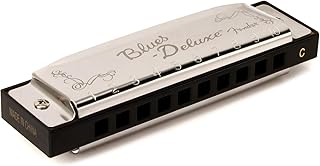
The Fender Blues Deluxe listing describes a key-of-C harmonica supplied with a harmonica holder. It mentions chromed metal covers, a molded PVC comb, and brass reeds, and positions the instrument for adults and children and for players at different skill levels.
The listing provides a set-style option for shoppers who want a holder along with the harmonica. However, the product details supplied here do not establish that this is a 16-hole diatonic model. They also use the phrase “Chromatic Harmonica” in the feature text, despite the product name identifying it as a Blues Deluxe harmonica. Check the full listing carefully if instrument type and hole count are essential.
- Best for: Buyers who want a key-of-C harmonica and a holder in one listing.
- Why it was selected: Its included holder and specified comb and reed materials distinguish it from the other listed alternatives.
- Limitation: The supplied details do not confirm its hole count or resolve the listing’s terminology about harmonica type.
Hohner Special 20 Diatonic Harmonica Bundle

The Hohner Special 20 is a key-of-C diatonic harmonica. Its listing describes a design with reed plates recessed into the comb and a projecting plastic mouthpiece. The bundle includes a zip case, instructional manual, and polishing cloth, according to the product name.
Hohner presents the Special 20 as suitable for beginners as well as professional players. The listing says it is available in other major keys, lower and higher octaves, and minor tunings. Those options may help shoppers compare versions, but the selected product is identified as the key-of-C bundle.
- Best for: Beginners seeking an instructional bundle or experienced players wanting a versatile key-of-C diatonic model.
- Why it was selected: It explicitly identifies the instrument as diatonic and describes its mouthpiece construction and included learning and care accessories.
- Limitation: The supplied details do not specify a 16-hole configuration. Do not assume it meets that exact requirement without checking the complete listing.
SWAN 10-Hole Blues Harmonica
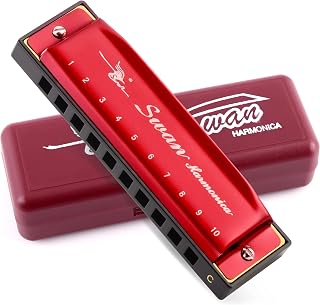
The SWAN listing identifies this as a key-of-C, 10-hole, 20-tone blues harmonica with a case. It is described as a stainless blues harp for adults and beginners. The burgundy-red color is part of the product title.
This option may suit a beginner who wants a clearly labeled 10-hole instrument and a carrying case. The listed hole and tone counts can help shoppers compare it with the specific 16-hole format they initially searched for. They are not interchangeable specifications: the product information does not say this model has 16 holes.
- Best for: Beginners looking for a key-of-C, 10-hole blues harmonica with a case.
- Why it was selected: Its listing states the hole count, tone count, key, intended audience, and case inclusion.
- Limitation: It is explicitly a 10-hole instrument, so it does not match a 16-hole requirement.
Buying Guide: How to Choose the Right Harmonica
Do you need exactly 16 holes?
Start by checking the hole count in the product title and detailed specifications. These five listings do not provide a confirmed 16-hole diatonic choice: four explicitly say 10-hole, while the Fender listing does not state its hole count. If 16 holes are essential, keep searching rather than treating a 10-hole model as a substitute. Confirm both “16-hole” and “diatonic” in the same product’s specifications before buying.
What does “diatonic” mean for your search?
Diatonic harmonicas are commonly organized around a particular musical key. The Hohner, East Top, EastRock, Fender, and SWAN listings identify a key of C. That specification matters when matching an instrument to lessons, sheet music, or other musicians. A key-of-C label does not tell you the number of holes, so verify both details separately.
Which option fits a beginner?
The EastRock listing specifically targets beginners and intermediate players and describes its airflow splitter as a learning aid. The Hohner Special 20 is presented for beginners and professionals and includes an instructional manual in the bundle. The East Top is also positioned for beginners and professionals. Compare the stated learning materials and construction rather than assuming that a beginner label guarantees an easier experience for every player.
Which materials and design details should you compare?
Product descriptions name different materials: East Top lists a plastic comb and phosphor bronze reeds; EastRock lists a food-grade ABS resin comb, phosphor bronze reeds, and stainless steel cover; Fender lists a molded PVC comb and brass reeds. Hohner describes recessed reed plates and a projecting plastic mouthpiece. These details help distinguish the listings, but the information provided does not support a direct performance ranking.
Do you need a case, holder, or learning materials?
Consider the accessories you will actually use. East Top, EastRock, and SWAN list cases; the Hohner bundle names a zip case, instructional manual, and polishing cloth; Fender lists a harmonica holder. A case supports storage and carrying, while a holder serves a different purpose. Check the current listing contents to confirm what is included in the specific version you select.
How should you compare musical styles and keys?
East Top and EastRock list several intended styles, including blues, folk, country, jazz, and rock, while SWAN is described as a blues harmonica. The Hohner listing discusses multiple available keys and tunings, but the bundle described here is in C. Choose a product whose stated key and intended use match your learning materials or playing plans, then verify that its hole count is also correct.
Frequently Asked Questions
Is any product here confirmed as a 16-hole diatonic harmonica?
No. Four listings explicitly identify 10-hole models. The Fender listing does not provide a hole count in the supplied product details, so it cannot be confirmed as 16-hole.
Are a 10-hole and a 16-hole harmonica the same thing?
No. They have different hole counts. A shopper who requires 16 holes should not assume a 10-hole model meets that requirement.
Which listed harmonica is explicitly diatonic?
The Hohner Special 20 listing explicitly calls it diatonic. The East Top listing also identifies its model as a diatonic harmonica. Check the full specifications for the other products if that classification is a deciding factor.
Which product includes an instructional manual?
The Hohner Special 20 bundle is described as including an instructional manual, zip case, and polishing cloth.
Which listed product includes a harmonica holder?
The Fender Blues Deluxe listing says it includes a harmonica holder. Its supplied details do not confirm a 16-hole configuration.
Are these products all in the key of C?
Each supplied product description identifies a key of C, including the Fender listing. Check the exact product variation before purchase, particularly when selecting a different key or tuning.