
The best 19-inch audio equipment rack depends on your available space, equipment depth, and need for mobility. The AxcessAbles rack is suited to buyers who want an open frame with wheels, while the AcouZen desktop rack is better for compact studios. For enclosed sides and venting, consider VEVOR; for a rack with a work surface, compare GEARit. Check equipment dimensions and the listed product details before choosing.
| Product | Best For | Notable Feature |
|---|---|---|
| AxcessAbles 12U Network Rack | Mobile AV and network setups | Open frame with caster wheels |
| AcouZen Wooden Desktop Studio Rack | Compact studio desks | 373 mm usable depth |
| Ktaxon 12U AV Rack | Shared or venue equipment | Removable, lockable casters |
| GEARit 12U Audio Rack | Studio workstations | Flat oak-colored top |
| VEVOR 12U AV Rack Stand | Flexible equipment access | Open front and back, side panels |
AxcessAbles 12U Network Rack

This open-frame 19-inch rack is designed for pro audio, video, IT, and network equipment. Its listed uses include mixers, routers, patch panels, servers, and power amplifiers. The product name specifies a 12U rack with 18-inch depth, while the features describe a steel frame and caster wheels for moving a loaded setup.
Best for: Buyers who need a mobile rack for a studio, DJ setup, or equipment area where rear access and airflow are useful. The open construction makes it easier to reach cables than a cabinet-style design.
Important limitation: The product name states a 500-pound capacity, while the feature text states up to 550 pounds. Confirm the capacity and equipment fit with the seller before loading the rack. Its open frame also does not enclose gear against dust or casual contact.
AcouZen Wooden Desktop Studio Rack

The AcouZen rack is made for desktop studio setups and standard 19-inch rack-mount equipment. The listed version is a 6U walnut woodgrain model, and the product is also described as available in sizes from 2U to 8U and in natural or walnut finishes. It has threaded rails, so cage nuts are not used.
The listed 373 mm usable depth suits many studio components, including preamps, audio interfaces, compressors, equalizers, effects units, patchbays, headphone amplifiers, and rack drawers. The description also cites an approximately 453 mm clear opening between the rails, which is intended to make equipment easier to slide into place.
Best for: Home-studio users who want frequently used processors and interfaces within reach on a desk. It was selected for its desktop-focused form and clearly stated usable depth.
Important limitation: Measure each device, including rear plugs and cable-bend space. A component that fits the rail width may still be too deep for the available clearance.
Ktaxon 12U AV Rack
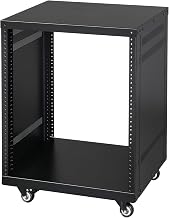
The Ktaxon rack is presented in its product name as a 12U, 19-inch AV and server equipment rack. Its feature text describes cold-rolled steel, a powder-coated finish, mesh ventilation panels, and four removable casters, two of which are lockable. The rack is intended for audio and network equipment in settings such as clubs, bars, restaurants, places of worship, and band setups.
Best for: Buyers who need to move a shared equipment setup and want casters that can be locked in place. The vented panels are a useful listed feature for equipment areas where airflow matters.
Important limitation: The feature text also refers to a “16U” rack, which conflicts with the 12U product name. Verify the actual rack-unit capacity before purchasing. The supplied details do not state a load limit or rack depth.
GEARit 12U Audio Rack With Oak Top

This GEARit rack combines 12U of 19-inch rack space with a flat oak-colored top. The listing describes it for compatible music gear, mixers, preamps, effects units, converters, servers, networking hardware, and other AV components. The top adds a work surface for items such as a laptop, notebook, drum machine, mixer, or audio interface.
Best for: Buyers who want rack-mounted equipment and an additional tabletop in one workstation. It was selected because the top surface distinguishes it from the other open-frame and cabinet-style options.
Important limitation: The listed details do not provide a rack depth, load capacity, or caster information. Check the dimensions of the gear and the available workspace before choosing it, especially if equipment will sit on the top.
VEVOR 12U AV Rack Stand

The VEVOR rack is described as a 12U stand for 19-inch audio and video equipment, with a depth of up to 18 inches. It uses Q235 carbon steel and has an open front and back for wiring and maintenance. The listing also describes removable side panels, ventilation, a top shelf, and lockable caster wheels.
Best for: Buyers who want a mobile rack that offers access from both sides and additional storage on top. It can suit studio, media, stereo, server, and AV equipment setups when the equipment fits the stated dimensions.
Important limitation: The listing does not specify a numerical load capacity in the supplied details. Confirm the load limit and measure equipment depth, including rear connections, before assembly and use.
Buying Guide: How to Choose a 19-Inch Audio Rack
How much rack space do you need?
Rack height is measured in rack units, or U. One rack unit is a standardized vertical increment used to describe rack-mount equipment and rack capacity. Add the U measurements of the components you plan to install, then leave room for future additions if your setup is likely to expand. A 12U rack, for example, offers more vertical space than a compact desktop rack listed in a smaller size.
Count only equipment designed to mount in a standard 19-inch rack when estimating filled rack space. A laptop or tabletop mixer placed on a rack’s top does not use rack units, but it does need a stable, suitable surface.
Will your equipment fit the rack depth?
Measure each device from its front mounting points to the rearmost part, including connectors. Allow extra space for power plugs and cable bends. The AcouZen listing gives a usable depth of 373 mm; the AxcessAbles product name lists an 18-inch depth, and VEVOR describes a depth of up to 18 inches. The other supplied product details do not state a rack depth.
Depth labels can refer to different parts of a rack, so compare the manufacturer’s usable interior measurement with your device dimensions rather than relying on an overall exterior measurement alone. Also check that cables can be routed without being sharply bent or obstructed.
Should you choose an open frame or a rack with panels?
An open-frame rack provides easy access to cables and equipment and can suit installations where airflow and maintenance access are priorities. It offers less physical separation from dust, pets, or accidental contact than a rack with side panels. VEVOR’s removable side panels and Ktaxon’s vented panels provide a different balance of access and enclosure; confirm exactly which panels are included for the configuration you select.
Do you need wheels?
Caster wheels can help when equipment needs to move between rooms or be repositioned for setup. Lockable casters are useful for keeping a rack from rolling once it is placed. A stationary rack may be preferable if you do not need mobility. Before moving a loaded rack, follow the product instructions and make sure the equipment is secured appropriately.
What should you check about rails and installation?
Confirm that the rack supports the mounting method used by your gear. The AcouZen listing specifies threaded rails and says cage nuts are not used. The other supplied listings do not specify their rail type. Check included hardware and the product’s assembly instructions, and verify that the rack’s usable width and rail spacing match the equipment requirements.
How should you compare capacity claims?
Do not assume that a rack can support a particular load unless the listing clearly states a capacity for the exact model. The AxcessAbles product information provided here gives two different figures, while the Ktaxon details conflict on rack-unit count. Resolve those inconsistencies with the seller or manufacturer before relying on either specification. Distribute equipment according to the rack’s instructions and keep heavy components securely supported.
What is the value of a top shelf or desktop?
A flat top can create a convenient surface for controllers, laptops, or other workflow items. GEARit lists an oak-colored flat top, and VEVOR describes an added top shelf. Consider the size of the surface and the weight of the items you plan to place there; the supplied product details do not give a separate top-surface load rating.
Frequently Asked Questions
What does 19-inch mean for an audio rack?
It refers to a standard rack-mount equipment format. Check that each device is designed for 19-inch mounting and confirm rail spacing and mounting hardware before buying.
How do I know how many rack units I need?
Add the rack-unit heights of the equipment you intend to mount. Choose enough capacity for those components, with additional space if you expect to add rack-mount gear later.
Can a desktop rack hold audio interfaces and preamps?
Yes, if those devices are designed for rack mounting and their depth fits the rack. AcouZen specifically lists interfaces, preamps, compressors, equalizers, effects units, and related studio equipment as intended uses.
Are caster wheels necessary for a studio rack?
No. Wheels are most useful when a rack must be repositioned or moved between areas. For a rack that stays in one place, mobility may be unnecessary; lockable casters can help prevent rolling when engaged.
Should I choose an open rack or one with side panels?
Choose an open rack when easy access and cable routing are priorities. Consider panels if you want more enclosure around the equipment, while checking that the design still provides suitable ventilation and access.
What should I verify before ordering an audio rack?
Check rack-unit capacity, usable depth, rail type, overall dimensions, included hardware, wheel features, and load capacity. Resolve any conflicting specifications in the listing before relying on them.