
The best 2-way active speakers depend on where you will use them: the JBL 305P MkII pair is suited to music production and podcasting, while the Edifier MR3 is a compact choice for desktop monitoring and everyday listening. The QSC K12.2 is a larger powered loudspeaker for sound reinforcement, and the Edifier R1280T is a straightforward home-audio option. The party speaker is designed for portable entertainment rather than precise studio monitoring. Compare the intended use, inputs, and speaker format before choosing.
| Product | Best suited for | Notable details |
|---|---|---|
| JBL 305P MkII | Music production and podcasting | Pair of 5-inch, 2-way powered monitors |
| Edifier MR3 | Desktop monitoring and listening | Bluetooth, TRS, RCA, AUX, and headphone output |
| QSC K12.2 | Live sound and larger spaces | 12-inch powered loudspeaker |
| Edifier R1280T | Home and computer audio | Two AUX inputs and side-mounted tone controls |
| FREEPEAR Party Bluetooth Speaker | Portable parties and outdoor use | Lighting, battery operation, and TWS pairing |
JBL 305P MkII Studio Monitor Pair

The JBL 305P MkII is the most directly targeted option here for people searching for 2-way active speakers for recording or content creation. The listing includes two 5-inch powered studio reference monitors. JBL describes the patented Image Control Waveguide as supporting precise imaging and a wide listening sweet spot, useful when positioning speakers for music production or podcast work.
Each monitor has dual 41-watt Class-D amplifiers, a 5-inch woofer, and a Slip Stream port. These listed components make the pair a sensible choice for near-field work where a producer or editor wants a dedicated left-and-right monitoring setup. Choose this pair if studio monitoring and stereo imaging matter more than Bluetooth convenience or portable use.
- Best for: Home studios, music production, and podcasting.
- Why it stands out: A two-speaker package with 5-inch drivers and a waveguide designed for imaging.
- Limitation: The supplied product details do not list Bluetooth or other consumer playback features.
Edifier MR3 Powered Studio Monitors

The Edifier MR3 is a compact active 2.0 speaker option for a desk, small listening area, or flexible home setup. Its listed connections include balanced TRS, RCA, AUX, and a headphone output. Bluetooth 5.4 supports multipoint connection, and the RCA and AUX inputs can connect more than one audio device at a time. That range of inputs makes the MR3 more adaptable than a monitor with only professional audio connections.
The stated system output is 18 watts RMS per speaker, with 3.5-inch mid-low drivers and 1-inch tweeters. Edifier lists a 52 Hz to 40 kHz response and Hi-Res Audio certification. Those specifications suit buyers who want speakers for both monitoring and general listening, while retaining wired options for audio equipment.
- Best for: Desktop users who want wired inputs, Bluetooth, and a headphone output.
- Why it stands out: Several connection types are built into a compact powered monitor pair.
- Limitation: Its 3.5-inch mid-low drivers make it a smaller-format choice than the 5-inch JBL monitors.
QSC K12.2 Active 12-Inch Loudspeaker
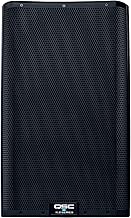
The QSC K12.2 is the large-format powered loudspeaker in this group. Its product name identifies a 12-inch speaker and 2000-watt powered design, making it more relevant to buyers considering sound reinforcement than to someone assembling a small desktop monitoring setup. It may suit a live performer, event operator, or venue buyer comparing active loudspeakers for a larger space.
Unlike the studio-focused products in this list, the information supplied for the K12.2 does not specify its inputs, frequency response, included accessories, or detailed driver arrangement. Check the seller’s current specifications and confirm that its connections and intended configuration suit your audio system before purchasing.
- Best for: Buyers seeking a powered 12-inch loudspeaker for live or event sound.
- Why it stands out: Its listed size and power rating distinguish it from compact near-field monitors.
- Limitation: The provided product details are limited, so verify technical requirements before treating it as a studio-monitor alternative.
Edifier R1280T Powered Bookshelf Speakers

The Edifier R1280T is a practical active 2.0 system for home listening, desktop audio, or a basic computer setup. The listing identifies 42 watts RMS, a wooden enclosure, a 13 mm silk-dome tweeter, and a 4-inch full-range unit. It is a better fit for everyday playback than for buyers who need the specific monitoring features or connectivity set of the JBL or MR3.
Two AUX inputs allow connection to two devices with a 3.5 mm headphone output or dual RCA output without repeatedly unplugging and switching cables. A remote control handles volume, while bass and treble adjustments are located on the side of the main speaker. This straightforward control layout can be useful for shared household listening.
- Best for: Home listeners who want powered bookshelf speakers with two AUX connections.
- Why it stands out: It combines a remote, tone controls, and inputs for two source devices.
- Limitation: The listed features do not include Bluetooth or balanced TRS inputs.
FREEPEAR Portable Party Bluetooth Speaker
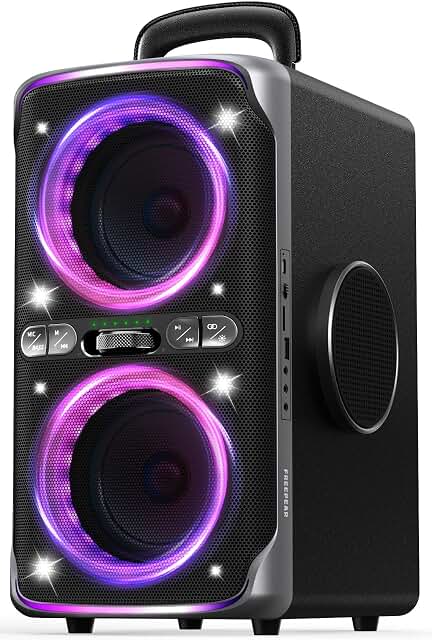
This FREEPEAR speaker is an entertainment-oriented active speaker, not a conventional studio monitor. Its listing describes dual subwoofers and dual tweeters, a 240-watt peak output, Bluetooth 5.3, a light show, an IPX4 water-resistance rating, and up to 15 hours of battery life. The stated features point to portable parties, backyard use, and other settings where lighting and wireless playback are priorities.
It also supports TWS pairing, which the listing says can link two speakers for a wider sound setup. Choose it if mobility and party features matter more than neutral sound for editing or recording. The listing notes that the manual incorrectly states 200 watts and identifies the actual peak output as 240 watts, so buyers should distinguish peak power from continuous output.
- Best for: Portable gatherings where battery operation, lights, and wireless pairing are useful.
- Why it stands out: It combines party-focused features with dual woofers and tweeters.
- Limitation: The product information does not position it as a reference monitor for accurate audio production.
Buying Guide: How to Choose 2-Way Active Speakers
What will you use the speakers for?
Start with the main task. Studio monitors are designed for close listening and production workflows, while powered PA-style loudspeakers serve live sound and event applications. Home bookshelf speakers prioritize convenient playback, and portable party speakers add features such as battery power, Bluetooth, or lighting. A speaker can be active without being the right choice for every use.
For recording, podcast editing, or mixing, the JBL 305P MkII offers a pair of 5-inch studio monitors and a waveguide designed for imaging. The Edifier MR3 is worth comparing if Bluetooth, a headphone output, and several input types matter alongside monitoring. For larger live-sound needs, the QSC is the distinct 12-inch option, but verify its technical details for your planned setup.
How much space do you have?
Driver size and overall format can help narrow the choices, but they do not alone determine sound quality or room suitability. The MR3’s 3.5-inch mid-low drivers and the R1280T’s 4-inch unit make them smaller-format options than the JBL’s 5-inch monitors or QSC’s 12-inch loudspeaker. Consider the available desk, shelf, or floor space and how close you will sit to the speakers.
Near-field monitors are commonly placed near the listener, while a large powered loudspeaker is usually considered for a different role and space. Before buying, confirm the product dimensions and placement needs in the current listing, since the supplied information does not provide dimensions for every model.
Which connections do you need?
Match the speaker inputs to your audio sources. The MR3 lists balanced TRS, RCA, AUX, and Bluetooth connectivity, plus a headphone output. The R1280T lists two AUX inputs for supported 3.5 mm or RCA sources. The JBL product details emphasize studio monitoring but do not specify its complete connection list in the supplied information.
For the QSC and party speaker, check the full product listing for the specific connection options your setup requires. Do not assume that an active speaker includes every input type simply because it has built-in amplification. Also decide whether you need a direct headphone connection, wireless playback, or the ability to leave multiple sources connected.
What does “active” mean, and does it guarantee two-way design?
An active or powered speaker has amplification built into the speaker system, so it does not require a separate external power amplifier in the same way as a passive speaker. The phrase “2-way” generally describes a speaker design that divides audio into two frequency ranges for different drivers. However, product titles and marketing descriptions do not always provide enough technical detail to confirm a specific crossover design.
For this selection, the JBL title explicitly calls the monitors 2-way, and the party speaker lists both subwoofers and tweeters. The MR3 and other products are described as active or powered, but the provided data does not consistently state a formal two-way design. Buyers who require a defined crossover or driver configuration should verify it in the manufacturer’s specifications.
How should you compare power specifications?
Look for the type of power measurement, not just the largest number. The MR3 and R1280T list RMS output, while the FREEPEAR listing gives a peak-power figure and explicitly distinguishes it from an incorrect manual specification. Peak and RMS figures describe different measurements and should not be treated as equivalent when comparing speakers.
Power ratings also do not tell the whole story about loudness, coverage, or sound quality. Compare the speaker’s intended application, driver size, input options, and placement requirements. When specifications are missing, such as in the provided QSC product details, consult the current product listing rather than filling gaps with assumptions.
Do you need Bluetooth or battery power?
Wireless features are useful for casual playback and portable use, but they may not be essential in a fixed studio setup. The MR3 includes Bluetooth 5.4 multipoint support, and the party speaker lists Bluetooth 5.3 and up to 15 hours of battery life. The R1280T instead emphasizes wired AUX connections and a remote control.
Choose based on how you plan to listen. A wired connection may be preferable when your equipment and workflow depend on it. Battery operation and TWS pairing are more relevant for gatherings where speakers need to be moved or linked wirelessly. Check the full listing for details about the included cables and exact pairing requirements.
Frequently Asked Questions
Are active speakers the same as powered speakers?
The terms are often used for speakers with built-in amplification. Check the product specifications for the exact amplifier and connection details, since naming conventions can vary.
Which product is best for music production?
The JBL 305P MkII pair is the clearest match among these options because it is listed as a pair of 5-inch, 2-way powered studio reference monitors, with features aimed at imaging and production.
Which option has the most connection types?
The Edifier MR3 lists balanced TRS, RCA, AUX, Bluetooth, and a headphone output. It is the most clearly specified choice here for buyers comparing multiple input and listening options.
Can a party speaker replace studio monitors?
Not necessarily. The FREEPEAR model is presented for portable entertainment, with lighting, battery operation, and TWS pairing. The listing does not identify it as a reference monitor for accurate production work.
Should I choose a 5-inch monitor or a 12-inch loudspeaker?
Choose according to the job. The JBL is a studio-monitor pair for near-field production, while the QSC is a 12-inch powered loudspeaker more suited to buyers considering live or event sound. Confirm room, placement, and connection requirements before purchasing either type.