
A true 24-channel AD/DA converter needs enough analog inputs and outputs for 24-channel recording or playback, but the products provided do not include a clearly specified 24-channel converter. The Aurora (n) 32 is the closest multichannel candidate; the RME ADI-2 FS is a two-channel studio converter, while the remaining options serve stereo playback or sensor-measurement tasks. Use this guide to separate genuine multichannel needs from smaller conversion jobs and to identify what to verify before buying.
| Product | Best suited for | Channel context |
|---|---|---|
| Aurora (n) 32 HD Audio Interface | Buyers investigating a multichannel studio device | 32-channel model name; listed features are not provided |
| RME ADI-2 FS | Two-channel studio conversion | 2 channels |
| AUTOUTLET Optical-to-RCA DAC | Basic digital-to-stereo analog playback | Stereo output |
| Hdiwousp Optical/Coaxial DAC | Stereo playback from optical or coaxial sources | Stereo output |
| ADS1220 ADC Module | Low-power sensor signal measurement | Measurement inputs, not multichannel audio |
Aurora (n) 32 HD Audio Interface

The Aurora (n) 32 HD is the closest product in this list to a 24-channel AD/DA requirement: its model name identifies it as a 32-channel audio interface. However, the supplied product information does not specify its analog input and output counts, connector types, sample rates, computer connectivity, or whether the 32-channel figure refers to analog channels or total digital I/O.
Best for: Buyers researching a higher-channel-count studio interface who can confirm the exact configuration from the current product listing or manufacturer documentation. It was selected because its 32-channel designation is the only listed studio product that suggests capacity beyond 24 channels.
Limitation: Do not assume the name guarantees 24 analog inputs and 24 analog outputs at once. Confirm the number and type of simultaneous analog channels, included connectivity, and conversion direction before purchase.
RME ADI-2 FS Two-Channel Converter

The RME ADI-2 FS is a two-channel AD/DA converter, not a 24-channel unit. Its listed features include a femtosecond clock, a headphone output, multiple formats, and a sample-rate range of 44.1 kHz to 192 kHz. These specifications make it relevant when the job is high-quality conversion for a stereo signal chain rather than recording or routing 24 separate channels.
Best for: Stereo studio, monitoring, or conversion setups where two channels are sufficient. It was selected as the clearest dedicated AD/DA converter in the list, and its stated sample-rate range helps buyers compare supported audio formats.
Limitation: Two channels cannot replace a multichannel converter. Choose this only if the workflow needs stereo conversion, or as a separate two-channel device within a larger system.
AUTOUTLET Optical-to-RCA DAC

This AUTOUTLET device converts optical digital audio to RCA analog output. Its listed specifications include 24-bit conversion, support up to 192 kHz, a 7-foot cable, and plug-and-play operation. The product description names televisions, DVD and Blu-ray players, and game consoles as possible source devices.
Best for: A buyer who needs to connect one optical digital source to a stereo RCA input. It was selected as a compact example of consumer digital-to-analog conversion, which can meet a simple home playback need but not a studio’s 24-channel requirement.
Limitation: This is an optical-to-RCA stereo DAC, not a multichannel recording interface or a 24-channel AD/DA converter. Check that the source provides a compatible optical signal and that the receiving equipment accepts RCA analog audio.
Hdiwousp Optical and Coaxial DAC
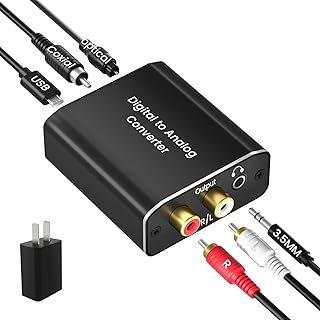
The Hdiwousp converter accepts digital coaxial or optical Toslink audio and provides analog output through RCA left/right and a 3.5 mm jack. Its listing describes support up to 192 kHz and an aluminum enclosure. This input flexibility can be useful when a stereo playback system needs to accept either of two common digital connection types.
Best for: Home users who need to convert a compatible optical or coaxial source to stereo analog audio. It was selected because it offers two listed digital input types and two analog output formats, making it more flexible for basic stereo connections than an optical-only option.
Limitation: The listed outputs are analog stereo connections, not 24 discrete channels. Confirm the digital source format and required output connection before choosing it; the product data does not establish multichannel audio conversion.
ADS1220 24-Bit ADC Module

The ADS1220 is a precision 24-bit analog-to-digital converter module intended for small sensor signals. Its listed features include SPI and I2C, a programmable-gain amplifier, input multiplexer, excitation current sources, voltage reference, oscillator, low-side switch, and temperature sensor. The description states two differential or four single-ended inputs and a maximum data rate of 2,000 samples per second.
Best for: Engineers and electronics hobbyists measuring sensors or low-level signals. It was selected because it is an ADC with 24-bit resolution, which may appear in searches for converters, but its purpose is measurement rather than multichannel audio recording.
Limitation: A 24-bit resolution specification does not mean 24 channels. This module is not presented as an audio AD/DA interface, and it does not provide digital-to-analog conversion.
Buying Guide: How to Choose a 24-Channel AD/DA Converter
Do you need 24 input channels, 24 output channels, or both?
“24-channel AD/DA converter” can describe different requirements. A recording setup may need 24 analog inputs converted to digital audio. A playback or routing system may instead need 24 digital channels converted to analog outputs. Some facilities need both directions at once. Identify the direction and number of simultaneous channels before comparing products, because a device with 24 inputs may not provide 24 outputs.
Write down the actual signal path. For example, specify the number of microphones or line-level sources, the number of playback feeds, and whether all channels must operate simultaneously. Count analog channels separately from digital channels. A model name containing “32” or an ADC resolution of “24-bit” does not, by itself, verify the number of usable analog audio channels.
Which connection types and system links are required?
Check the analog connector type on every input and output, then verify how the converter connects to the rest of the system. Multichannel studio equipment may rely on a digital audio connection, computer interface, or expansion format to carry many channels. The product information supplied for the Aurora (n) 32 does not state these details, so buyers should verify them with the current listing or product documentation before ordering.
For a home stereo connection, optical or coaxial digital input followed by RCA or 3.5 mm analog output may be enough. Those consumer DAC connections are not substitutes for multichannel studio I/O. Match the converter’s inputs to the source’s outputs and its analog outputs to the destination’s inputs.
How should you compare sample rate and bit depth?
Sample rate describes how often audio is sampled, while bit depth describes the digital word length. The RME listing states a 44.1 kHz to 192 kHz range, and the AUTOUTLET and Hdiwousp listings describe support up to 192 kHz. These figures can help when comparing stereo devices, but they do not establish channel count, connector compatibility, or whether the converter supports the exact format used by a larger system.
Check supported rates for the actual operating mode and connection. A converter may have different limits depending on how many channels are active or which digital connection is used. Since those operating details are not specified for every product here, confirm them rather than assuming the highest stated rate applies to every configuration.
Is a 24-bit ADC the same as a 24-channel converter?
No. “24-bit” refers to resolution, not the number of channels. The ADS1220 module is described as a 24-bit ADC with two differential or four single-ended inputs for sensor measurements. It is not identified as a 24-channel audio converter and has no listed DAC function. For multichannel audio, look for explicit analog input and output counts and audio-specific connectivity.
What should you verify before ordering?
- Confirm simultaneous analog input and output counts, not just a product’s model name.
- Check whether the unit performs analog-to-digital conversion, digital-to-analog conversion, or both.
- Verify connector types, digital formats, computer or system connection, and supported sample rates.
- Determine whether the listed device is a studio interface, a stereo playback DAC, or a measurement ADC module.
- For the Aurora (n) 32, verify its exact channel configuration because the supplied features do not state its analog I/O details.
For a 24-channel studio workflow, the Aurora (n) 32 is the closest candidate in this selection, but its exact configuration needs confirmation. The RME ADI-2 FS is a clearly identified two-channel AD/DA converter. The two small DACs are intended for stereo playback, while the ADS1220 is for sensor measurement. Selecting by application and verified channel count helps avoid buying a device that uses similar terminology but cannot handle the required audio workflow.
Frequently Asked Questions
Is any listed product confirmed as a 24-channel AD/DA converter?
No. The Aurora (n) 32 is the closest multichannel candidate by its model name, but the supplied information does not confirm its analog input and output configuration. The other products are identified as two-channel, stereo, or sensor-measurement devices.
Does the RME ADI-2 FS support 24 channels?
No. The listed product is a two-channel AD/DA converter with a headphone output and support for sample rates from 44.1 kHz to 192 kHz.
Does 24-bit mean a converter has 24 channels?
No. Bit depth describes digital resolution. Channel count describes how many separate signals a device can handle. The ADS1220 is a 24-bit ADC module, not a 24-channel audio interface.
Can a stereo DAC serve as a 24-channel studio converter?
No. The AUTOUTLET and Hdiwousp products provide stereo analog output from digital sources. They are intended for simpler playback connections, not 24-channel audio recording or routing.
What is the first specification to check when buying a multichannel converter?
Check the number of simultaneous analog inputs and outputs in the exact configuration you plan to use. Then confirm connection type, supported formats, and sample-rate limits for that channel count.