
The best 3.5mm-to-RCA cable depends on the distance between your audio source and receiver: choose a short cable for nearby equipment, a longer one for flexible placement, or an angled plug when space behind a device is tight. The options below include UGREEN models in three lengths, a JSAUX cable with clearly marked connectors, and a CableCreation cable with a right-angle 3.5mm plug. These are stereo audio cables, not turntable phono preamps.
| Product | Best For | Length | Standout Feature |
|---|---|---|---|
| UGREEN 3.3FT | Short, nearby connections | 3.3 feet | Compact cable run |
| UGREEN 6.6FT | Everyday home setups | 6.6 feet | Flexible PVC jacket |
| JSAUX 6.6FT | Easy left-right setup | 6.6 feet | Color-marked RCA plugs |
| UGREEN 10FT | Longer equipment gaps | 10 feet | Extra reach |
| CableCreation 10FT | Restricted connector space | 10 feet | Right-angle 3.5mm plug |
UGREEN 3.3FT: Best For Short Connections

This UGREEN cable connects a device with a 3.5mm headphone or audio output to equipment with two RCA inputs. Its 3.3-foot length is best for components placed close together, such as a phone or computer near a stereo receiver. A shorter cable can also help limit excess wire around a desk or media cabinet.
The cable has gold-plated connectors, copper conductors, and a flexible PVC jacket. UGREEN also describes it as tangle-resistant and designed for more than 10,000 bends. The two RCA plugs carry the left and right stereo channels to a receiver, speaker, or other RCA-equipped audio device.
- Best for: Nearby devices and tidy setups where extra cable would be inconvenient.
- Why it stands out: It offers the same basic 3.5mm-to-stereo-RCA connection as the longer UGREEN options in a compact length.
- Limitation: At 3.3 feet, it may not reach equipment across a room or to a distant shelf.
UGREEN 6.6FT: Best Everyday Length

The UGREEN 6.6-foot cable is a practical middle option for connecting a 3.5mm audio output to a stereo system with RCA inputs. It gives more placement flexibility than a short cable without the longer run of a 10-foot model. Use the 3.5mm plug at the source and connect the red and white RCA plugs to the matching stereo inputs.
Its listed features include gold-plated connectors, copper conductors, and a flexible PVC jacket. UGREEN says the design aims to reduce signal loss and interference, and that the cable is rated for more than 10,000 bends. These features make it a sensible choice for a connection that may be moved or unplugged occasionally.
- Best for: Home listening areas where the source and receiver are several feet apart.
- Why it stands out: Its moderate length balances reach and cable management.
- Limitation: Measure the route first; 6.6 feet may be insufficient if the cable must go around furniture or along a wall.
JSAUX 6.6FT: Best For Easy Setup

JSAUX’s 6.6-foot cable is a stereo 3.5mm-to-two-RCA adapter for connecting a compatible audio source to a receiver, amplifier, speaker, television, or other device with RCA audio connections. Its red and white RCA plugs are color-marked, making left- and right-channel hookups easier to identify. The RCA connectors also have grips intended to make plugging and unplugging more convenient.
The cable features dual shielding, gold-plated connectors, and an oxygen-copper wire core. Those construction details are intended to support stereo signal transfer and reduce susceptibility to outside interference. Its listed compatibility examples include phones, tablets, MP3 players, receivers, speakers, and amplifiers, provided the devices have the appropriate ports.
- Best for: Buyers who want clearly identified RCA channels and an everyday 6.6-foot cable.
- Why it stands out: The color-marked plugs and connector grips make the physical setup straightforward.
- Limitation: It does not convert digital audio or add a phono preamp; the source must provide an analog 3.5mm output.
UGREEN 10FT: Best For More Reach
This 10-foot UGREEN model suits setups where the audio source and RCA-equipped system are farther apart. It uses the same general connector arrangement as the shorter UGREEN cables: one 3.5mm plug and two RCA plugs for stereo audio. That added length can help when a source sits on a desk or table away from the receiver.
UGREEN lists gold-plated connectors, copper conductors, a flexible PVC jacket, and a tangle-resistant design. The company states that the cable is designed to handle more than 10,000 bends. Choose it when you need extra reach, but plan the cable route before buying so the wire is long enough without being excessively loose.
- Best for: Equipment with a larger gap or a cable path that needs room to run around furniture.
- Why it stands out: It offers the longest listed length among the three UGREEN options here.
- Limitation: More cable can create extra slack in a compact setup, so it is not the neatest choice when devices are close together.
CableCreation 10FT: Best For Tight Spaces
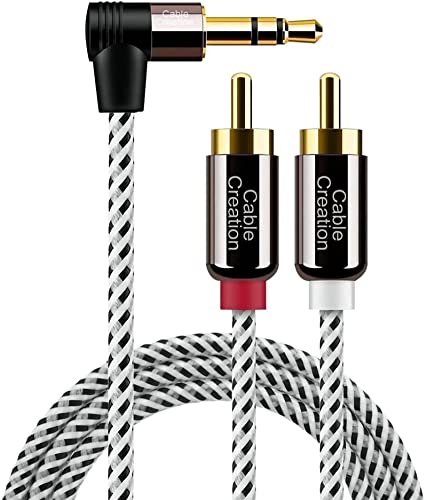
CableCreation’s 10-foot cable has a right-angle 3.5mm connector, a useful design when a straight plug would stick out behind a device or press against a wall. The cable connects a 3.5mm port with two RCA connectors and is described as bi-directional: it can carry audio between the two connection types, but the direction must be source to destination rather than both directions at once.
The product listing describes a slim, gold-plated 3.5mm plug intended to fit devices with 3.5mm jacks. Its 90-degree connector may also reduce strain where the cable exits the source. This is a distinctive alternative to standard straight-plug models if the connector area is crowded.
- Best for: Setups where the source is close to a wall, rack, or other obstruction.
- Why it stands out: The angled plug addresses connector clearance, while the 10-foot length offers extra routing flexibility.
- Limitation: Confirm that the right-angle plug points in a direction that works with your device’s port location.
Buying Guide: How To Choose A 3.5mm-To-RCA Cable
What Does A 3.5mm-To-RCA Cable Connect?
A 3.5mm-to-RCA cable carries analog audio between a device with a 3.5mm audio connection and equipment with two RCA audio connections. The 3.5mm end commonly connects to an analog headphone or line output. The red and white RCA plugs typically carry the right and left stereo channels. Check the labels and instructions on your equipment because input and output ports serve different purposes.
The word “phono” can refer to RCA-style connectors, but a phono input on a turntable receiver is not the same as a standard line-level RCA input. A turntable’s phono signal may need a phono preamp before it can connect to a line-level input. A basic 3.5mm-to-RCA cable does not provide that amplification or equalization.
Which Cable Length Should You Buy?
Measure the route from the source to the destination rather than estimating the straight-line distance. Include the path around a cabinet, along a wall, or behind a desk, and leave enough slack to connect each plug without pulling it tight.
- 3.3 feet: Choose this for nearby equipment and a compact cable run.
- 6.6 feet: Choose this for a typical home setup with moderate separation.
- 10 feet: Choose this when the source and receiver are farther apart or the cable needs a longer route.
A cable that is too short can strain its plugs. A cable that is much longer than necessary can leave extra wire to manage. The right length is the one that reaches comfortably along the actual route.
Do You Need A Straight Or Right-Angle Plug?
A straight 3.5mm plug is suitable when there is open space behind the source. A right-angle plug can be a better fit when the device sits near a wall or inside a tight rack. Before choosing an angled connector, check the direction it will face when inserted. A right-angle plug can save space in one arrangement but interfere with a nearby surface in another.
How Can You Confirm Device Compatibility?
Check that one device has an analog 3.5mm audio output and the other has compatible RCA audio inputs. A cable cannot make an output port act as an input, or change a digital-only connection into analog audio. Some newer phones and computers may not have a 3.5mm jack; verify the available ports and any required adapter before selecting a cable.
For stereo playback, connect the red RCA plug to the red or right-channel connection and the white plug to the white or left-channel connection. If audio plays through only one channel, check that both RCA plugs are fully inserted and that the source and receiving equipment are set to the correct ports.
Do Materials And Shielding Matter?
Product listings may describe gold-plated connectors, copper conductors, shielding, or flexible jackets. These features describe construction, but they do not make an incompatible connection work or guarantee a particular sound improvement in every setup. For most buyers, the first priorities are the correct connector types, enough cable length, a suitable plug shape, and secure connections.
Frequently Asked Questions
Is a 3.5mm-to-RCA cable the same as a phono cable?
Not necessarily. The cable has RCA connectors, but a turntable’s phono output may require a phono preamp before connection to a standard line input. The cable itself does not provide phono preamplification.
Can I connect a phone to an RCA receiver with this cable?
Yes, if the phone provides analog audio through a 3.5mm output and the receiver has the appropriate RCA audio inputs. A phone without a 3.5mm jack may need a separate compatible adapter.
Which RCA plug is left and which is right?
On standard stereo connections, white is left and red is right. Match each plug to the corresponding color or channel label on the receiving equipment.
Can these cables carry audio in either direction?
A passive 3.5mm-to-RCA cable can carry an analog signal between compatible input and output connections. The source must connect to an input; the cable does not turn an input into an output or send audio both ways simultaneously.
Will a 3.5mm-to-RCA cable improve sound quality?
A cable provides the physical connection and carries the available analog signal. It cannot improve a weak source signal or replace an audio converter, amplifier, or phono preamp when the equipment requires one.