
Best 300-Watt Stereo Amplifier for Home Audio
The buyer’s goal is clear: find a reliable 300-watt stereo amplifier that powers passive speakers with clean, durable sound. This guide highlights five top options, explains who each model suits best, and shows practical trade-offs. Ideal buyers include small to medium rooms, home theaters, and DIY audio setups seeking robust power, simple controls, and adaptable inputs. Read on to compare power, connectivity, and tone controls to choose the right 300W stereo amp for your speakers and space.
| Product | Best For | Key Benefit |
|---|---|---|
| Fosi BT20A Pro | Small rooms, Bluetooth-enabled setups | High efficiency with NE5532 swap options for sound tuning |
| Daakro AK45 | Budget-friendly Bluetooth streaming | Volume, bass, and treble knobs for hands-on control |
| Fosi TB10D | Versatile home ecosystems | 600W total, flexible integration with other gear |
| Facmogu 298A | Compact apartments | Affordable, compact with multiple inputs |
| AIYIMA A07 | High-fidelity desktop and bookshelf use | Premium chip pair for clean power |
Fosi Audio BT20A Pro Bluetooth 5.0 Amplifier
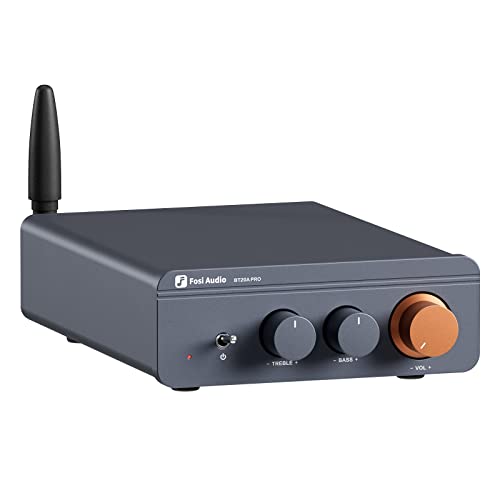
Best for compact rooms or outdoor stereo setups with wireless playback. The BT20A Pro uses the TI TPA3255 chip for clean power and low idle loss, with a strong SNR and very low THD. It accepts plug-in Op-Amps for custom sound shaping, enabling a tailored listening experience. The built-in Bluetooth 5.0 can be easily paired, and a memory function aids quick reconnect. This model suits listeners who want an upgrade over compact receivers while keeping a small footprint. Caution: Op-Amp swaps require some technical comfort and a careful approach to avoid accidental damage.
Daakro AK45 Stereo Audio Amplifier 300W Bluetooth 5.1

Best for budget-minded buyers who want tactile controls. The AK45 includes volume, bass, and treble knobs, plus a remote for distant adjustments. It emphasizes ease of use in smaller living spaces or secondary rooms where simple setup and visible tone shaping are valued. Limitation: the device notes about remote packaging should be handled before initial use to ensure full functionality.
Facmogu 298A 2 Channel Bluetooth 5.0 Amplifier
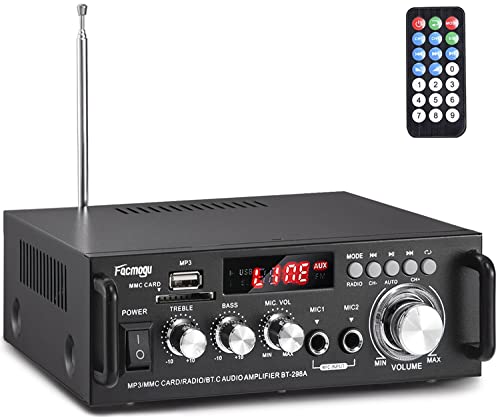
Best for compact apartments and tight budgets. The 298A focuses on essential Bluetooth streaming, RCA/USB/SD inputs, and a compact footprint for bookcases or AV cabinets. It supports room-filling stereo with reasonable clarity at a low price point. Caution: It’s less feature-rich than higher-end models, so expect fewer advanced tone-shaping options or robust high-res inputs.
AIYIMA A07 Premium TPA3255 Power Amplifier

Best for listeners seeking higher fidelity from a compact chassis. The A07 pairs the TI TPA3255 with a NE5532 dual op-amp, promoting low noise and stable performance. It’s capable of driving 2-8 ohm passive speakers and is suitable for desktop or bookshelf setups where clean power matters. Caution: While compact, it may require careful speaker pairing to maximize its true 600W potential without clipping at high volumes.
Buying Guide
What should I consider when choosing a 300W stereo amplifier?
- Speaker compatibility: Check impedance (ohms) and recommended power ratings. Aim for amps that comfortably drive your speakers without reaching peak limits too quickly.
- Power versus room size: Larger rooms may benefit from higher headroom; smaller spaces can perform well with efficient, well-controlled amps.
- Inputs and controls: Bluetooth, USB, RCA, and pre-outs affect how you connect sources and integrate with existing systems. Tone controls (bass/treble) help tailor sound to space.
- Reliability and cooling: Class D designs run cooler and more efficiently, which matters for longer listening sessions or compact enclosures.
- Upgrade path: Some amps allow Op-Amp swapping or modular tuning; assess your comfort with minor hardware changes for long-term satisfaction.
Practical comparison questions
- Is Bluetooth streaming essential? If so, seek models with robust wireless performance and clear memory pairing.
- Do you need remote control? If yes, prefer amps with accessible remotes or app control.
- How important is tone shaping? If critical, pick amps with dedicated bass/treble knobs or easy pre-out options for external EQs.
- Are multiple inputs important? For multi-source setups, ensure the amplifier offers a mix of Bluetooth, RCA, and USB inputs.
Quick buyer tips
- For small spaces, prioritize compact form and efficient Class D designs with good thermal management.
- Pair with compatible passive speakers that match the amplifier’s impedance and power range.
- Prefer models that allow user customization (like Op-Amp swaps) only if you’re comfortable with electronics.
FAQ
- What does 300W x 2 mean? It indicates the amplifier can deliver up to 300 watts per channel into a pair of 4-ohm or compatible speakers, totaling 600W across the stereo pair.
- Do I need a separate DAC with these amps? Not necessarily. Most provide line-level sources through RCA or Bluetooth; add a DAC if you require higher-resolution input from digital sources.
- Can I use these with powered speakers? These are designed for passive speakers; using them with powered speakers may bypass the intended amplification path.
- Is Class D power efficient for home use? Yes, Class D designs typically run cooler and offer higher efficiency, which is beneficial in small enclosures and extended listening sessions.
- What maintenance is required? Keep vents clear, avoid dust buildup, and replace damaged cables or accidentally bent connectors to maintain clean audio paths.