
The best 32-bit/384kHz DAC depends on how you plan to use it: choose a USB-C headphone dongle for a phone or computer, or an I2S decoder board for a DIY audio project. The VUM and Xumee adapters stand out for their CX31993 and MAX97220 dual-chip designs; the StarTech adapter adds listed microphone support and broad operating-system compatibility. The PCM5102A modules are intended for electronics projects rather than plug-and-play headphone use.
| Product | Best For | Key Listed Feature |
|---|---|---|
| VUM USB-C DAC Adapter | Headphones that may benefit from a built-in amplifier | 32-bit/384kHz decoding; CX31993 and MAX97220 chips |
| Xumee USB-C DAC Dongle | Portable USB-C listening | Dual-chip design and silver-plated cable |
| USB-C Dual-Chip HiFi Adapter | Users seeking a DAC and amp in one dongle | 32-bit/384kHz decoding; CX31993 and MAX97220 |
| PCM5102A I2S DAC Modules | DIY audio and embedded projects | 32-bit/384kHz stereo conversion |
| StarTech USB-C Audio Adapter | Wired headset use across device types | DAC, microphone input, and TRRS jack |
VUM USB-C Dual-Chip DAC Adapter

The VUM is a USB-C-to-3.5mm adapter built around a CX31993 DAC and MAX97220 amplifier. Its listed decoding ceiling is 32-bit/384kHz PCM. The product description also gives output figures of 63–65mW at 32 ohms and 125mW, and says it is intended to drive headphones from 32 to 300 ohms.
Best for: Listeners who want a compact wired-headphone adapter with a dedicated amplifier, particularly if their headphones may need more drive than a basic adapter provides. It was selected because its listed chip combination, sample-rate support, and output information make it a detailed option for comparing portable DACs.
The adapter includes a silver-plated copper cable, a rubber jacket, shielding, and a cotton braid, according to the product details. It also lists TRRS microphone input support.
Limitation: The output specifications use more than one power figure, so check the product listing for the exact operating conditions before comparing its power directly with another device.
Xumee USB-C DAC and Amp Dongle

The Xumee dongle combines a CX31993 DAC with a MAX97220 headphone amplifier and supports audio playback up to 32-bit/384kHz, as stated in its product details. It converts a USB-C connection to a 3.5mm headphone jack, with an eight-strand silver-plated single-crystal copper cable and gold-plated connectors.
Best for: USB-C phone users seeking a portable DAC-and-amplifier adapter with a straightforward 3.5mm connection. The listing names iPhone 17, 16, and 15 series, Samsung Galaxy S26, S25, and S24, and Pixel devices among compatible product families. Verify the specific device and connection requirements before purchase.
Choose this if you want a dual-chip design in a compact dongle and value the listed cable construction. Its feature set is similar to the VUM, making output specifications and device fit useful points to compare.
Limitation: The supplied product details do not state a headphone impedance range or amplifier output power, so they do not establish how it will perform with especially demanding headphones.
USB-C 32-Bit/384kHz Dual-Chip Adapter

This USB-C-to-3.5mm adapter lists the CX31993 and MAX97220 chips, 32-bit/384kHz decoding, and a built-in headphone amplifier. Its product description says it is intended for use with sensitive in-ear monitors as well as higher-impedance studio headphones, but it does not provide a specific output-power figure in the supplied information.
Best for: Buyers who want a combined DAC and amplifier and prefer a cable-based adapter with an eight-strand silver-plated monocrystalline copper cable. It was selected because it offers the same headline resolution and dual-chip configuration as the other portable options, while listing compatibility with iPhone, Android, PC, and Mac devices.
The listed construction includes gold-plated connectors and an aluminum casing. Those are product-description details, not a guarantee of sound quality or device compatibility.
Limitation: The brand name, exact power output, and detailed compatibility conditions are not provided in the supplied product data. Check the listing for connection requirements before choosing it for a particular source device.
PCM5102A I2S DAC Decoder Modules

This listing is for two PCM5102A I2S DAC decoder boards, not a USB-C headphone dongle. The product name specifies 32-bit/384kHz stereo digital-to-analog conversion and identifies Raspberry Pi, ESP32, and Arduino as compatible project platforms. It also lists a 112dB signal-to-noise ratio.
Best for: Makers and developers building a digital audio project that can provide an I2S connection. It was selected because it meets the 32-bit/384kHz search criteria in a different format from the portable adapters, and its stated use cases help distinguish it from consumer headphone products.
Choose this if you need a decoder module for an electronics project and can work with board-level connections. It is not the simplest choice for someone who only wants to connect wired headphones to a phone or laptop.
Limitation: The supplied listing information does not specify a USB connection, headphone amplifier, or included cables. Confirm the board’s electrical and assembly requirements for your project before buying.
StarTech USB-C TRRS Audio Adapter
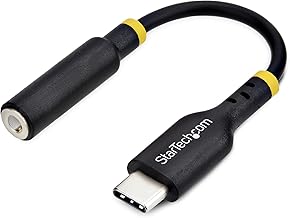
The StarTech USBCAUDIO2 converts a USB-C connection to a 3.5mm TRRS audio jack for wired headphones, headsets, or speakers. Its built-in 32-bit DAC supports listed sample rates from 44.1 to 384kHz and 16-, 24-, or 32-bit samples. The product details identify a Realtek ALC4030U chipset and microphone input support.
Best for: Users who want one small adapter for stereo listening and a wired headset microphone. The listing states compatibility with USB-C and Thunderbolt hosts, including laptops, phones, and tablets, and names Windows, macOS, Linux, iOS, and Android as supported operating systems. It also lists in-line control support.
Unlike the dual-chip products above, the supplied StarTech specifications focus on broad host support, microphone input, and stated signal-to-noise figures: 105dBA for output and 94dB for microphone input.
Limitation: Its description identifies a 32-bit DAC and support up to 384kHz but does not describe it as a 32-bit/384kHz dual-chip DAC-and-amplifier design. Choose it for its listed headset functions rather than assuming it has the same amplifier configuration as the other dongles.
Buying Guide: How to Choose a 32-Bit/384kHz DAC
Do you need a USB-C dongle or an I2S module?
Start with the connection type. A USB-C-to-3.5mm adapter is designed to connect a compatible USB-C source to wired headphones or a headset. An I2S decoder board is a component for a project that provides the appropriate digital audio interface. The PCM5102A modules are intended for DIY electronics; they are not direct substitutes for the consumer dongles in this list.
Does 32-bit/384kHz support matter for your setup?
A DAC’s maximum supported bit depth and sample rate describe formats it can accept under stated conditions. They do not guarantee that every recording, app, operating system, or connected device will send audio at that resolution. Check the source device and playback software, and remember that the audio file or stream must also provide the format you want to play.
For a simple headphone connection, device compatibility and the type of output may be more important than the maximum resolution printed in a product name. For a project board, verify that your hardware and software can supply the listed I2S audio format.
Should you choose a DAC with a headphone amplifier?
A DAC converts digital audio into an analog signal; a headphone amplifier supplies the signal needed to drive headphones. Several portable products here list both a DAC and an amplifier. The VUM gives output figures and an impedance range, while the Xumee and the third dongle do not provide equivalent detailed power figures in the supplied information.
If you use demanding headphones, compare output power and the conditions under which it is measured. Do not assume that a 32-bit/384kHz rating alone indicates how loudly or effectively a dongle will drive a particular headphone. For sensitive in-ear headphones, also consider whether the product supplies relevant noise or output information.
Do you need microphone and headset controls?
For calls, gaming, or voice recording, check whether the adapter has a TRRS jack and supports microphone input. VUM and StarTech explicitly list microphone support; StarTech also lists in-line controls. A standard headphone output does not necessarily provide the headset functions you need, so confirm the connector type and your headset’s requirements.
How should you compare cable and build descriptions?
The VUM, Xumee, and third adapter list silver-plated copper cable construction, while the third also lists an aluminum casing. These are useful product-description details for comparing physical design, but they do not independently establish audible performance. Consider cable length, connector shape, and how you will carry or use the adapter, using the listing details rather than assuming a material specification proves better sound.
What compatibility details should you verify?
Check the source device’s port, operating system, and audio-output support. The StarTech listing gives the broadest explicit operating-system information, while Xumee names several phone families. Product-family names do not guarantee that every model, case, or software configuration will work. Verify the exact device and any needed adapter or permissions in the product listing before ordering.
Frequently Asked Questions
What does 32-bit/384kHz mean on a DAC?
It describes the maximum listed digital audio bit depth and sample rate the DAC supports. It does not mean that all music will play at that resolution; the source recording, app, and device settings also matter.
Is a USB-C DAC dongle the same as an I2S DAC board?
No. A USB-C dongle connects to a USB host and typically provides a headphone or audio jack. An I2S DAC board is a component for a project with an I2S audio connection, so it is not automatically plug-and-play with a phone.
Which listed adapter includes microphone support?
The VUM product details state TRRS HD microphone input support. The StarTech listing also specifies microphone input and a TRRS jack, along with support for in-line controls.
Which product lists headphone amplifier output power?
The VUM listing gives output figures of 63–65mW at 32 ohms and 125mW, and states a 32–300 ohm headphone range. The other supplied product descriptions do not provide directly comparable output-power details.
Will a 384kHz DAC improve every song?
No. A DAC’s supported maximum does not change the resolution of a lower-resolution recording. The source material and playback chain determine the audio format being sent to the converter.
What should I check before buying a USB-C-to-3.5mm adapter?
Confirm that your device supports USB-C audio output, that the adapter’s jack matches your headphones or headset, and whether you need microphone or in-line control support. For higher-impedance headphones, compare stated amplifier output and impedance information rather than relying only on a resolution rating.