
A 4-channel car amplifier can run multiple speakers and, when its channels can be bridged and the subwoofer’s electrical requirements match, a subwoofer as well. The Pioneer GM-A6704 is a strong fit for buyers who want a bridgeable amp with high- and low-pass filters; the Taramps TS 400×4 is a compact full-range option with two bridged channels. The Skar Audio RP-75.4AB, ORION CBA2500.4, and Taramps TS 1200 offer other power or crossover approaches. Compare RMS output and wiring requirements before choosing.
| Product | Best suited for | Notable listed details |
|---|---|---|
| Pioneer GM-A6704 | Speaker-and-sub configurations needing a bridgeable amp | Class AB; high- and low-pass filters |
| Taramps TS 400×4 | Compact full-range setups that need two bridged channels | 400 watts RMS; RCA input |
| Skar Audio RP-75.4AB | Buyers comparing stated RMS output at different loads | 75 watts x 4 at 4 ohms; 125 watts x 4 at 2 ohms |
| ORION CBA2500.4 | Setups needing adjustable filters and bass boost | 400W RMS; 2/4-ohm stable, as listed |
| Taramps TS 1200 | Buyers seeking a higher-output, full-range four-channel model | Fixed full-range crossover; RCA/wire input |
Pioneer GM-A6704

The Pioneer GM-A6704 is a Class AB, bridgeable four-channel amplifier listed with a 1000W maximum rating. Its high- and low-pass filters make it a candidate for a system in which the amplifier needs to direct different frequency ranges to connected speakers and a subwoofer. Filter availability is useful, but it does not by itself confirm that a particular subwoofer can be driven safely.
Best for: Buyers who want a bridgeable four-channel amp with listed high- and low-pass filters. It was selected because those features are relevant to splitting amplifier channels between speakers and a subwoofer.
- Class AB design.
- Bridgeable four-channel configuration.
- High- and low-pass filters.
- Listed 1000W maximum output; do not treat this maximum figure as RMS output.
Limitation: The supplied product details do not state RMS output or bridged impedance requirements. Check the manufacturer’s specifications against the subwoofer and speaker ratings before wiring.
Taramps TS 400×4

The Taramps TS 400×4 is a full-range Class D amplifier listed at 400 watts RMS, with four channels and two bridged channels. That combination makes it relevant to a system using separate channels for speakers and a bridged pair for a subwoofer, provided the manufacturer’s wiring and load requirements are met. The model listing also identifies RCA input.
Best for: Buyers looking for a small, full-range four-channel model with two bridged channels. It was selected because the stated bridge capability directly relates to using a four-channel amplifier for speakers and a subwoofer.
- 400 watts RMS, as stated in the product name.
- Four channels and two bridged channels.
- Class D design and RCA input.
Limitation: The supplied information does not specify per-channel RMS output or the supported bridged load. The listing strongly recommends professional installation by a qualified technician and warns that improper installation may cause damage or injury.
Skar Audio RP-75.4AB

The Skar Audio RP-75.4AB is a full-range, Class A/B four-channel amplifier with a 500-watt listing. Its stated RMS output is 75 watts per channel at 4 ohms and 125 watts per channel at 2 ohms. These load-specific figures give buyers useful information for comparing the amp with speakers, but they do not establish whether a bridged subwoofer connection is supported.
Best for: Buyers who want stated per-channel RMS figures at both 2 and 4 ohms. It was selected because those figures help make a more meaningful comparison than a maximum-wattage claim alone.
- Full-range, Class A/B, four-channel amplifier.
- 500-watt total rating in the product description.
- RMS output listed as 125 watts x 4 at 2 ohms.
- RMS output listed as 75 watts x 4 at 4 ohms.
Limitation: The supplied details do not mention bridge capability, crossover controls, or bridged output. Choose it for a speaker-and-sub setup only after confirming the manufacturer’s bridge specifications and permitted load.
ORION CBA2500.4 Cobalt

The ORION CBA2500.4 Cobalt is a Class A/B four-channel amplifier listed as 400W RMS. Its product description includes adjustable low- and high-pass filters, bass boost, MOSFET power, and 2/4-ohm stability. These features may help buyers configure a system around speaker and subwoofer frequency needs, but the supplied details do not confirm a specific bridged output rating.
Best for: Buyers who want adjustable filter controls and a listed RMS figure in one four-channel amplifier. It was selected for its clearly stated crossover and bass-boost features, which are relevant when planning a mixed speaker-and-sub system.
- Class A/B, four-channel design.
- 400W RMS stated in the product name.
- Adjustable low- and high-pass filters and bass boost.
- Listed as 2/4-ohm stable.
Limitation: The supplied description does not give RMS output per channel or a bridged-load specification. Confirm those details in the current manual before connecting a subwoofer.
Taramps TS 1200
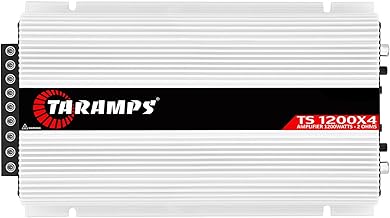
The Taramps TS 1200 is a four-channel, full-range Class D amplifier described as a 1200-watt model. Its listing identifies a fixed full-range crossover and both RCA and wire input. Those input options may be useful when choosing how to connect an audio source, but the provided details do not explain the exact input wiring or show a bridged output rating.
Best for: Buyers comparing higher headline output figures and a four-channel full-range design. It was selected because its stated input choices and crossover distinguish it from the other listed models.
- Four-channel, full-range Class D amplifier.
- 1200-watt rating in the product name.
- Fixed crossover.
- RCA and wire input are listed.
Limitation: The provided information does not include RMS output by channel, bridge capability, or supported speaker and subwoofer loads. Do not select it based on the 1200-watt name alone; verify the specifications for the exact configuration.
Buying Guide: How to Choose a Four-Channel Amp for Speakers and a Sub
Can a four-channel amp power speakers and a subwoofer?
Yes, some four-channel amplifiers can run speakers and a subwoofer, but the connection depends on the amp’s channel configuration. A common approach is to use two channels for speakers and bridge the other two channels for a subwoofer. This only works when the amplifier is explicitly designed for bridged operation and the subwoofer’s impedance falls within the stated limit. Do not assume that every four-channel amp can be bridged.
Some systems instead use all four channels for speakers and a separate amplifier for the subwoofer. That can be a more suitable arrangement when the four-channel model lacks a documented bridge mode or when its available output does not match the subwoofer. The product details provided here do not establish every model’s suitability for a particular subwoofer.
Should you compare RMS watts or maximum watts?
Use RMS power figures as the main starting point when matching an amplifier to speakers or a subwoofer. RMS ratings describe continuous output more usefully than a peak or maximum number. For example, the Skar listing provides per-channel RMS figures at 2 and 4 ohms, while the Pioneer listing gives a maximum rating without RMS details in the supplied information. These numbers are not directly interchangeable.
Compare the amplifier’s RMS output at the intended load with the connected speaker or subwoofer’s recommended power range. Check whether the published number applies per channel, across all channels, or to a bridged configuration. If the product listing does not state this clearly, consult the manufacturer’s documentation instead of estimating.
What do impedance and bridging mean?
Impedance, measured in ohms, affects the electrical load presented to the amplifier. An amplifier may support one load per channel and a different minimum load when bridged. Bridging combines two channels to drive one output, so it changes how the amplifier sees the connected speaker. A load that is acceptable on a single channel may be unsafe when those channels are bridged.
Check the amplifier’s minimum supported impedance in the exact operating mode you plan to use. Also check the subwoofer’s final impedance after accounting for its voice coils and wiring. When either specification is unclear, ask a qualified installer rather than connecting the components by trial and error.
Which crossover controls matter for a speaker-and-sub system?
A low-pass filter can limit higher frequencies sent to a subwoofer, while a high-pass filter can limit lower frequencies sent to speakers. The Pioneer is listed with high- and low-pass filters, and the ORION has adjustable versions of both. The Taramps TS 1200 listing identifies a fixed full-range crossover. These descriptions differ, so check the manual for filter behavior and adjustment ranges before planning a specific setup.
Bass boost is not a substitute for a suitable subwoofer match or correct tuning. If an amplifier offers bass boost, use the manufacturer’s instructions and avoid assuming that the feature increases safe output for every speaker or sub.
What else should you check before buying?
- Channel plan: Decide which channels will power speakers and whether the sub will use a bridged pair or a separate amplifier.
- RMS output: Look for output figures at the correct impedance and operating mode.
- Bridge support: Verify that bridging is explicitly supported and confirm the minimum bridged load.
- Inputs: Compare the listed RCA or wire-input options with the audio system you intend to connect.
- Installation: Plan for proper wiring, mounting, and safe installation. The TS 400×4 listing specifically recommends professional installation.
- Controls: Check whether filters are adjustable or fixed and whether their functions match the system plan.
When the product data does not provide RMS output, bridge specifications, or input details, treat that as an item to verify, not as evidence that a particular configuration will work. The right choice depends on the actual speakers, subwoofer, wiring, and intended channel layout.
Frequently Asked Questions
Can I connect a subwoofer to any four-channel amplifier?
No. The amplifier must support the intended connection, including bridging if you plan to combine channels. Its minimum permitted impedance and output rating must also match the subwoofer.
Is a 1000-watt or 1200-watt label enough to compare amplifiers?
No. A maximum or headline wattage figure does not show RMS output for each channel or a bridged pair. Compare RMS specifications at the load you plan to use.
Which listed model explicitly states that it has bridged channels?
The Taramps TS 400×4 listing states that it has two bridged channels. The Pioneer listing describes the GM-A6704 as bridgeable, but the supplied details do not state its bridged output or load requirements.
Do high- and low-pass filters make an amplifier compatible with every subwoofer?
No. Filters control frequency range, but they do not confirm that the amplifier’s power, bridge mode, or impedance is suitable for a specific subwoofer.
When should I use a professional installer?
Use a qualified installer when you are unsure about power wiring, channel bridging, impedance, or safe mounting. The Taramps TS 400×4 listing specifically recommends professional installation and warns about improper setup.