
Best 4 Inch Full Range Drivers for Small Enclosures
Looking for a compact 4-inch full-range driver that delivers solid bass while staying thin and easy to integrate? This article highlights five strong options and explains which buyers they’re best for. Ideal buyers include DIY speaker builders, portable sound systems, car audio upgrades, and compact bookshelf setups. Each pick is explained with who benefits most, plus practical pros and limitations to guide your choice.
| Product | Best For | Key Benefit |
|---|---|---|
| Dayton Audio PC105-8 | Compact enclosures, high-frequency extension | Smooth roll-off with controlled inductance |
| Dayton Audio RS100-4 | Balanced full-range with low distortion | Long-excursion motor for better bass |
| Dayton Audio PC105-4 | High power handling in tight spaces | Vented coil/pole for power handling |
| Dayton Audio RS100-8 | Low distortion, high resolution | Rigid cone and dual paths for control |
| PRV Audio 4MR60-NDY-4 | Compact car or portable systems | Neodymium motor, wide 90-20k Hz |
Dayton Audio PC105-8 4″ Full-Range Driver

The PC105-8 uses a poly damped woven glass fiber cone to control cone break-up and deliver a smooth roll-off. A copper cap helps keep inductance low and extends high-frequency response. A 1″ vented aluminum voice coil former and vented pole piece support higher power handling. Best for DIY enclosures where crisp highs and a clean midrange matter. Suitable for compact bookshelf speakers or small PA boxes. Caution: frequency extension may dip slightly at the very top end in some enclosures.
Dayton Audio RS100-4 4″ Reference Full-Range Driver 4 Ohm
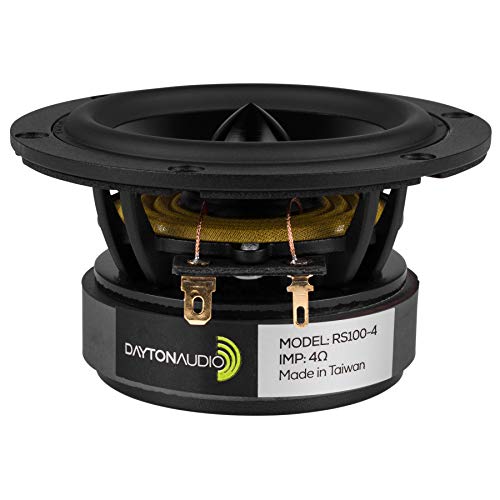
The RS100-4 is designed for true full-range performance with low distortion. Its long-excursion motor and low-loss surround contribute to strong bass response for a 4″ driver. This model is best for listeners who want a simple, single-driver solution in compact cabinets or sealed enclosures. Limitation: as a 4-ohm driver, system impedance should match with compatible amplifiers to avoid overloading the output stage.
Dayton Audio PC105-4 4″ Full-Range Poly Cone Driver

Similar to the 8-ohm variant, the PC105-4 uses a poly damped cone for smooth roll-off and a copper cap to manage inductance. The 1″ vented aluminum voice coil former and vented pole piece enable high power handling. Best for budget-minded builders needing reliable 4″ performance in small cabinets. Consider enclosure tuning to preserve the intended high-frequency response.
Dayton Audio RS100-8 4″ Reference Full-Range Driver

Noted for very low distortion and high-resolution output, the RS100-8 employs a low-distortion, high-excursion motor with dual short-circuit paths and a rigid black anodized aluminum cone for strong bass. Best for listeners seeking precise, clean full-range sound in small to medium enclosures. Limitation: 8-ohm impedance may require amplification with higher sensitivity or more robust power delivery to achieve loud listening levels.
Dayton Audio DMA105-8 4″ Dual Magnet Aluminum Cone Full-Range Driver 8 Ohm

The DMA105-8 offers excellent high-frequency response for true full-range applications, with a dual neodymium motor creating a symmetrical magnetic field for precise control. The large copper cap reduces distortion while improving high-frequency performance. Best for compact, high-fidelity systems where extended highs are important. Limitation: 8-ohm design may require higher amplification or careful matching in some setups.
PRV Audio 4″ Full-Range Neodymium Speaker 4MR60-NDY-4

This 4″ neodymium driver delivers high efficiency with 60 watts handling in a compact form. Its broad 90-20,000 Hz range and flat midrange support clear vocals and instruments. Best for portable speaker systems, line arrays, or car audio where space is limited. Limitation: neodymium magnets can require careful handling during installation and may heat more quickly under high power.
Dayton Audio DMA105-4 4″ Dual Magnet Aluminum Cone Full-Range Driver 4 Ohm
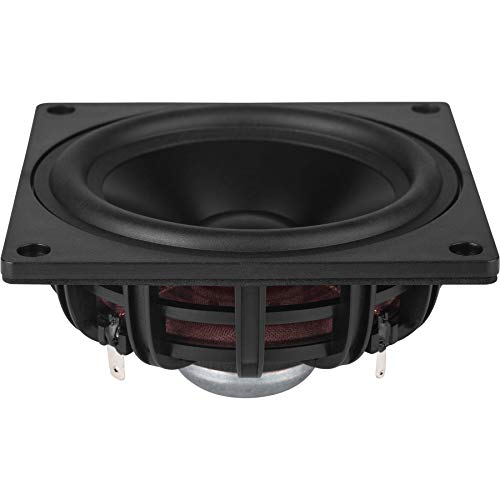
The DMA105-4 features excellent high-frequency response for true full-range use with a dual neodymium motor that provides superb control. A large copper cap lowers distortion while boosting high-frequency response. Best for compact cabinets where accurate highs are key. Limitation: 4-ohm configuration may require compatible amplification to reach higher SPLs in larger rooms.
Buying Guide
What should you consider when choosing a 4″ full-range driver? Start with enclosure size and desired bass extension. Impedance matters for amplifier compatibility; 4-ohm models generally deliver more output per watt than 8-ohm variants, but require suitable amps. Cone material affects distortion and breakup: poly cones often provide smoothness, while aluminum cones offer brightness and higher stiffness. Power handling indicates how much input the driver can tolerate; look for copper caps and vented coil designs that improve high-frequency performance. Consider voice coil diameter and venting for heat management in compact boxes. Size and price often trade off with low-end depth and clarity at moderate volumes.
How do I pair these drivers with an amplifier?
Choose an amp with sufficient wattage for the driver’s impedance (4 ohms or 8 ohms). A baseline rule is to match the amplifier’s output to the driver’s sensitivity and enclosure design. For compact enclosures, prioritize drivers with strong power handling and controlled breakup to avoid distortion at higher volumes.
What enclosure type works best?
Sealed enclosures are common for 4″ full-range drivers, delivering tight bass and predictable response. Small bass-reflex (ported) designs can extend low-end output but require careful tuning to avoid boomy or uneven response. For portable or space-limited applications, consider a sealed box with appropriate internal volume guidelines from the driver’s datasheet.
Are there material differences to consider?
Poly cone drivers tend to offer smooth midrange and controlled high-frequency roll-off, while aluminum cones provide strength and better high-end detail. Neodymium magnets reduce weight and can enhance efficiency, but may demand specific mounting considerations and heat management in some installations.
What about reliability and maintenance?
Most 4″ drivers in this list are designed for continuous operation with appropriate enclosure tuning and ventilation. Check for vented pole pieces and proper heat sinking in high-power designs to extend performance life in demanding uses such as car audio or portable systems.
How to compare these models quickly?
- Best for high-frequency clarity: DMA105-8 and RS100-8
- Best for compact, budget builds: PC105-4 and RS100-4
- Best for portable or tight spaces: PRV 4MR60-NDY-4
Frequently Asked Questions
- What is a 4-inch full-range driver best used for?
Compact speaker projects, portable systems, and bookshelf setups where a small footprint is required.
- Which impedance should I choose, 4 ohm or 8 ohm?
4 ohm drivers can deliver more power per watt but require compatible amplifiers; 8 ohm drivers are usually easier to match with a wider range of amps.
- Do all 4″ drivers require a dedicated enclosure?
Yes, most perform best in a properly sized enclosure, whether sealed or ported, to achieve consistent bass and midrange.
- Can I mix different 4″ drivers in one project?
Mixing drivers can yield uneven tonal balance; if mixing, ensure crossover alignment and enclosure tuning match system goals.
- How important is the cone material?
Cone materials influence breakup, damping, and frequency response; poly cones usually offer smoother midrange, while metal cones can improve high-frequency extension.
- Are neodymium-magnet drivers safer to install?
They are lighter and can be more efficient, but handle magnets with care during installation and ensure proper mounting to avoid magnet contact with metal parts.