
Best Near Field Monitors for Accurate Desktop Sound
Answer: When choosing active near-field monitors, look for clear high- and mid-range detail, suitable power for your room, and flexible inputs. The top picks below suit different buyers—from home studios and podcasters to multimedia creators and music producers. This guide highlights five monitors that balance clarity, versatility, and value.
| Product | Type | Power (approx.) | Best For |
|---|---|---|---|
| Edifier R1280T | 2.0 near-field bookshelf | 42W | Starter studios and compact desks |
| PreSonus Eris 3.5 | 3.5″ active near-field | 50W | Multimedia, gaming, streaming |
| pegcabac PMH-66A | 6.5″ bi-amp near-field | 160W (total) | Mixing and detailed mastering |
| Edifier MR4 | 4″ active near-field | — | Compact desktop music production |
| JBL 308P MkII | 8″ two-way active monitor | 112W | Professional-level accuracy |
Edifier R1280T Powered Bookshelf Speakers — Near Field Studio Monitors
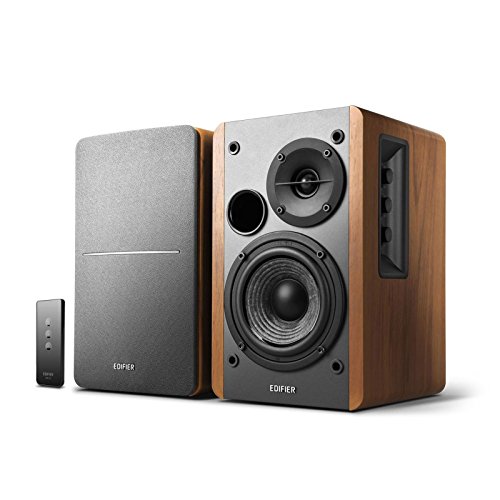
Best for: beginners and small desk setups that need a simple, plug-and-play solution. These 2.0 monitors offer built-in power with dual AUX inputs for quick device switching, and a silk-dome tweeter with a 4-inch full-range woofer for natural sound.
Why chosen: The dual AUX accepts two devices without re-plugging, and a side-mounted bass/treble control lets you tailor the sound in real time. The remote control adds convenience when the desk layout makes reach difficult.
Caution: As a 2.0 system, low-end depth may be limited for bass-heavy mixes; consider a subwoofer if you need extended bass. Best for near-field listening at lower room volumes.
PreSonus Eris 3.5 Powered Studio Monitors (Pair)

Best for: small home studios and desktop environments needing accurate, distortion-free playback at moderate volumes. The pair delivers a clear, dynamic sound with a 3.5” woofer and 1” silk-dome tweeters for balanced highs.
Why chosen: 50 watts of internal amplification provide ample headroom to reveal dynamics in music, podcasts, and game audio. The 80 Hz–20 kHz range covers most critical content without overwhelming higher frequencies.
Caution: While compact and versatile, the small woofer may not satisfy users seeking deep bass for EDM or film work. Consider placement to reduce boundary boost in small rooms.
StudioMan MS3 3.5″ Near Field Studio Monitor (Pair)
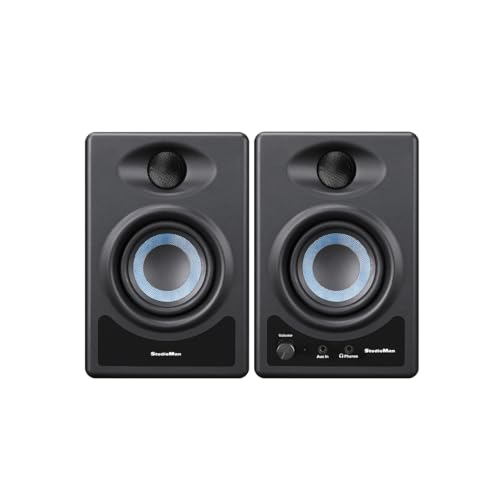
Best for: compact desks that want a higher-end 2-way near-field experience with Kevlar drivers for more consistent dispersion. The 3.5” woofer and 1” silk-dome tweeter deliver cleaner transients.
Why chosen: Kevlar woofers reduce time-smearing and improve clarity in busy mixes. The design emphasizes a smooth, wide dispersion ideal for near-field listening and home video production.
Caution: The data notes a “near-field” focus; very large rooms or very low-frequency work may require larger monitors or a subwoofer for full-range accuracy.
pegcabac PMH-66A 6.5″ Bi-Amp Powered Studio Monitor

Best for: mid-to-large desks where precise midrange and deep bass translation are essential, such as mixing and mastering at near-field distance. The 6.5″ woofer and 1″ soft-dome tweeter provide a wide, neutral frequency response from 60 Hz to 20 kHz.
Why chosen: Bi-amped design isolates LF and HF amplification for better clarity and separation. The 92 dB sensitivity helps achieve clean sound at modest levels in typical home studios.
Caution: Bi-amped configurations require more space and proper calibration for optimal performance; ensure enclosure and room acoustics support accurate listening.
JBL Professional 308P MkII 8-Inch Near Field Monitor
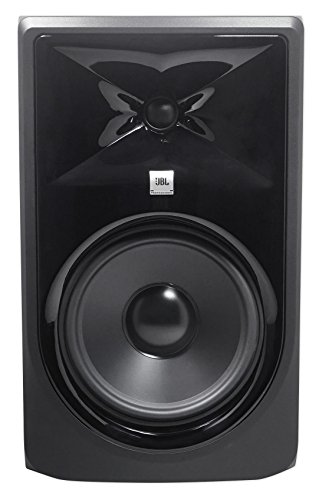
Best for: serious near-field work in mid-to-large rooms where accurate translation matters for mixing and mastering. The 8″ woofer and 1″ tweeter deliver robust low-end and clean highs.
Why chosen: A higher-powered option with professional-grade reference capability suitable for critical listening. Suitable for writers, producers, and engineers who need reliable translation across playback systems.
Caution: Larger footprint means more desk space is required; ensure your setup accommodates the 308P MkII size and placement constraints.
Buying Guide: Key Considerations For Near Field Monitors
- Room size and listening distance: Smaller rooms benefit from smaller drivers (3.5″ to 4″) to avoid excessive bass build-up. Larger rooms can justify 6.5″ or 8″ monitors for deeper low end.
- Power and headroom: Look for monitors with enough amplifier power to avoid distortion at typical listening levels. More power helps maintain clarity at higher volumes.
- Input options: Dual AUX, RCA, TRS, and subwoofer outputs offer versatility. Consider whether you need Bluetooth or wired only.
- Frequency response: A flat or neutral response is ideal for mixing. Note any deliberate boosts (e.g., for bass) and plan placement accordingly.
- Acoustic treatment: Near-field monitors perform best with minimal room coloration. Small room treatment, speaker placement (acute angles to ears), and isolation pads improve accuracy.
- Budget vs. needs: For basic podcasts and music production, compact 3.5″ or 4″ monitors may suffice. For critical mixing, larger, accurately tuned systems are preferable.
FAQ
- What is the main difference between 2.0 and 2.1 near-field monitors?
– 2.0 systems have two drivers (one woofer, one tweeter) and no dedicated subwoofer channel, while 2.1 systems add a subwoofer for deeper bass extension. - Do I need an audio interface to use these monitors?
– Yes, for most professional setups you’ll connect monitors to an audio interface or mixer via balanced or unbalanced outputs. - Is Bluetooth on near-field monitors necessary?
– It’s optional. Bluetooth adds convenience but can introduce latency and may reduce clarity for critical mixing. Prefer wired connections for accuracy. - How do I choose the right size monitor for my desk?
– Consider listening distance, room size, and bass handling. Smaller rooms benefit from 3.5″–4″ models, larger rooms can handle 6.5″ and 8″ models. - Can near-field monitors replace studio-grade sound treatment?
– They are a core component, but proper room treatment and placement significantly influence accuracy and translation. - What should I look for in a subwoofer pairing?
– Ensure the subwoofer has a clear crossover control and a seamless integration with your monitors to avoid boominess or phase issues.