
A 4-ohm passive crossover routes different frequency ranges to the speakers in a multi-driver audio system. For a clearly specified 4-ohm option, consider the Audiopipe CRX-303; for a crossover rated for a broader 4–8-ohm range, compare the HiQltyla 3-way models. The Audiopipe CRX-203 and DS18 PRO-CFX are two-way choices, but their supplied product details do not state an impedance rating, so confirm compatibility before buying.
| Product | Best For | Key Listed Detail |
|---|---|---|
| Audiopipe CRX-303 | Three-way car audio systems | 4 ohms; 300 watts maximum |
| HiQltyla 3-way crossover, 860Hz/6000Hz | 4–8-ohm home or car audio | 200 watts peak; 3-way |
| HiQltyla 3-way crossover, alternate components | Buyers comparing component versions | 4–8 ohms; 200 watts peak |
| Audiopipe CRX-203 | Two-way tweeter and mid/high setup | 150 watts RMS; 300 watts peak |
| DS18 PRO-CFX | Two-way car audio | 300 watts RMS listed |
Audiopipe CRX-303 4-Ohm 3-Way Crossover

The Audiopipe CRX-303 is the clearest match for shoppers specifically looking for a 4-ohm passive crossover. Its listed specifications identify a 4-ohm, three-way design with a maximum power handling figure of 300 watts. The product is supplied as a two-pack, making it relevant to buyers building or updating a pair of speaker channels.
Its three-way format is intended to divide a speaker signal among three driver ranges rather than only two. Listed construction features include high-grade polymer capacitors, ferrite components, and air-cooled spools. Those details help distinguish it from simpler two-way options, but the supplied information does not give crossover frequencies or a continuous RMS rating.
- Best for: Buyers who need a stated 4-ohm, three-way car audio crossover.
- Why it was selected: It explicitly lists 4-ohm impedance and 300-watt maximum power handling.
- Check before buying: Confirm the drivers’ frequency ranges and power requirements; crossover points are not provided in the supplied details.
Choose this if a three-way layout and a specific 4-ohm rating are priorities. Avoid assuming that its 300-watt maximum figure means 300 watts RMS, because the listing describes it as maximum power.
HiQltyla 3-Way Crossover, 860Hz/6000Hz
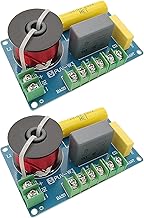
This HiQltyla passive crossover is listed for 4–8-ohm speakers, so it includes 4-ohm systems within its stated impedance range. It is a three-way model rated at 200 watts peak, with a listed frequency range of 45Hz–25kHz and division points at 860Hz and 6000Hz. The product is offered as a two-pack.
Screw terminals are intended to simplify wiring without soldering. Listed components include a bass inductor, a dedicated MPX capacitor, and a 100V 10uF high-current capacitor. The product details describe it for HiFi home audio while also mentioning installation with car or home audio, so buyers should assess enclosure, wiring, and system fit rather than assume every application is interchangeable.
- Best for: Buyers seeking a three-way crossover with a stated 4–8-ohm range and defined crossover points.
- Why it was selected: Its impedance range includes 4 ohms, and it supplies useful frequency and power specifications.
- Check before buying: The 200-watt figure is peak, not an RMS rating.
Choose this model when its 860Hz and 6000Hz division points suit the intended drivers. If the speakers need different crossover frequencies, verify the fit before purchase.
HiQltyla 3-Way Crossover With MKP Capacitor

This is another HiQltyla three-way crossover listed for 4–8-ohm speakers and rated at 200 watts peak. Its frequency range is 45Hz–25kHz, with division points at 860Hz and 6000Hz. The listed components include a bass inductor, dedicated MKP and MPX capacitors, and a 50V 12uF high-current capacitor. Screw terminals are intended to make connections convenient without welding or soldering.
Compared with the other HiQltyla option in this list, the stated impedance range and crossover points are the same, while the supplied component details differ. Those component descriptions may help shoppers distinguish the listings, but they do not establish that one version will sound better in a particular system.
- Best for: Buyers comparing 4–8-ohm three-way options who want the listed MKP capacitor configuration.
- Why it was selected: It explicitly covers 4-ohm speakers and gives frequency, division-point, and peak-power information.
- Check before buying: Confirm that the listed 860Hz and 6000Hz points suit the drivers being connected.
Choose this if the stated component configuration is the one you need. Its 200-watt peak rating should not be treated as a continuous RMS limit.
Audiopipe CRX-203 Two-Way Crossover

The Audiopipe CRX-203 is a two-way passive crossover sold as a two-pack for car audio tweeter and mid/high applications. Its listed power handling is 150 watts RMS and 300 watts peak. The stated tweeter frequency range is 3.39–20kHz, and gold-plated screw terminals are included in the feature list.
This model is a useful comparison for buyers whose speaker arrangement needs two frequency paths rather than the three paths provided by the CRX-303 or HiQltyla models. However, the supplied product details do not specify its impedance. A shopper searching specifically for a 4-ohm crossover should confirm the product’s impedance compatibility before selecting it.
- Best for: Buyers looking for a two-way car audio crossover with stated RMS and peak ratings.
- Why it was selected: It serves the tweeter and mid/high application and provides a defined tweeter frequency range.
- Check before buying: Its listed details do not confirm 4-ohm compatibility.
Choose this if the system requires two-way filtering and the impedance is verified independently. Do not infer a 4-ohm rating from the keyword or product category.
DS18 PRO-CFX Two-Way Crossover

The DS18 PRO-CFX is a two-way car audio passive crossover designed for tweeters and mid-range speakers. The supplied product details describe filtering frequencies for two components and state a 300-watt RMS capability. They also say the crossover uses one amplifier channel to serve two speakers while filtering unwanted frequencies. The product is sold as a two-pack.
Its two-way approach is suited to systems where the goal is to separate the signal for two speaker components. The listed information does not include a frequency range, crossover point, or impedance rating. That makes it important to compare the actual requirements of the speakers and amplifier with the product’s full specifications before choosing it for a 4-ohm installation.
- Best for: Buyers seeking a two-way car audio crossover with a stated 300-watt RMS capability.
- Why it was selected: It is specifically described for tweeters and mid-range speakers, with two-speaker filtering from one amplifier channel.
- Check before buying: The supplied features do not confirm 4-ohm impedance or crossover frequencies.
Choose this if its power handling and two-way function match the system and impedance is confirmed. Avoid treating the 300-watt figure as proof of speaker or amplifier compatibility.
Buying Guide: How To Choose A 4-Ohm Passive Crossover
What does 4-ohm compatibility mean?
Impedance describes the electrical load a speaker presents to an amplifier. A crossover must be suitable for the speakers and system it will serve, so check the crossover’s stated impedance range as well as each connected driver’s rating. In this selection, the Audiopipe CRX-303 is listed as 4 ohms, while the two HiQltyla crossovers are listed for 4–8 ohms. The supplied details for the CRX-203 and DS18 PRO-CFX do not state impedance.
A product’s stated impedance is not a substitute for checking the complete setup. Where specifications are missing, consult the manufacturer or product documentation before connecting it. Do not assume a model is compatible with a 4-ohm load just because it is a passive crossover or is sold for car audio.
Should you choose a two-way or three-way crossover?
A two-way crossover divides the signal into two frequency paths, while a three-way crossover divides it into three. Choose based on the number and roles of the drivers in the speaker system. The Audiopipe CRX-203 and DS18 PRO-CFX are two-way options. The CRX-303 and both HiQltyla listings are three-way models.
More ways do not automatically mean better performance. The crossover arrangement needs to match the drivers and speaker design. If the speaker system is designed for a tweeter and mid-range driver, a two-way model may be the relevant format. A three-way arrangement is appropriate only when the system has the corresponding drivers and the selected crossover points suit them.
How should you compare crossover points?
Crossover points identify where the signal is divided between speaker ranges. The two HiQltyla products list division points of 860Hz and 6000Hz and a frequency range of 45Hz–25kHz. The Audiopipe CRX-203 lists a tweeter frequency range of 3.39–20kHz, but the supplied details do not give a full set of crossover points. The CRX-303 and DS18 listings also do not provide crossover frequencies in the supplied information.
Compare these values with the drivers’ recommended operating ranges. A crossover point that does not suit a speaker can prevent the system from working as intended. When a product listing lacks crossover frequencies, request the complete specification rather than estimating the values from the model name.
What is the difference between RMS and peak power?
RMS and peak ratings are different measures and should not be compared as though they were interchangeable. The CRX-203 lists 150 watts RMS and 300 watts peak. The DS18 PRO-CFX lists 300 watts RMS. The CRX-303 lists 300 watts maximum, and the HiQltyla models list 200 watts peak. Match the rating type to the amplifier and speaker documentation, and avoid treating a peak figure as continuous power handling.
Power figures alone do not determine compatibility. The speaker impedance, crossover topology, frequency points, and amplifier arrangement also matter. If the system’s power requirements are unclear, review the full specifications for all connected components before installation.
Which connection features matter?
Screw terminals can make wire connections more convenient. Both HiQltyla listings and the Audiopipe CRX-203 mention screw terminals; the CRX-203 specifies gold-plated screw terminals. Check that the terminal arrangement accommodates the wire and connections in the intended setup. The supplied feature information does not specify terminal dimensions or wire-gauge limits.
Installation convenience does not establish electrical compatibility. Follow the product instructions and ensure that amplifier input and speaker output connections are correctly identified. For car audio, also consider where the crossover will be mounted and how wiring will be routed, while following the vehicle and component instructions.
How do you choose between the two HiQltyla listings?
The two models share a 4–8-ohm range, a 200-watt peak rating, a frequency range of 45Hz–25kHz, division points of 860Hz and 6000Hz, and screw terminals. Their listed capacitor details differ: one mentions a 100V 10uF high-current capacitor and a dedicated MPX capacitor; the other names MKP and MPX capacitors and a 50V 12uF high-current capacitor. Compare the exact listing and component specification you require rather than assuming the products are identical.
What should you verify before ordering?
- Confirm the crossover’s impedance range includes the connected speaker load.
- Match two-way or three-way design to the number of speaker frequency bands.
- Compare crossover points with the drivers’ operating recommendations.
- Check whether the power specification is RMS, peak, or maximum.
- Verify package quantity and terminal details against the product listing.
- For products with missing specifications, obtain confirmation before use in a 4-ohm system.
Frequently Asked Questions
Which product here explicitly lists 4 ohms?
The Audiopipe CRX-303 is listed as a 4-ohm three-way crossover. Both HiQltyla models are listed for 4–8-ohm speakers, which includes 4 ohms.
Can I use a crossover rated for 4–8 ohms with 4-ohm speakers?
The HiQltyla product details specify suitability for 4–8-ohm impedance. Check the speaker configuration and complete product instructions to confirm the intended connection.
Are passive crossovers interchangeable between car and home audio?
Not automatically. Compare impedance, crossover points, power handling, driver needs, and installation requirements. A product’s mention of car or home audio does not establish compatibility with every system.
Does a 300-watt peak rating mean 300 watts RMS?
No. Peak and RMS are distinct ratings. The Audiopipe CRX-303 lists 300 watts maximum, while the CRX-203 lists both 150 watts RMS and 300 watts peak.
Which options have clearly stated two-way filtering?
The Audiopipe CRX-203 and DS18 PRO-CFX are listed as two-way crossovers. The supplied details do not state an impedance rating for either model, so verify 4-ohm compatibility before choosing one for that load.
Do the supplied crossover specifications guarantee a particular sound quality?
No. Product features and ratings describe stated design information, but they do not guarantee a listening result. Speaker matching, installation, amplifier setup, and crossover points all affect system performance.