
Best 5.1 Digital Audio Decoder Solutions for Home Theater and Gaming
If you’re upgrading an older AV setup or building a new home theater, a 5.1 digital audio decoder can unlock true surround sound from digital sources. These devices convert optical, coaxial, and USB inputs into 5.1 channel analog output, or provide virtual 5.1 processing for stereo signals. This guide highlights five solid options across budgets and use cases, focusing on which buyers each model serves best. The quick reference table below helps compare core features at a glance.
| Product | Best For | Key Benefit |
|---|---|---|
| SOUTHSKY 5.1/2.1 Audio Rush | Older AV receivers needing 5.1 from Toslink/Coax | Two input types and a one-key 5.1/2.1 switch |
| DOREWINAUD 5.1CH | Home theater with HDMI 4K/HDR | Broad format support with virtual 5.1 |
| Heayzoki Digital Audio Converter | Multi-source setups | USB, Optical, Coaxial, and USB input switching |
| Tangxi 5.1 Audio Decoder | ARC-enabled TVs and game/music content | Bluetooth 5.0 and ARC compatibility |
| GOWENIC 5.1 Channel Digital Audio | HDMI ARC heavy systems | Multiple inputs with auto-detect and 5.0/5.1 modes |
SOUTHSKY 5.1/2.1 Audio Rush Digital Sound Decoder
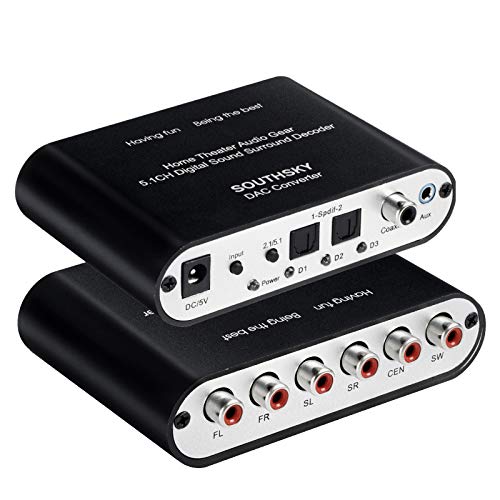
Best for older AV receivers that need 5.1 channel output from Toslink or coaxial sources. This device converts digital optical and coaxial signals into six RCA outputs for FL, FR, SL, SR, CEN, and SW, plus 2.1 channel stereo. It includes a dedicated 5.1/2.1 toggle so you can switch between modes as needed. It supports LPCM, and decodes Dolby, DTS, and AC-3 audio formats for home theater setups. The input memory feature helps to restore the previously used signal after a restart, speeding up setup. A potential limitation is that this unit focuses on analog output and may require compatible analog inputs on your AV gear.
Who it’s for: Ideal for users with older AV receivers or stereo systems that lack robust digital-to-analog conversion yet still want genuine 5.1 playback from optical or coaxial sources. It’s also suitable for home theaters upgrading from legacy components without HDMI audio extraction.
5.1CH Digital Sound Decoder for Home Theater System
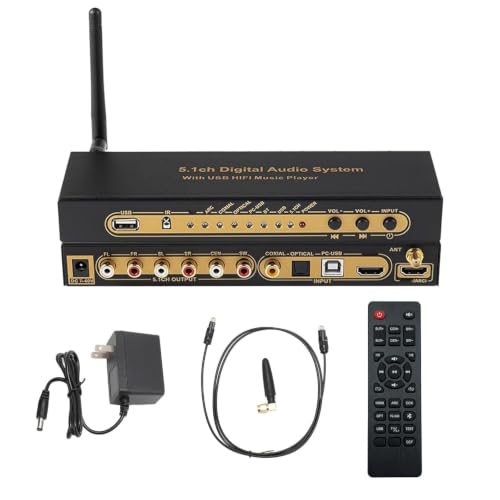
This model emphasizes broad HDMI compatibility, including HDMI 2.0b with 4K@60Hz and backward compatibility with HDMI 1.4. It supports HDCP 2.3/2.2 and can pass 3D content while decoding a wide array of audio formats (DTS, DTS-ES, Dolby Digital AC3, FLAC, APE, AAC, MP3, and more). It provides virtual 5.1 processing for 2.0/2.1 sources, making it a flexible option when true 5.1 is not available from your source. Best for users who want modern HDMI features alongside robust digital decoding with virtual surround when needed. A possible caveat is that virtual 5.1 may not match real 5.1 in all content.
Who it’s for: Best for home theaters or PCs where HDMI sources are prominent and users want forward-looking HDMI features while preserving a reliable multi-format audio decoder.
Tangxi 5.1 Audio Decoder
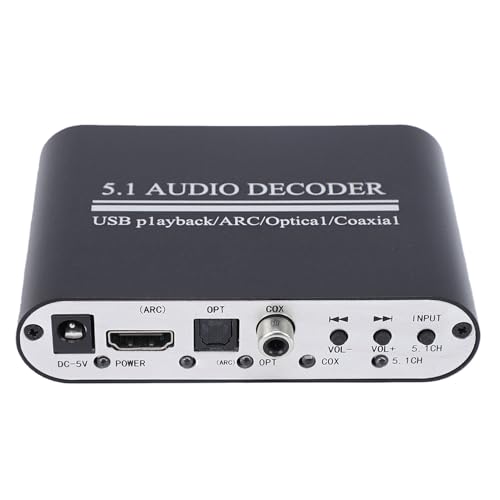
Best for ARC-enabled TVs and environments that blend TV audio with game or music content. Tangxi offers multiple inputs including USB for playback and supports Bluetooth 5.0 for wireless sound devices. It decodes common formats like DTS, AC3, and LPCM, and delivers either true 5.1 or virtual 5.1 depending on signal source. A notable limitation is Bluetooth latency on some devices, which may affect lip-sync in live actions. This decoder is well-suited for living rooms with mixed sources and a desire for wireless convenience.
Who it’s for: Choose this if you want a flexible, ARC-friendly option that can connect to TVs, game consoles, and wireless speakers, while keeping a simple setup for different content types.
Yaregelun Digital to Analog 5.1 Audio Decoder
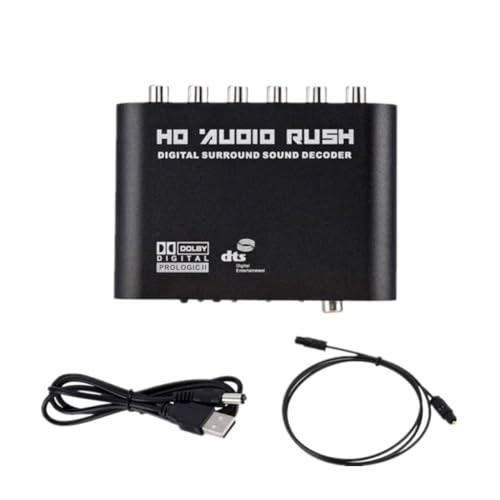
Best for users who want a straightforward DTS or AC3 5.1 decoding experience for TV and home theater use. It provides an analog 5.1 channel output after processing the audio from various sources, including TVs and set-top boxes. The design emphasizes a broad audience by focusing on core decoding capabilities and the compatibility with common playback devices. A limitation is that the product description highlights broad usage rather than specific, tested scenarios, so ensure your source supports DTS or AC-3 decoding before purchasing.
Who it’s for: Choose this if you want a simple, no-frills 5.1 decoder that covers standard digital formats and is easy to integrate with typical home theater gear.
5.1CH Digital Sound Decoder From Zopsc

Best for systems needing high-resolution audio decoding with multi-source switching. Zopsc highlights 24-bit/192 kHz sampling and support for formats including DTS, DTS-ES, and AC3, along with a broad compatibility range for HDMI, Optical, Coaxial, USB, and flash drives. It provides true 5.1 decoding for surround sources and soft decoding for stereo inputs. A potential caveat is that some users may require manual input detection to ensure the correct source is routed to 5.1 output.
GOWENIC 5.1 Channel Digital Audio

Best for HDMI ARC-centric setups needing reliable 5.1 output across multiple inputs. GOWENIC converts HDMI ARC, Optical, and Coaxial signals to 5.1 channel analog sound and 2.1 stereo, with a 5.0 version featuring LED indicators for easy input status. It supports auto-detection of input formats, simplifying daily use. A limitation is it may require careful source matching to ensure the most accurate 5.1 output, especially with high-bandwidth video sources.
Aurikall 5.1 Digital Sound Decoder

Best for flexible digital formats and mixed connection setups. Aurikall supports AC-3, DTS, and PCM with a variety of input options: two SPDIF optical inputs, one coaxial input, and one 3.5mm analog. It uses a 24-bit DSP, a 96 kHz digital receiver, and a 192 kHz/24-bit ADC/DAC to convert DTS/AC-3 sources to 5.1 or stereo. A note is that the device’s emphasis on multiple input types makes it a versatile option but may require careful cable management in tighter spaces.
Buying Guide
What should you look for in a 5.1 digital sound decoder?
- Input compatibility: Ensure the device accepts your source formats (HDMI ARC, optical, coaxial, USB) and matches your existing cables.
- Output configuration: Confirm it provides true 5.1 analog outputs (FL, FR, SL, SR, CEN, SW) or reliable virtual 5.1 processing for two-channel sources.
- HDMI support: If you plan to pass through video alongside audio, HDMI 2.0/HDCP compliance and 4K compatibility are advantageous.
- Format decoding: Look for DTS, AC-3 (Dolby Digital), LPCM, FLAC, and other formats you actually use. Virtual 5.1 can be a good fallback for stereo sources.
- Ease of use: Features like one-key switching, auto input detection, and LED indicators help with daily setup and operation.
- Latency and lip-sync: Bluetooth connections may introduce latency; consider fixed cables if perfect lip-sync is critical for gaming or live video.
What scenarios suit a physical 5.1 decoder vs. virtual 5.1?
- Physical 5.1: Best when your sources provide discrete surround channels and your speakers can reproduce each channel independently.
- Virtual 5.1: Useful when only stereo sources are available or you want to simulate surround without wiring additional speakers.
How to plan installation?
- Map out inputs and outputs before buying to avoid wiring clutter.
- Label cables to simplify future changes or upgrades.
- Test with a variety of content (movies, music, gaming) to verify that the desired channel output is consistent.
Frequently Asked Questions
- Do these decoders require a separate power supply? Most models include internal power or a dedicated supply; always check the product specs.
- Can I use a decoder with a soundbar? Yes, if the soundbar accepts analog 5.1 input or can be integrated with analog outputs from the decoder.
- Is virtual 5.1 as good as true 5.1? Virtual 5.1 can improve stereo sources, but it usually isn’t equal to a full 5.1 setup that has separate surround speakers.
- Will a decoder improve my TV’s built-in audio? If your TV’s native audio options are limited to stereo or PCM, a decoder can unlock multi-channel output when paired with compatible speakers or an AV receiver.
- Do I need HDMI for decoding? Not always; many decoders handle optical or coaxial inputs. HDMI is optional but beneficial for 4K video passthrough and HDR compatibility.
- Can I use these with PC gaming setups? Yes, many models support HDMI ARC/Optical/Coaxial and USB inputs suitable for PC audio, though latency considerations apply for competitive gaming.