
The best 5-channel power amp depends on where you plan to use it: the Marantz MM7055 and OSD Audio Nero HTA5200 are home-theater amplifiers, while the VEVOR and Stinger models are designed for car audio. The ZK-1002T is a two-channel DIY board, not a five-channel amp, so it is included only as a clearly labeled mismatch. Compare channel count, power ratings at the intended speaker impedance, inputs, and installation needs before choosing.
| Product | Best suited for | Key distinction |
|---|---|---|
| Marantz MM7055 | Home theater with 8-ohm speakers | 140 watts per channel into 8 ohms |
| OSD Audio Nero HTA5200 | Home theater with flexible input options | XLR and RCA inputs; 5 channels |
| VEVOR 5-Channel Class D | Car audio with a subwoofer | Four speaker channels plus a sub channel |
| Stinger MT-1000.5 | Compact vehicle installations | Class D design and included bass-control features |
| ZK-1002T | DIY two-channel stereo projects | Not a five-channel amplifier |
Marantz MM7055

The Marantz MM7055 is a five-channel amplifier for home theater and other home audio systems. Its listed output is 140 watts per channel into 8 ohms. Gold-plated four-way binding-post terminals provide speaker connections, and the product description highlights a thermal tunnel designed to draw heat away from the output stages.
Best for: Home theater buyers who need five amplified channels and want the listed output rating at 8 ohms. It is a relevant choice for a five-speaker setup or for a larger system using additional amplification.
Why it stands out: The 8-ohm power specification makes it easier to compare with speakers and other amplifiers rated at the same impedance. The binding posts support a secure speaker-wire connection, while the heat-management design addresses the warmth associated with amplifier operation.
Limitation: The description says the amplifier requires a dedicated cooling unit to remove excessive heat. Plan for suitable ventilation and confirm the cooling requirements for the intended installation. The product description also names Marantz AV7005 and MM7025 components as pairing options; check system compatibility before purchase.
OSD Audio Nero HTA5200

The OSD Audio Nero HTA5200 is a five-channel Class AB home-theater amplifier. Its listed output is 210 watts per channel into 4 ohms or 145 watts per channel into 8 ohms, with all channels driven. It provides balanced XLR and RCA inputs, a 12-volt trigger, and channel-status LEDs for on, standby, or protection status.
Best for: Home-theater owners who want a five-channel amplifier with both XLR and RCA input options. The two input formats can be useful when selecting connections to match the associated processor or preamp.
Why it stands out: Its published output ratings cover both 4-ohm and 8-ohm loads, which supports a more direct comparison with a speaker system’s specifications. The 12-volt trigger is designed for remote power on and off, and the per-channel indicators help show operating status.
Limitation: This is a power amplifier, so confirm that the system provides the appropriate preamp-level outputs and connections. Its listed power differs by speaker impedance; do not compare the 4-ohm figure directly with an amplifier’s 8-ohm rating.
VEVOR 5-Channel Class D Car Amplifier

The VEVOR is a five-channel Class D amplifier designed for vehicle speaker and subwoofer systems. Its listed maximum output is four channels at 100 watts each into 4 ohms or 200 watts each into 2 ohms, plus a subwoofer channel rated at 500 watts into 4 ohms or 1,000 watts into 2 ohms. The description also identifies bridgeable channels for additional subwoofer power.
Best for: Car-audio buyers seeking one amplifier for four full-range speaker channels and a subwoofer channel. Its channel layout suits installations where the system needs separate speaker and bass amplification.
Why it stands out: The Class D design and five-channel configuration consolidate multiple amplification duties in one unit. The listed specifications provide separate power figures for the speaker and subwoofer channels at different impedances. VEVOR also lists THD below 0.01% and a 93 dBA signal-to-noise ratio.
Limitation: The supplied power figures are identified as maximum output. Check the amplifier’s operating ratings, the vehicle’s electrical system, speaker impedance, and installation requirements before relying on those figures. Do not assume the car-focused unit is suitable for a home-theater system.
Stinger MT-1000.5 Compact Class D
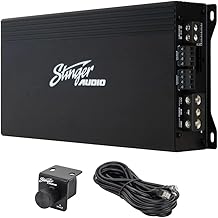
The Stinger MT-1000.5 is a compact five-channel Class D car amplifier measuring 6.10 inches long, 13.23 inches wide, and 2.09 inches high. Its listed features include a bass-boost function, remote bass knob, high- and low-pass crossover, and subsonic filter. The product description gives several channel-output configurations, including 75 watts by four plus 300 watts by one at 4 ohms.
Best for: Vehicle owners who need five channels in a space-conscious installation and want controls for adjusting bass and filtering the signal. Its stated dimensions can help buyers assess whether it may fit an available mounting area.
Why it stands out: The feature set combines speaker and subwoofer amplification with crossover and subsonic-filter controls. The description also says it accepts high-level input by connecting to speaker wires or low-level input from a head unit’s preamp cables, giving installers two input approaches.
Limitation: Verify available mounting space and wiring requirements before purchase. Output varies with impedance and channel configuration, so match the specified load and wiring plan rather than treating the headline 1,200-watt figure as the output for every setup.
ZK-1002T: Two-Channel DIY Board

Important: The ZK-1002T is not a five-channel power amp. The listed product information describes a 2.0-channel stereo amplifier board with Bluetooth 5.0, USB, and AUX inputs. Its stated output is 100 watts per channel, and it includes independent treble and bass adjustment controls.
Best for: DIY users looking for a compact two-channel stereo module, not buyers building a five-channel system. Bluetooth, USB, and AUX inputs offer multiple ways to feed audio to the board.
Why it is included: This product appears among the supplied options but does not match the requested channel count. Identifying the mismatch helps prevent a buyer from mistaking a two-channel board for a five-channel amplifier.
Limitation: It cannot provide five amplified channels based on the listed specifications. The description also says to disconnect Bluetooth when using AUX mode. Choose a genuine five-channel unit if the system requires five separately amplified outputs.
Buying Guide: How to Choose a Five-Channel Power Amp
Is the amp for a car or a home theater?
Start with the installation type. The Marantz and OSD Audio models are described for home audio or home theater. The VEVOR and Stinger units are car amplifiers. Vehicle and home systems use different installation and connection arrangements, so a five-channel label alone does not make an amp suitable for both uses.
How many channels does the system actually need?
A five-channel amplifier provides five amplified outputs, but those channels may be configured differently. The VEVOR, for example, is described with four speaker channels and one subwoofer channel. The Marantz and OSD Audio products are home-theater five-channel amplifiers. Check that the channel layout matches the speakers and subwoofer in the system.
How should you compare power ratings?
Compare output ratings at the same impedance and under comparable stated conditions. The OSD lists 210 watts per channel at 4 ohms and 145 watts at 8 ohms, while the Marantz lists 140 watts per channel at 8 ohms. The vehicle models also list different output figures at 2- and 4-ohm loads. A maximum-output figure is not interchangeable with a rating for a different load or operating condition.
- Check the speaker or subwoofer impedance specified by its manufacturer.
- Compare the amplifier’s output rating at that same impedance.
- Confirm whether a quoted figure applies to one channel, multiple channels, or a bridged configuration.
- Do not use a product’s headline maximum wattage as the only comparison measure.
Which inputs and controls do you need?
For home systems, the OSD offers XLR and RCA inputs and a 12-volt trigger. For car audio, the Stinger lists high-level and low-level input methods, crossover controls, a subsonic filter, and a remote bass knob. Choose based on the connections available from the receiver, processor, or head unit and the controls needed for the installation.
Will the amplifier fit and get adequate ventilation?
Check the available mounting location, dimensions, cable access, and ventilation. The Stinger publishes physical dimensions, which help with a vehicle-space check. The Marantz description specifically notes heat management and a need for dedicated cooling. Do not assume an amplifier can be enclosed in a tight space without checking its ventilation requirements.
Should you choose Class D or Class AB?
The supplied car amplifiers are Class D, while the OSD is Class AB. These labels describe amplifier designs, but they do not replace a comparison of channel layout, power ratings, inputs, load compatibility, and installation needs. For this selection, match the actual product specifications to the system rather than choosing on class alone.
What should you verify before ordering?
- Confirm that the listing describes five channels, rather than a two-channel board.
- Match the amp’s output and impedance specifications to each connected speaker or subwoofer.
- Check the required input connection and whether the system has a suitable preamp or head-unit output.
- Review wiring, mounting, ventilation, and vehicle electrical requirements for the intended setup.
- Verify that any bridged-channel configuration is supported for the intended load.
Frequently Asked Questions
What is a five-channel power amplifier used for?
A five-channel power amplifier supplies amplified audio to five outputs. Depending on the model, it may serve a home-theater speaker system or a car-audio setup with separate speaker and subwoofer channels.
Can a car five-channel amp power a home theater?
Do not assume that it can. The car models listed here are described for vehicle audio, while the Marantz and OSD units are described for home audio. Check power requirements, inputs, installation needs, and system compatibility before selecting an amplifier.
Is the ZK-1002T a five-channel amplifier?
No. Its listed specifications identify it as a two-channel stereo amplifier board with Bluetooth, USB, and AUX inputs. It is not a substitute for a five-channel unit.
Why do amplifiers list different wattages at different ohms?
Power ratings can change with the connected load’s impedance. Compare an amplifier’s rating at the same impedance as the intended speaker, and follow the product’s supported-load specifications.
What is the difference between a five-channel amp and a stereo amp?
A stereo amplifier has two channels for left and right audio. A five-channel amplifier has five amplified outputs, which can support a larger speaker arrangement or a combination of speakers and a subwoofer, depending on its design.
Does a five-channel amplifier include a subwoofer?
No. An amplifier powers connected speakers but does not itself provide a subwoofer. Check whether the amplifier includes a dedicated subwoofer channel and select a compatible subwoofer separately.