
Best 500 Watt RMS Amps at 4 Ohms for Car Audio Enhancement
If you’re shopping for a 500W RMS amplifier at 4 ohms, you want clarity, reliability, and the right flood of power to drive your subwoofers or full-range speakers without overheating. This guide highlights five top options, explaining who each is best for, why it was selected, and where to avoid common pitfalls. Perfect for car enthusiasts, installers, and budget-conscious buyers seeking solid performance from a compact Class D or AB design.
| Product | Best For | Why It Stands Out |
|---|---|---|
| ORION CBA2000.1D | Subwoofers needing high continuous power | Strong 1 Ohm capability, durable design, efficient Class D |
| DS18 SXE-3000.4D/RD | Multi-channel, customized tuning | Fully variable crossover, compact Class D for space-limited installs |
| Polk PA D1000.1 | Stable performance at 4 ohms, cooling efficiency | High-speed MOSFET, 1200W at 1 ohm within safe design |
| ORION CBA3500.4 | 4-channel builds with high efficiency | Cobalt Class A/B with MOSFET supply, strong crossovers |
| DS18 SXE-3000.4D/BK | 4-channel, compact power | Same SXE family, flexible crossover, small size |
ORION CBA2000.1D Cobalt Mono 1-Channel Class D Amp

This mono sub amplifier is designed to deliver high continuous power to subwoofers, with efficiency advantages from a Class D design. It supports low-level RCA inputs for straightforward integration with standard car receivers. Best for single-sub setups that demand strong, clean bass without overheating. Caution: rated for demanding loads; ensure adequate heat dissipation in tight engine bays or hot climates.
DS18 SXE-3000.4D/RD Car Amplifier

This 4-channel Class D amplifier provides extensive crossovers, gain control, and compact form, making it ideal for multi-speaker systems that require precise tuning. Best for custom installations where space and tone shaping matter. Caution: ensure proper heat management in bundle installs; multi-channel amps generate heat with heavy use.
Polk Audio PA D1000.1 Class D Mono

Polk’s single-channel amp is optimized for efficiency and cooler operation, delivering robust 4-ohm performance with high-speed MOSFET switching. Best for subwoofer race setups or any single-channel push to a bass driver. Limitation: at 4 ohms, output aligns with 500W rough power, so ensure compatible sub(s) to avoid underutilization of headroom.
ORION CBA3500.4 Cobalt 4-Channel

The CBA3500.4 blends high-efficiency Class A/B operation with a robust MOSFET supply, letting you power four speakers at 2/4 ohms with controlled crossovers. Best for those building a front-stage and rear-stage setup with strong sound alignment. Caution: larger footprint than some compact 4-channel rivals—ensure mounting space fits your vehicle.
PRV Audio QS400.4 2 Ohm 4-Channel

This compact 4-channel amplifier is stable at 2 ohms and provides 400W total, with digital Class D efficiency. Best for budget builds needing multiple channels with reliable power. Limitation: total RMS at 4 ohms is lower than some dedicated 4-channel competitors—plan channel by channel to avoid underpowered configurations.
Rockville RVA600.1 Mono Class AB

Offers strong output with 1200W peak and 200W RMS at 4 ohms, plus flexible crossover controls. Best for older designs or installations preferring class AB efficiency with solid musical detail. Caution: Class AB may run warmer than Class D under heavy loads.
Rockville dB10 Mono Car Amplifier
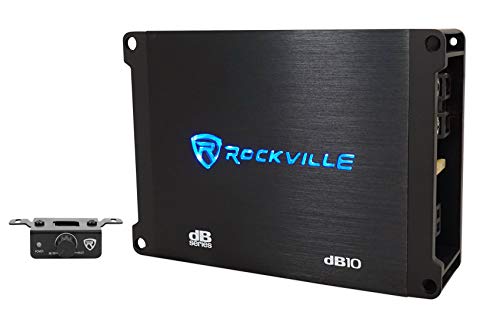
Provides 800W peak and 200W RMS at 4 ohms with a 12dB/octave crossover and bass EQ for tuning. Best for subwoofer-focused builds needing straightforward adjustment. Caution: ensure your electrical system can support sustained high power draws, especially in older vehicles.
Buying Guide: 500W RMS At 4 Ohms — What To Check
- Power and impedance: Confirm the amplifier delivers at least 500W RMS at 4 ohms for your specific speakers or subwoofers. Match to your load to avoid clipping or overheating.
- Channel count: Choose mono (1-channel) for subwoofers or multi-channel amps for full-range, front/rear setups. Consider future expansion.
- Efficiency and class: Class D tends to run cooler and lighter; Class AB can offer different sound characteristics and warmth. Your vehicle’s electrical system matters.
- Crossover and filtering: Look for adjustable crossovers and subsonic filters to shape bass response and prevent woofer over-excursion.
- Thermal management: Ensure sufficient ventilation and, if needed, external heat dissipation in tight spaces or enclosed trunks.
- Inputs and compatibility: Low-level RCA inputs simplify integration with most head units. Check remote level control options if subwoofer gain control is desired.
Frequently Asked Questions
- What does 500W RMS at 4 ohms mean for my system? — It represents the continuous power the amplifier can deliver to a 4-ohm load without distortion, guiding you to match with compatible speakers or subwoofers.
- Is Class D always better for car audio? — Class D is typically more efficient and cooler, which helps in compact installations, but sound characteristics can vary by model.
- Should I choose mono or multi-channel for bass-focused systems? — Choose mono for a single subwoofer; multi-channel is better for full-range speakers and multi-speaker setups.
- What should I check about thermal performance? — Look for heat sinks, fan-assisted cooling, and enclosure ventilation to prevent performance drops from thermal throttling.
- Do I need a remote bass control? — If you want on-the-fly bass level adjustments from the listening seat, a model with a remote sub level control is advantageous.
- Can I run two different amps in one system? — Yes, with careful impedance planning and proper crossovers, you can run multiple amps to power different speaker groups.