
Best Realistic Stereo Electret Condenser Microphones for Clear Recordings
Realistic stereo electret condenser microphones deliver compact, budget-friendly options for capturing detailed stereo sound. This guide highlights five highly suitable models for different types of buyers, from hobbyists to semi-professional creators. The top picks are best for: home studios needing versatile stereo capture, field recording with portability, and DIY projects that require reliable, easy-to-connect mics. Below is a quick summary table of the recommended products to help you compare at a glance.
| Product | Best For | Key Benefit |
|---|---|---|
| Superlux CM H8K Stereo Electret Condenser Microphone Set | Home studios seeking balanced stereo pairs | Identical features on both mics for matched stereo image |
| Sony ECM-DS70P | On-camera use and portable setups | Unidirectional stereo with direct recorder connection |
| Audio-Technica ATR6250X | Camera or portable recorders | High-quality stereo pickup and rugged build |
| LyxPro SDPC-2 | Studio and stage environments | Interchangeable pickup capsules for flexible patterns |
| UMLIFE 20PCS 9X7mm Electret Mics | DIY projects and multi-mic setups | Bulk set with compact size for many channels |
Superlux CM H8K Stereo Electret Condenser Microphone Set

The Superlux CM H8K is a stereo pair designed for balanced, natural-sounding recordings. Features include wide frequency response, high sensitivity, wide dynamic range, low distortion, and identical performance across both mics. Best for: home studios and small ensembles where matched stereo imaging matters. Limitation: may require a preamp or interface with adequate gain for very quiet sources. Reason to choose: reliable paired mics reduce phase and level differences in stereo captures.
uxcell Electret Microphone 6×3.5mm, 2-Wire, 3.5mm Jack, 10Pcs

uxcell offers a compact electret condenser microphone with a 3.5mm jack and 2-wire connectivity. Best for: quick, on-the-go stereo or mono recordings in DIY projects and consumer devices. Caution: 3.5mm mics can pick up more room noise if not placed carefully. Why selected: ideal for budget multicam or multi-channel setups where size matters and quantity matters.
Sony ECM-DS70P Electret Condenser Stereo Microphone

Sony’s ECM-DS70P provides unidirectional stereo capture with a straightforward on-device control layout. Best for: on-camera recording and field shoots where portability and reliability matter. Limitation: single mic unit limits true stereo placement flexibility compared to matched dual-mic sets. Why selected: Sony’s mic is well-suited for quick, clean stereo recordings directly into cameras or recorders.
E-outstanding MIC Electret Condenser Microphone 10PCS

The E-outstanding kit includes ten small 6027-style microphones. Best for: DIY electronics projects and multi-mic recordings where several small condensers are needed. Caution: data notes indicate sensitive audio behavior; pay attention to wiring to avoid phase issues. Why selected: bulk quantity makes it practical for large DIY rigs and multi-mic experiments.
Cylewet 10Pcs Cylindrical Electret Condenser Microphone Pickup for Arduino

These cylindrical mics are compact for Arduino and DIY sensor projects. Best for: hobbyists building sensor arrays or multi-mic demos. Limitation: smaller capsules may have lower maximum SPL and require careful amplification. Why selected: ease of integration with microcontroller projects and low-cost expansion options.
UMLIFE 20PCS Electret Microphone Condenser Pickup
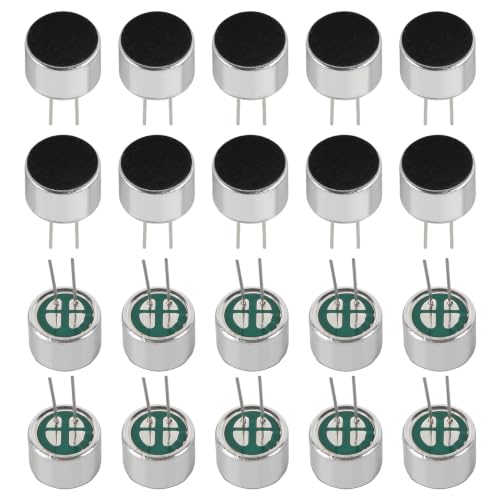
The UMLIFE kit includes 20 small electret mics with 2-pin leads, suitable for DIY projects and general experiments. Best for: classroom labs, large DIY projects, and multi-mic experiments on a budget. Caution: assembled sets may vary in sensitivity; individual testing is recommended. Why selected: high quantity supports multi-channel experiments without purchasing individually.
Buying Guide
What to consider when selecting stereo electret condenser microphones:
- Sound quality vs. price: For clean stereo images, prioritize matched pairs or capsules from the same model family.
- Pickup pattern: Cardioid or omnidirectional capsules affect room ambiance and isolation; choose based on environment.
- Connectivity: 3.5mm jacks are common for consumer devices; XLR or built-in preamps may be needed for professional gear.
- Size and mounting: Smaller mics are versatile for on-camera and DIY projects but may have lower SPL ratings.
- Number of mics: Bulk packs are convenient for multi-mic setups but verify consistency among units.
How to position for best stereo results
Place two mics at appropriate distances to capture a balanced stereo image. For acoustic instruments or small ensembles, use closely matched mics to minimize phase differences. In rooms with reflective surfaces, add a subtle sense of space by adjusting the distance to sources and your recording space’s reverberation characteristics.
FAQ
- Q: Do I need a mixer or audio interface for these mics? A: For best results, connect to an audio interface or recorder with adequate gain; some mics may work with a DSLR or portable recorder that supplies a suitable preamp.
- Q: Can I use these mics for field recording? A: Yes, especially compact models like the Sony ECM-DS70P, but consider wind protection and battery or power needs if applicable.
- Q: Are these mics suitable for professional studio use? A: They are suitable for budget-conscious, educational, or hobbyist studios; for high-end professional work, consider matched pairs with higher-spec capsules.
- Q: What is the difference between omnidirectional and cardioid capsules? A: Omnidirectional captures sound from all directions, while cardioid emphasizes sounds in front and reduces side noise, affecting room ambience.
- Q: How important is mic placement? A: Placement greatly affects stereo image, noise, and intelligibility; experiment with left-right spacing and height to optimize your mix.
- Q: Do bulk mics vary in quality? A: They can vary; test each mic if possible, especially for multi-mic setups to ensure uniform response.