
The best 6.5-inch door speakers depend on your priorities: the JVC CS-J620 suits buyers seeking a conventional coaxial replacement with stated sensitivity and frequency response, while the Kenwood KFC-1666S is a good fit for shoppers who value included grilles and a two-way design. The Pioneer is a straightforward 4-ohm coaxial option, the BOSS lists useful mounting measurements, and the DS18 is a specialized midrange driver rather than a typical coaxial replacement.
| Speaker | Best For | Notable Detail |
|---|---|---|
| JVC CS-J620 | Coaxial replacement buyers | 92 dB sensitivity; 30W RMS listed |
| Kenwood KFC-1666S | Buyers wanting grilles included | Two-way design with woofer and tweeter |
| Pioneer TS-F1634R | Simple 4-ohm coaxial upgrade | 25W nominal power handling listed |
| BOSS CH6530 | Shoppers checking fit dimensions | 2.1-inch mounting depth listed |
| DS18 PRO-GM6B | Midrange-focused custom systems | Single 8-ohm midrange speaker |
JVC CS-J620 6.5-Inch Coaxial Speakers

The JVC CS-J620 is a two-way coaxial speaker set for drivers replacing factory speakers with a conventional woofer-and-tweeter setup. The listed components include a 6.5-inch mica-cone woofer and a 1-inch PEI tweeter. Its stated 35 Hz–22 kHz frequency response and 92 dB sensitivity give shoppers specific figures to compare against other options.
JVC lists 30 watts RMS and 300 watts peak power per speaker, along with 4-ohm impedance. The product description also identifies rubber and cloth diaphragm materials and black ABS composite grilles. These details make it a useful comparison choice for buyers who want stated power handling and sensitivity, rather than relying only on a maximum-watt figure.
- Best for: Buyers seeking a two-way coaxial replacement with listed frequency response and sensitivity.
- Why it stands out: The set combines a mica woofer and PEI tweeter, with 30W RMS specified.
- Consider: Confirm vehicle fit and available mounting space before ordering; the provided details do not establish compatibility with a particular car.
Kenwood KFC-1666S Two-Way Speakers

The Kenwood KFC-1666S is a 6.5-inch, two-way speaker option for buyers prioritizing a separate woofer and tweeter in one speaker assembly. Kenwood lists a polypropylene woofer with a treated cloth surround and a 1-inch PEI balanced-dome tweeter. The woofer is described as supporting bass response, while the tweeter is intended to reproduce high frequencies.
Included grilles are a practical feature for shoppers who want speaker protection as part of the package. Kenwood describes installation as easy, but the available product details do not provide mounting depth, cutout size, impedance, or power-handling figures. Check the speaker dimensions against the vehicle and compare system requirements before choosing it.
- Best for: Buyers looking for a two-way design with grilles included.
- Why it stands out: The product specifies woofer and tweeter materials, making the component arrangement clear.
- Consider: The supplied specifications do not state fit dimensions or power ratings, so verify those details for your installation.
Pioneer TS-F1634R 6.5-Inch Coaxial Speakers

The Pioneer TS-F1634R is a two-way coaxial speaker designed around an integrated woofer and tweeter. The listed specifications include 4-ohm impedance, 25 watts nominal power handling, and 200 watts maximum power handling. For shopping comparisons, the nominal rating is the more useful figure to consider alongside the output of the car stereo or amplifier.
Pioneer also lists 88 dB sensitivity. That gives buyers another specification to compare when assessing how a speaker may perform with a given amount of input power. The product description presents it as a car-door speaker, but the listed information does not provide cutout or mounting-depth measurements.
- Best for: Buyers seeking a basic two-way coaxial speaker with stated impedance and nominal power handling.
- Why it stands out: Its integrated woofer-and-tweeter design and 4-ohm rating are clearly identified.
- Consider: Check the vehicle’s mounting measurements separately; the supplied specifications do not confirm fit for a specific door.
BOSS CH6530 6.5-Inch Three-Way Speakers

The BOSS Audio Systems CH6530 is a three-way speaker choice for shoppers comparing speaker layout and installation measurements. The listed dimensions are 6.6 by 6.6 by 2.4 inches. BOSS also specifies a 5.5-inch mounting hole, 2.1-inch mounting depth, and 4-ohm impedance. Those measurements are particularly useful when checking whether a speaker can fit in a door opening.
The product name states 300 watts per pair, but the provided feature details do not separate peak and RMS power. Avoid comparing that figure directly with a speaker’s RMS rating unless the rating types match. The available specifications also do not include sensitivity or frequency response.
- Best for: Buyers who want mounting-hole and depth figures to compare with their vehicle’s door space.
- Why it stands out: The listed measurements make preliminary fit checks more specific than relying on speaker diameter alone.
- Consider: Verify the actual opening and clearance in the vehicle; a 6.5-inch label alone does not guarantee a fit.
DS18 PRO-GM6B 6.5-Inch Midrange Driver
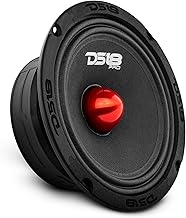
The DS18 PRO-GM6B is a specialized 6.5-inch midrange driver, not a standard two-way coaxial speaker. It is intended to handle a significant portion of the audible midrange spectrum, including vocals and instruments. The listed specifications are 140 watts RMS, 480 watts maximum, and 8-ohm impedance. The product listing identifies it as one speaker.
DS18 also specifies a 1.5-inch high-temperature Kapton voice coil. This model may suit a custom system built around dedicated drivers and appropriate system components. It is a less direct choice for someone seeking a simple factory-speaker replacement, because the listed design is midrange-focused and does not describe an integrated tweeter.
- Best for: Buyers building a system that specifically calls for a separate midrange driver.
- Why it stands out: It has a stated 140W RMS rating and a high-temperature voice coil.
- Consider: Avoid choosing it as a direct full-range coaxial replacement without confirming that the rest of the system is designed to cover other frequencies.
Buying Guide: How to Choose 6.5-Inch Door Speakers
A 6.5-inch label is a helpful starting point, but it does not guarantee that a speaker will fit a particular door. Compare the speaker’s mounting depth and cutout requirements with the available space. Also consider whether the door has obstructions behind the speaker and whether the existing grille or mounting hardware can be reused. If complete fit measurements are not listed, look them up before purchase rather than assuming compatibility.
Do You Need Coaxial, Three-Way, or Midrange Speakers?
Two-way coaxial speakers place a woofer and tweeter together in one assembly. They are a common format for buyers seeking a straightforward speaker replacement. The JVC, Kenwood, and Pioneer models in this selection are described as two-way speakers. The BOSS is listed as three-way, while the DS18 is identified as a midrange driver.
A dedicated midrange driver is not automatically interchangeable with a coaxial speaker. Consider the whole audio system: a midrange-focused driver may require other components to reproduce the frequencies it does not cover. Choose a coaxial model if you want an all-in-one woofer-and-tweeter arrangement, and choose a specialized driver only when its role in the system is clear.
How Should You Compare Power Ratings?
Look for RMS or nominal power handling when comparing speakers with an amplifier or head unit. Peak and maximum ratings describe a different measurement and should not be treated as equivalent to RMS. In this group, JVC lists 30W RMS, Pioneer lists 25W nominal, and DS18 lists 140W RMS. The BOSS product name states 300 watts per pair, while its supplied details do not clarify the rating type.
Match the speaker’s requirements with the audio equipment and follow the manufacturers’ specifications. A larger maximum-watt number alone does not establish that a speaker will be louder or sound better in a particular vehicle.
Why Do Impedance and Sensitivity Matter?
Impedance is part of determining whether a speaker is appropriate for the connected audio equipment. Pioneer and JVC list 4-ohm impedance, as does BOSS; DS18 lists 8 ohms. Check the equipment documentation before mixing speakers with different impedance ratings.
Sensitivity is another comparison point, especially when considering the power available from a car stereo. JVC lists 92 dB, and Pioneer lists 88 dB. These figures should be compared on the same measurement basis when possible. They do not, by themselves, predict performance in every vehicle or installation.
What Installation Details Should You Check?
- Measure the door opening and available mounting depth before ordering.
- Check the mounting-hole size and speaker dimensions, not just the nominal diameter.
- Confirm the speaker’s impedance and power ratings are suitable for the connected system.
- Determine whether grilles, adapters, or other installation parts are needed for your vehicle.
- For a midrange driver, make sure the system design accounts for the rest of the frequency range.
Among these options, BOSS provides specific mounting-hole and depth measurements. Kenwood states that grilles are included. The other supplied feature lists focus more on speaker design and audio specifications. These differences can help narrow a choice, but vehicle-specific fit should still be verified.
Frequently Asked Questions
Are all 6.5-inch speakers compatible with every car door?
No. Speaker diameter alone does not confirm fit. Check the door’s cutout, mounting depth, clearance, and any vehicle-specific installation requirements.
What is the difference between RMS and peak power?
RMS describes a continuous power-handling figure, while peak or maximum ratings refer to a different measurement. Compare RMS with RMS where possible instead of treating the numbers as interchangeable.
Are coaxial speakers a good choice for replacing factory door speakers?
They can be a practical option when the vehicle accepts the speaker size and the buyer wants a woofer and tweeter combined in one assembly. Confirm fit and system requirements first.
Can I use the DS18 PRO-GM6B as a regular full-range replacement?
The listed product is a midrange driver, not a conventional coaxial speaker with an integrated tweeter. Use it when the audio system is designed for a separate midrange driver and covers the remaining frequencies appropriately.
Which product lists the most useful mounting measurements?
The BOSS CH6530 listing provides a 5.5-inch mounting-hole measurement and 2.1-inch mounting depth, along with overall dimensions. Compare these figures with the vehicle’s actual space before buying.