
A 6-channel line driver can strengthen audio signals for multiple amplifiers or processors in a car audio system. The AudioControl Matrix Plus is best for boosting line-level signals, while the NVX XLOC66X is designed to convert six speaker-level inputs to RCA outputs. The AudioControl LC7i adds factory-radio integration and bass restoration; the Stetsom EQX764 combines six outputs with equalization.
| Product | Best For | Key Feature |
|---|---|---|
| AudioControl Matrix Plus 6-Channel High Voltage | Boosting existing line-level signals | Up to 13V peak output |
| NVX XLOC66X | Six-channel speaker-to-RCA conversion | Handles up to 40V input |
| AudioControl LC7i | Factory stereo integration | AccuBASS bass restoration |
| AudioControl Matrix Plus, 24 dB | Accessible output adjustment | Top-mounted controls and indicators |
| Stetsom EQX764 | Equalization and multi-amplifier setups | Seven EQ bands and six outputs |
AudioControl Matrix Plus 6-Channel High Voltage
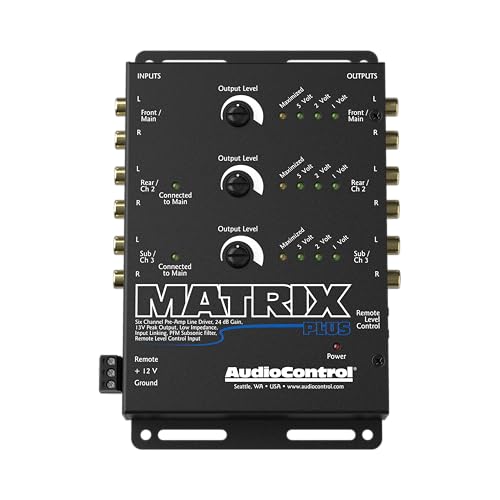
This AudioControl Matrix Plus is a dedicated six-channel line driver for systems that need stronger line-level signals feeding downstream amplifiers, subwoofers, or processors. It has three sets of balanced differential line-level inputs and three sets of low-impedance line-level outputs, making it a practical option when integrating with compatible factory audio equipment.
It can boost signals to 13 volts peak, or 9.5 volts RMS, at the stated load. The manufacturer lists total harmonic distortion below 0.005%, a frequency response of 10 Hz to 100 kHz, and a signal-to-noise ratio of -110 dB. These specifications make it the best fit in this group for a buyer focused on clean, high-voltage line-level output rather than speaker-level conversion or sound shaping.
Best for: Drivers who already have line-level audio signals and want to increase their voltage across six channels. Why it was selected: Its listed input and output arrangement, voltage capability, and distortion specifications directly match the needs of a six-channel line driver.
Limitation: The listed inputs are line-level, so choose a speaker-level converter instead if your installation needs speaker-wire inputs.
NVX XLOC66X Six-Channel Line Output Converter

The NVX XLOC66X converts six speaker-level inputs into six RCA outputs. That makes it a better match than a line-level-only driver for a system where the audio signal is taken from speaker wires. Its listed input handling is up to 40 volts, or 400 watts RMS, and its output can reach 9.5 volts.
This model is best for a buyer adding aftermarket amplification while working with speaker-level signals from an existing audio system. Six inputs and six outputs also provide a direct channel-count match for installations that need multiple signal paths. Compare its speaker-level input design with the AudioControl Matrix Plus, which is described with line-level inputs.
Best for: Installations needing six speaker-level inputs and six RCA outputs. Why it was selected: The channel count and stated input handling make its role clear for high-level signal conversion.
Limitation: The listed features do not mention equalization or bass-restoration processing. Choose another option if those functions are a priority.
AudioControl LC7i With AccuBASS

The AudioControl LC7i is a six-channel active line output converter for adding subwoofers, amplifiers, or processors while retaining a factory stereo. It converts speaker-level signals from an OEM radio or amplifier to preamp outputs and is specified to handle up to 400 watts per channel.
Its distinguishing feature is AccuBASS, which is designed to correct and restore bass roll-off as the factory radio’s volume is increased. The product listing also notes that factory volume and steering-wheel controls can be retained. This makes the LC7i a strong choice for buyers prioritizing integration with the original head unit and addressing reduced bass at higher volume, rather than simply raising signal voltage.
Best for: A factory-stereo upgrade that needs speaker-level conversion and bass restoration. Why it was selected: It combines six-channel signal conversion with a named bass-processing feature and factory-control retention.
Limitation: Its main distinction is factory integration and AccuBASS, not a listed 13-volt peak output. Compare output requirements before choosing it as a voltage-focused line driver.
AudioControl Matrix Plus With Top-Mounted Controls

This AudioControl Matrix Plus is another six-channel line driver, with emphasis on accessible adjustment. Its listed features include up to 24 dB of gain and a maximum output of 9.5 volts RMS. Top-mounted controls are intended to make adjustments accessible, while indicators show 1-, 2-, or 5-volt output and include a Maximized indicator.
Choose this version if visible output indicators and top-mounted controls matter for setup or later adjustment. It is better suited to someone who wants a line driver with clear level-status indicators than a buyer seeking speaker-level inputs, bass restoration, or equalization. Compare the listed output specification with the 13-volt-peak figure on the other Matrix Plus listing; peak and RMS voltage are different measurements and should not be treated as identical.
Best for: Buyers who value gain adjustment and output-status indicators. Why it was selected: It provides six-channel line driving with clearly described adjustment and indicator features.
Limitation: The listed features do not specify speaker-level input conversion, so verify that the source signal type suits the installation.
Stetsom EQX764 Seven-Band Equalizer

The Stetsom EQX764 combines equalization with line-driving capability. It has four input channels and six output channels, with outputs listed up to 10 volts RMS. Its seven EQ bands are centered at 50 Hz, 125 Hz, 315 Hz, 750 Hz, 2.2 kHz, 6 kHz, and 16 kHz, each with a stated adjustment range of 12 dB.
This unit is best for a buyer who wants to shape frequency response as well as feed multiple amplifiers. Dedicated subwoofer level and frequency controls are also listed, which add adjustment options for bass-focused systems. Compared with a straightforward line driver, the EQX764 provides more sound-shaping functions but has four inputs rather than six.
Best for: Users who want seven-band equalization and six outputs in one component. Why it was selected: It combines up to 10 volts RMS output with practical frequency and subwoofer controls.
Limitation: It has four input channels, not six. Confirm that its input count and RCA/high-input options suit the planned signal layout.
Buying Guide: How to Choose a 6-Channel Line Driver
Do you need line-level inputs or speaker-level inputs?
Start by identifying the signal coming from the stereo or factory amplifier. A line-level input accepts a preamp-style signal. A speaker-level input accepts a higher-voltage signal taken from speaker wiring and may be needed when retaining a factory head unit without preamp outputs.
The AudioControl Matrix Plus listings describe line-level inputs, while the NVX XLOC66X and AudioControl LC7i list speaker-level conversion. The Stetsom EQX764 lists RCA and high-level input options. Match the product’s input type to the actual source signal before comparing other features.
How many inputs and outputs does your system require?
A six-channel output count can serve several amplifiers or signal destinations, but the input count also matters. The NVX XLOC66X lists six inputs and six outputs. The Stetsom EQX764 lists four inputs and six outputs. The AudioControl Matrix Plus models are described as six-channel units, with the high-voltage version listing three sets of inputs and outputs.
Map each source channel to its intended amplifier or processor before buying. A channel mismatch may require signal summing, additional processing, or a different component, so do not assume that six outputs automatically mean six independent source inputs.
What output voltage should you compare?
Check the output voltage supported by the downstream amplifier or processor, then compare it with the line driver’s stated maximum. A stronger signal can help make the source level appropriate for connected equipment, but maximum output ratings do not by themselves determine sound quality or guarantee compatibility.
Also distinguish peak voltage from RMS voltage. The AudioControl Matrix Plus high-voltage listing gives both 13 volts peak and 9.5 volts RMS. Other products list up to 9.5 volts or 10 volts RMS. Compare the same measurement type whenever possible.
Is bass restoration or equalization important?
A standard line driver’s primary job is to increase or provide an appropriate signal level. If a factory stereo reduces bass as volume rises, the LC7i’s AccuBASS feature is specifically listed for correcting and restoring bass roll-off. If you want to adjust multiple frequency ranges, the Stetsom EQX764 has seven EQ bands and dedicated subwoofer controls.
These features address different needs. Bass restoration targets a change in factory bass output, while equalization gives the user frequency-range adjustments. Neither function should be assumed on products that do not list it.
Which setup and adjustment details should you check?
Consider where the unit will be installed and how often levels may need adjustment. The newer Matrix Plus listing specifies top-mounted controls and output indicators. Other product listings provide voltage, channel, or processing details but do not describe the same adjustment indicators.
Before installation, review the unit’s wiring and setup instructions and confirm the signal type, channel layout, and output level with the connected equipment. Keep gain settings appropriate for the entire signal chain; increasing a control beyond the usable range can introduce unwanted distortion.
Frequently Asked Questions
What does a 6-channel line driver do?
A 6-channel line driver provides or strengthens audio signals across six channels for connected amplifiers, subwoofers, or processors. The exact input type and features vary by model.
Can a line driver connect to a factory stereo?
Some models accept speaker-level signals from a factory stereo, while others are designed for line-level inputs. Check the listed input type. The LC7i and NVX XLOC66X are examples in this selection that specify speaker-level conversion.
Is a line driver the same as a line output converter?
Not always. A line output converter commonly changes speaker-level audio into RCA line-level output. A line driver generally strengthens or supplies a higher-voltage line-level signal. Some products combine functions, so compare the stated inputs and outputs rather than relying on the name alone.
Does a higher output voltage always mean better sound?
No. Output voltage is one specification, not a complete measure of sound quality. The source signal, gain settings, input limits of connected equipment, and system setup also matter.
Which option is best when bass fades at higher volume?
The AudioControl LC7i is the clearest match in this selection because its listed AccuBASS feature is designed to correct and restore bass roll-off as the factory radio’s volume increases.
Should I choose a line driver with an equalizer?
Choose an equalizer-equipped model if you want to adjust frequency ranges as part of the installation. The Stetsom EQX764 lists seven bands and six outputs. If you only need signal-level support, a more direct line driver may be a closer match.