
The Dayton Audio Classic C40 is the clearest match for shoppers seeking a center speaker with a confirmed 6-ohm impedance. The other models below are relevant center-channel alternatives, but their supplied product details either do not confirm a 6-ohm rating or list a different compatibility range. Choose the C40 when the receiver requires a 6-ohm speaker; consider the Polk Monitor XT30 if its stated 4- and 8-ohm compatibility suits your system.
| Speaker | Best For | Impedance Information Provided |
|---|---|---|
| Dayton Audio Classic C40 | A confirmed 6-ohm match | 6 ohms |
| Yamaha NS-C210BL | HD-source playback | Not specified in supplied details |
| Polk Blackstone TL1 | A compact, curved design | Not specified in supplied details |
| Polk Monitor XT30 | Compact home theater systems | 4- and 8-ohm compatibility stated |
| Polk Signature Elite ES30 | Shoppers considering a walnut-finish model | Not specified in supplied details |
Dayton Audio Classic C40
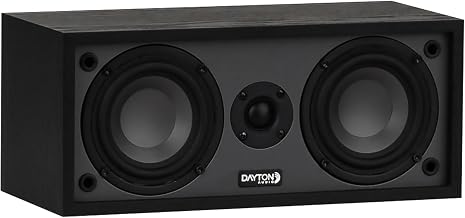
Best for: Buyers who need a center speaker with a stated 6-ohm impedance. Among these five options, the C40 is the most direct match because its listed specifications identify its impedance as 6 ohms.
It is rated for 50 watts RMS and 100 watts maximum power handling, with a stated frequency response of 70 Hz to 20 kHz. Custom 4-inch poly drivers are paired with a 1-inch silk-dome tweeter. The manufacturer describes the tweeter as designed for detailed treble without harshness, while the drivers and cabinet provide bass support.
Why it was selected: Its explicitly listed impedance makes it the strongest choice for a search focused on 6-ohm center speakers, and its power and frequency figures give buyers useful comparison points.
Limitation: The listed response begins at 70 Hz, so buyers seeking deeper low-frequency effects should check their system requirements rather than assume the center speaker handles sub-bass.
Yamaha NS-C210BL Center Speaker

Best for: Buyers prioritizing a speaker designed to reproduce the dynamic sound of HD sources. Yamaha describes this model as a two-way, bass-reflex center speaker and identifies light aluminum-cone woofers as a design feature intended to support fast response.
Why it was selected: It is a dedicated center-channel model with a clearly stated design and intended use. Its HD-source focus makes it a relevant alternative for movie and television dialogue systems, although the supplied specifications do not establish a 6-ohm rating.
Impedance check: The product details provided here do not state the NS-C210BL’s impedance. Do not assume it is a 6-ohm speaker based on its brand or center-channel role. Confirm the rating from the product label or official documentation before matching it to a receiver with specific impedance requirements.
Limitation: The supplied feature list does not provide impedance, power handling, or frequency response, so it offers fewer specification-based comparison points than the Dayton C40.
Polk Blackstone TL1 Center Speaker

Best for: Buyers who want a center speaker with a curved, high-gloss enclosure. Polk lists a half-inch silk-dome tweeter and dual 2.5-inch Dynamic Balance mid-woofers among its features.
Why it was selected: The TL1 is a dedicated TV center speaker, and its driver configuration and distinctive enclosure make it a useful design alternative to the larger cabinet styles in this list. Polk also describes Time Lens technology as aligning drivers for improved soundstaging and imaging.
Impedance check: The supplied details do not specify this model’s impedance. Treat it as an alternative to investigate, not as a confirmed 6-ohm match. Check the speaker’s documentation and the receiver’s requirements before purchasing.
Limitation: The provided product information does not state power handling or frequency response, making it harder to compare directly with speakers that publish those figures.
Polk Monitor XT30 Center Speaker

Best for: Buyers seeking a compact center speaker with stated compatibility for 4- and 8-ohm systems. The XT30 uses a 1-inch tweeter and two 5.25-inch dynamically balanced woofers, according to its product details.
Polk describes the XT30 as a home theater speaker for clear dialogue and dynamic sound. Its listing also identifies Dolby Atmos and DTS:X surround sound as intended system applications and mentions streaming sources. These details describe the speaker’s role in a system; they do not establish that it is a 6-ohm speaker.
Why it was selected: Its driver information and stated 4- and 8-ohm compatibility make it a useful comparison when a shopper is weighing nominal impedance and compact form. It may be a better fit than the C40 when the receiver or system calls for one of those stated compatibility options.
Limitation: The supplied listing states 4- and 8-ohm compatibility, not a 6-ohm rating. Buyers specifically requiring 6 ohms should verify the exact specification with Polk before choosing it.
Polk Signature Elite ES30

Best for: Shoppers comparing a center speaker offered in a contemporary walnut finish. The supplied product name identifies the ES30 as a Polk Signature Elite center-channel speaker.
Why it was selected: It is another dedicated center-channel option in the supplied product list, giving buyers a design and product-line alternative to the C40, Yamaha, and other Polk models. Its finish may be a consideration when the speaker will be visible in a living room or media space.
Impedance check: No product features or impedance information were supplied for the ES30. Its 6-ohm suitability cannot be confirmed from the available details. Check the manufacturer’s current specifications and the model label before using it with a receiver that requires a particular impedance.
Limitation: With no supplied driver, power, frequency-response, or impedance specifications, this option cannot be compared on those technical points here.
Buying Guide: Choosing a 6 Ohm Center Speaker
Does the speaker need to be rated at exactly 6 ohms?
Start with the receiver or amplifier manual. It states which speaker impedances the electronics support and whether there are restrictions on connecting speakers. A 6-ohm rating is not interchangeable with every other impedance rating by default. The Dayton Audio Classic C40 is the only model in this selection whose supplied details explicitly state 6 ohms.
Do not infer a speaker’s impedance from its brand, size, appearance, or use as a center channel. The Yamaha NS-C210BL and Polk Blackstone TL1 details provided here do not state impedance. The Polk Monitor XT30 listing identifies 4- and 8-ohm compatibility, which is not the same as a confirmed 6-ohm rating. Verify uncertain specifications with the manufacturer.
How should you match a center speaker to a receiver?
Compare the speaker’s nominal impedance with the receiver’s supported range and follow the receiver manufacturer’s instructions. Also review power-handling information when it is available, but do not treat a speaker’s maximum power figure as a recommended amplifier output. For the C40, the supplied figures are 50 watts RMS and 100 watts maximum; the available product information does not give comparable power figures for every model here.
If the receiver documentation does not clearly answer whether a speaker is suitable, contact the receiver or speaker manufacturer. This is especially important when choosing a model whose supplied listing does not provide its impedance.
What matters most for dialogue clarity?
The center speaker carries much of the dialogue in many surround-sound setups, so consider the speaker’s position and its relationship to the listening area as well as its specifications. A model’s driver design can help explain its construction, but it does not guarantee how it will sound in a particular room. The C40 lists a silk-dome tweeter and poly drivers; the XT30 lists a 1-inch tweeter and two 5.25-inch woofers.
Place the speaker so its front faces the listening area, and avoid blocking it with furniture. Follow the product instructions for placement and setup. Receiver calibration, room layout, and other speakers in the system can also affect the result.
Should the center speaker match the left and right speakers?
Matching speakers from the same series can make it easier to maintain a consistent system design, but check the exact models and receiver requirements rather than assuming all speakers from one brand share the same impedance. If replacing only the center channel, compare its tonal character and specifications with the existing left and right speakers, and use the receiver’s setup options to balance the system.
Which product is best for a smaller or style-conscious room?
The Polk Blackstone TL1 is a consideration for buyers drawn to its curved, high-gloss enclosure. The Polk Monitor XT30 is described as compact and has two 5.25-inch woofers. The product details supplied here do not include dimensions for these models, so measure the available shelf or cabinet space and confirm each speaker’s official dimensions before buying.
For a visible installation, also consider finish and placement. The TL1 has a high-gloss finish, while the ES30 listing identifies a contemporary walnut finish. A finish preference does not establish impedance compatibility, so check both appearance and electrical specifications separately.
Frequently Asked Questions
Which speaker in this list is confirmed as 6 ohms?
The Dayton Audio Classic C40 is the only model with a 6-ohm impedance explicitly stated in the supplied product features.
Is the Polk Monitor XT30 a 6-ohm speaker?
The supplied XT30 listing states 4- and 8-ohm compatibility. It does not confirm a 6-ohm rating. Check Polk’s official specifications if your receiver requires a specific impedance.
Can I use a speaker with an unknown impedance?
Do not assume it is suitable. Check the speaker’s official documentation and compare it with the receiver’s supported impedance range before connecting it.
What is the difference between RMS and maximum power handling?
RMS and maximum are separate power-handling figures. The C40 listing states 50 watts RMS and 100 watts maximum. Compare amplifier and speaker specifications using their stated measurement conditions, and follow the manufacturers’ guidance.
Does a center speaker handle all movie bass?
Not necessarily. The C40’s listed frequency response begins at 70 Hz, and the product details do not establish that it reproduces deep sub-bass. System bass management and any subwoofer should be configured according to the receiver and speaker instructions.
Should I buy a center speaker based on brand alone?
No. Compare the exact model’s impedance, receiver compatibility, dimensions, and available performance specifications. Two speakers from the same brand can have different specifications.