
The best 8-channel wireless microphone system depends on how much frequency control, setup simplicity, and microphone durability you need. The Phenyx Pro PTU-6000-8H is best for buyers who want auto-scanning and selectable frequencies; the PTU-4000-8H suits fixed installations that need quick setup. The PTU-4200-8H emphasizes metal construction, while MicrocKing offers individual outputs and receiver controls. TONOR is a headset-and-lavalier alternative, but its provided product details do not confirm eight channels.
| System | Best For | Notable Feature |
|---|---|---|
| Phenyx Pro PTU-6000-8H | Flexible frequency management | Auto scan and selectable UHF frequencies |
| Phenyx Pro PTU-4000-8H | Fixed, repeatable setups | Fixed frequencies and memory switch |
| Phenyx Pro PTU-4200-8H | Frequent handling | Metal construction and color-coded rings |
| MicrocKing 8-Channel UHF | Separate channel connections | Eight XLR outputs |
| TONOR Headset/Lavalier System | Hands-free speaking | Headset and lapel microphone format |
Phenyx Pro PTU-6000-8H

Best for: Venues that need to coordinate multiple wireless microphones and adjust frequencies when interference occurs. This system includes eight dynamic handheld microphones and an eight-channel UHF receiver.
Its auto-scan feature searches for a frequency with less interference, and IR synchronization pairs each microphone with the receiver. The supplied details list 8 groups of 40 selectable frequencies and a stated line-of-sight range of 290 to 328 feet. A frequency-lock function can help preserve selected settings. The cardioid pickup pattern is intended to focus on the speaker or singer while reducing ambient sound.
Why it stands out: Compared with fixed-frequency systems, this model gives users more frequency-selection tools. It is a practical choice for karaoke, church services, weddings, and events where wireless conditions may vary.
Limitation: The stated maximum range is line of sight; walls, obstacles, and local radio conditions can affect real-world performance. Frequency coordination still requires attention when other wireless equipment is in use.
Phenyx Pro PTU-4000-8H
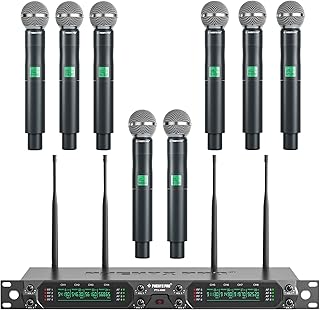
Best for: Buyers who use the same venue and setup regularly and prefer a straightforward fixed-frequency system. The package is described as an eight-channel UHF system with handheld microphones.
Each microphone uses a dynamic cardioid cartridge designed to capture vocals while rejecting unwanted noise. The receiver has an LCD frequency display and individual volume controls, which help operators balance voices channel by channel. The product information specifies a range of up to 260 feet. A memory switch retains the last settings, and snap-on BNC antennas are designed for quick connection.
Why it stands out: This is better for repeatable installations than for users who expect to change frequencies often. Fixed-frequency circuitry and retained settings can simplify setup for a home karaoke area, community venue, or event team that returns to the same configuration.
Limitation: Fixed frequencies offer less adjustment flexibility than selectable-frequency models. Check the operating environment and other wireless equipment before settling on a permanent setup.
Phenyx Pro PTU-4200-8H

Best for: Users who prioritize a sturdy receiver and handheld microphones for regular event use. The system is described as an eight-channel UHF model with metal construction.
The product includes eight anti-rolling rings that can color-code the handheld microphones, making it easier to distinguish speakers or performers. Its 8 groups of 20 tunable frequency options provide a way to change frequencies if a preset does not work well. The stated operating distance is up to 200 feet in open-space line of sight. Cardioid capsules and the system’s circuitry are designed to support stable vocal transmission and limit feedback.
Why it stands out: Compared with a fixed-frequency option, this model offers frequency adjustment, while its included rings help identify microphones quickly. It suits karaoke, live performances, church services, and outdoor events where several people share equipment.
Limitation: Its listed 200-foot distance is shorter than the maximum ranges stated for some alternatives. Treat that number as an open-space line-of-sight figure, not a guarantee for every venue.
MicrocKing 8-Channel UHF System

Best for: Sound operators who want eight separately controlled microphone channels and individual connections to a mixer. The listed system includes a receiver and eight handheld microphones.
The receiver is described as having eight XLR balanced outputs plus one quarter-inch mixed output. Separate volume controls allow channel-by-channel vocal balancing. The receiver and handheld microphones have LCD displays for working status and battery information. The product information describes rugged all-metal construction, fixed frequencies, and a four-antenna receiver design. Its detailed feature list states remote operation up to 300 feet in open space.
Why it stands out: The eight XLR outputs are useful when an operator wants to route microphones separately rather than relying only on a combined mix. This makes it a strong option to compare for venues with a mixer and an operator managing multiple voices.
Limitation: The system uses fixed frequencies, so frequency changes are not described as a feature. The product name mentions 400 feet, while its detailed features state up to 300 feet; confirm the current specifications before choosing based on range.
TONOR Headset And Lavalier System

Best for: Speakers, instructors, or presenters who need a hands-free microphone format instead of a handheld microphone. The supplied information describes headset and lavalier lapel microphones, UHF digital wireless operation, and four antennas.
The system is described as using a cardioid dynamic capsule to reduce background noise and feedback. Its stated transmission distance is up to 295 feet, and the auto-pair and memory features are intended to make setup quicker by remembering the last frequency. Each bodypack transmitter requires two AA batteries, which are not included.
Why it stands out: It offers a different microphone format from the four handheld systems above, which can be more practical when a presenter needs to keep both hands free. It may be worth considering for speech-focused use.
Limitation: The provided product details do not state that this is an eight-channel system. Do not choose it as an eight-microphone solution without confirming its channel count and the number of included transmitters.
Buying Guide: How To Choose An 8-Channel Wireless Microphone
Do you need selectable or fixed frequencies?
Selectable frequencies provide options when a channel encounters interference or when the system must be coordinated with other wireless equipment. The Phenyx Pro PTU-6000-8H adds auto scan, while the PTU-4200-8H lists tunable frequency groups. Fixed-frequency systems, such as the PTU-4000-8H and MicrocKing model, can suit a stable setup but offer less adjustment according to the supplied descriptions.
Before buying, consider the wireless microphones, in-ear monitors, and other radio equipment used at the venue. An eight-channel receiver does not by itself guarantee that every channel will work without coordination in every environment.
How much range do you actually need?
Compare the stated range with the layout of the room and the distance between the receiver and performers. The listed figures vary: up to 260 feet for the PTU-4000-8H, up to 200 feet for the PTU-4200-8H, up to 300 feet in the MicrocKing detailed features, and up to 295 feet for TONOR. The PTU-6000-8H lists 290 to 328 feet.
These figures are not directly equivalent guarantees. Several are specified for open space or line of sight. Walls, people, receiver placement, and radio interference can reduce usable range. Place the receiver where antennas have a clear path to the microphones when possible.
Do you need individual outputs for a mixer?
Check the receiver’s outputs before choosing a system. MicrocKing specifically lists eight balanced XLR outputs and a quarter-inch mixed output. That layout can help an operator send each microphone to a separate mixer channel. If you only need a combined signal, a mixed output may be sufficient, but confirm the exact connections and routing in the product specifications.
Handheld, headset, or lavalier: which format fits?
Handheld microphones suit singing, announcements, and situations where users can hold or pass a microphone. Headset and lavalier formats can keep a presenter’s hands free. The TONOR listing describes headset and lapel microphones, but its supplied details do not confirm an eight-channel configuration. Verify the number of transmitters and receiver channels before treating it as a substitute for an eight-handheld system.
What setup and maintenance details matter?
Look for features that match the people running the event. Auto scan and IR synchronization can support frequency selection and pairing. A memory switch can preserve a familiar configuration. Individual volume controls help balance multiple voices. For shared microphones, color-coding rings can make handoffs easier. Also check battery requirements: the TONOR bodypacks require two AA batteries each, which are not included.
For any model, keep a record of the selected frequencies and label microphones when multiple users share the system. Test all channels in the intended location before an event, and follow the manufacturer’s instructions for pairing, frequency selection, and receiver placement.
Frequently Asked Questions
What does an eight-channel wireless microphone system mean?
An eight-channel system is designed to receive audio from eight microphone channels. Confirm how many microphones are included and whether the receiver has the outputs needed for your mixer or sound system.
Is auto scan better than fixed frequency?
Auto scan can help find a less-interfered frequency, which is useful when wireless conditions change. Fixed-frequency systems can be simpler for stable setups, but the supplied product details describe less flexibility for changing channels.
Can eight wireless microphones be used at the same time?
The systems in this comparison are presented as eight-channel systems, but simultaneous operation depends on correct setup and compatible frequency coordination. Follow the system instructions and account for other wireless equipment in the venue.
Are advertised wireless ranges guaranteed indoors?
No. Product range figures commonly describe line-of-sight or open-space conditions. Walls, people, receiver placement, and interference may reduce the distance available in a building.
Does the TONOR listing confirm eight channels?
No. The supplied TONOR product information describes headset and lavalier microphones, auto-pairing, and a stated 295-foot range, but it does not specify an eight-channel receiver. Confirm channel count and included transmitters before buying it for an eight-microphone setup.