
Best 8 Ohm Mini Speakers for Arduino Projects and Small Displays
Answering common buyer questions: these compact 8 ohm mini speakers are ideal for Arduino projects, Raspberry Pi accessories, advertising machines, and small LCD/LED displays. They’re best for hobbyists building compact audio modules, DIY electronics, or miniature signage. The top picks below are chosen for stable 8 ohm impedance, compact size, and easy integration with JST terminals. The summary table helps you compare core specs at a glance.
| Product | Brand | Impedance | Power | |
|---|---|---|---|---|
| DWEII 4 PCS Speaker 3W 8Ω | DWEII | 8 Ω | 3 W | Arduino projects and small displays |
| DWEII 4 PCS Speaker 1W 8Ω | DWEII | 8 Ω | 1 W | Low-power micro projects |
| DWEII 4PCS 3W 8Ω Single Cavity | DWEII | 8 Ω | 3 W | Portable advertising machines |
| D-FLIFE 6pcs 3W 8Ω | D-FLIFE | 8 Ω | 3 W | Arduino and robotics projects |
| Alrhso 4 Pcs 1W 8Ω | Alrhso | 8 Ω | 1 W | Compact DIY displays and signage |
DWEII 4 PCS Speaker 3W 8Ω Mini Speaker

Best for compact Arduino projects and small LCD displays requiring fuller sound. This 8 Ω speaker offers a 500 Hz to 20 kHz range with 3 W rated power and a stable internal magnetic circuit. Its JST-PH2.0 interface suits compact boards and breadboard-ready builds. Suitable for advertising displays or monitors with limited space.
- Full-range frequency response for general audio tasks.
- Rectangle shape with internal magnetic circuit.
- 4-piece pack for multi-channel or spare usage.
Caution: The higher power class means it may be louder than micro drivers; ensure your driver can handle 3 W outputs to avoid distortion.
DWEII 4 PCS Speaker 1W 8Ω Mini Speaker

Best for low-power micro projects or tight-budget builds. This 8 Ω, 1 W speaker is built for small Arduino projects, robotics, or Raspberry Pi experiments with limited current. The JST-PH1.25mm terminals simplify wiring and quick integration into DIY devices.
- Lightweight, durable construction with a small form factor.
- JST pin terminals enable quick connections.
- Compact power suitable for quiet beeps or simple audio alerts.
Limitation: Lower power means it won’t reproduce louder audio in noisy environments; pair with visual indicators for clarity.
DWEII 4PCS 3W 8Ω Single Cavity

Best for small portable advertising devices and embedded systems needing a clean, compact audio output. With dimensions suitable for tight enclosures, this 8 Ω, 3 W speaker provides stable performance and tight sealing for dependable operation in compact machines.
- Suitable for advertising machines and small consoles.
- 3.3 V or 5 V operation options for varied boards.
- Compact size supports thin chassis designs.
Caution: The single cavity design may limit bass response; use in applications where mid and high frequencies matter most.
D-FLIFE 6pcs 3W 8Ω Mini Speaker
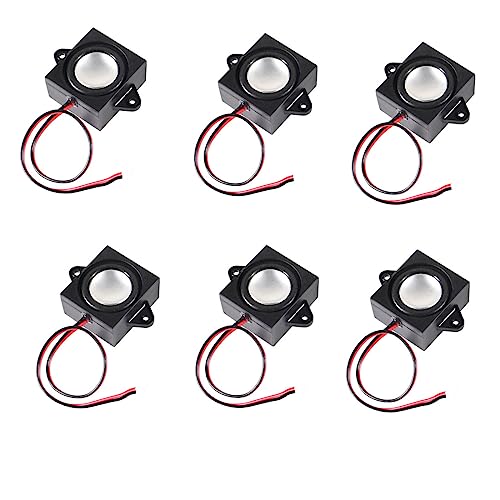
Best for Arduino, robot projects, and Raspberry Pi experiments needing a reliable 3 W output. The 8 Ω impedance and full-range cavity deliver clear sound from a compact package. The separating two-pin interface supports flexible wiring at 3.3 V or 5 V.
- One-to-Two interface supports multiple connections.
- Suitable for DIY projects across microcontrollers and SBCs.
- 31 mm by 28 mm by 15 mm footprint fits many enclosures.
Limitation: Some users may require additional amplification for loud environments; consider a small audio amp if needed.
Alrhso 4 Pcs 1W 8Ω Mini Speaker

Best for space-constrained DIY projects and advertising displays requiring minimal power. This 8 Ω, 1 W speaker uses a JST PH1.25mm-2 pin interface for easy integration with development boards, delivering clear, full-range sound for compact devices.
- JST PH connector simplifies wiring without soldering.
- Very small form factor suited for tight enclosures.
- Good for beeps, alerts, and simple audio cues in displays.
Caution: With only 1 W, it may not deliver strong performance in loud environments; pair with visual indicators when needed.
Buying Guide: 8 Ohm Mini Speakers For Small Electronics
What should you consider when choosing an 8 ohm mini speaker?
- Power and expected volume: If you need louder sound in a small cabinet, prefer 3 W rated models and verify driver compatibility with your audio source.
- Interface and wiring: JST PH2.0 or PH1.25 connectors are common. Ensure the connector matches your development board or use a compatible breakout cable.
- Size and enclosure: Look at the footprint and depth to fit your project enclosure; many options are around 15–31 mm in one dimension.
- Frequency response: Full-range designs are versatile for beeps, alerts, or simple audio; bass will be limited in tiny drivers.
- Compatibility: Confirm the speaker’s mechanical and electrical compatibility with your board (Arduino, Raspberry Pi, advertising machines).
- Durability and sealing: Some models emphasize tight sealing for long-term use in displays or monitors; check the magnetic circuit type if you expect vibration.
What scenarios suit these speakers best?
- Arduino projects requiring audible feedback or simple audio cues.
- Compact advertising displays or kiosks with space constraints.
- DIY media players or small game machines needing lightweight sound output.
- Educational kits and hobby electronics where multiple speakers enable stereo experiments.
Frequently Asked Questions
- What does 8 ohms mean for these speakers?
It refers to the impedance; typical microcontroller drivers handle this range well for small audio tasks. - Can these be powered directly from a microcontroller?
They are designed for low current draw but may require a driver or amplifier for higher volumes. - Are these suitable for Raspberry Pi projects?
Yes, many are compatible via JST connections and standard 3.3V/5V logic interfaces. - Which size is best for a tight enclosure?
Smaller footprints around 15–20 mm dimension fit tight spaces, while larger 31 mm items offer more mounting flexibility. - Is it better to choose more wattage for louder output?
Higher wattage can deliver more volume, but ensure the amplifier and power supply support it without distortion. - Do these require soldering?
Most come with JST connectors that allow plug-in use; some projects may still need soldering for custom wiring.