
A 9-channel AV receiver can power a Dolby Atmos home theater with speakers arranged for immersive surround sound, such as a 5.1.4 or 7.1.2 system, depending on the model. The Onkyo TX-NR7100 is best for Dirac Live room correction and 8K video features; the Onkyo TX-RZ50 suits buyers who want 11.2-channel processing and expansion options; the Denon AVR-X3800H offers several immersive audio formats; the Onkyo TX-RZ30 is a Dirac-equipped alternative; and the JBL MA9100HP supports up to a 5.1.4 layout.
| Receiver | Best For | Notable Feature |
|---|---|---|
| Onkyo TX-NR7100 | Room correction and streaming | Dirac Live and 9 channels of processing |
| Onkyo TX-RZ50 | System expansion | 11.2-channel processing and 7.2.4 pre-outs |
| Denon AVR-X3800H | Format flexibility | Dolby Atmos, DTS:X Pro, IMAX Enhanced, and Auro 3D |
| Onkyo TX-RZ30 | Dirac Live included | Full Bandwidth room-correction license |
| JBL MA9100HP | Clearly specified speaker layouts | Supports up to 5.1.4 configurations |
Onkyo TX-NR7100

The Onkyo TX-NR7100 is a 9.2-channel receiver with Dirac Live room correction, HDMI 8K/4K transfer at up to 40 Gbps, and three HDMI outputs. Its listed features also include discrete Zone 2 HDMI switching and access to Spotify, TIDAL, Deezer, TuneIn, and Pandora.
Best for: Buyers who want a 9-channel Atmos receiver with automatic room calibration and several streaming options. Dirac Live can calibrate with a smartphone and the included wired microphone, or through a computer application and a compatible third-party USB microphone.
It is also a good fit for households that want separate high-definition entertainment in a home theater and a second room. Sonos integration is available when paired with a Sonos Port, which is not included in the listed receiver features.
Limitation: The listed description specifies 9 channels of processing, so buyers planning to expand beyond a 9-channel speaker layout should compare receivers with more processing channels.
Onkyo TX-RZ50
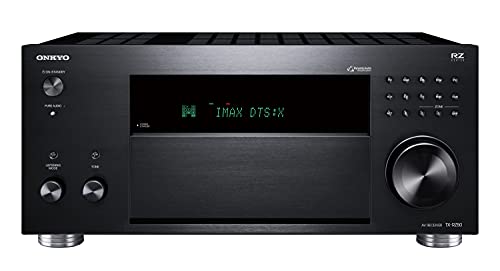
The Onkyo TX-RZ50 has 9.2 channels of amplification and up to 11.2 channels of processing. Its feature list specifies pre-outs for 7.2.4 system layouts, Dirac Live room correction, HDMI 2.1 with 8K support, and THX certification.
Best for: Buyers who want a 9-channel receiver now but may later build a larger Atmos system. Its 11.2-channel processing and 7.2.4 pre-outs give it a clear expansion advantage over models listed with only 9 channels of processing.
Dirac Live is designed to calibrate audio for the room, using the included wired microphone and a smartphone or a computer application. The receiver also supports discrete Zone 2 HDMI switching and the listed streaming services, including Spotify, TIDAL, Deezer, TuneIn, and Pandora.
Limitation: The 7.2.4 pre-outs indicate an expanded system layout, but buyers should confirm the amplification and external equipment needed for their intended configuration before purchase.
Denon AVR-X3800H

The Denon AVR-X3800H is a 9.4-channel receiver rated at 105 watts per channel in its product name. It supports 8K/60Hz pass-through, eARC, HDCP 2.3, and video formats including HDR10+, HLG HDR, Dolby Vision, and Dynamic HDR.
Best for: Buyers who want support for a broad selection of immersive audio formats. Listed formats include Dolby Atmos, DTS:X Pro, IMAX Enhanced, and Auro 3D. Dolby Height Virtualization and DTS Virtual:X are also included for virtual overhead effects in some speaker setups.
The receiver’s Dolby Surround and DTS Neural:X upmixers can process content for a more immersive listening experience. Its 8K video support makes it a candidate for systems that combine newer TVs or sources with surround sound.
Limitation: The provided feature list does not specify room-correction details or an exact speaker-layout limit. Check those requirements against the full product specifications if they determine your choice.
Onkyo TX-RZ30

The Onkyo TX-RZ30 is a 9.2-channel receiver listed at 100 watts per channel. Its features include Dirac Live Full Bandwidth room correction included out of the box, Works with Sonos certification, THX certification, and IMAX Enhanced.
Best for: Buyers who want Dirac Live room correction as part of the receiver’s stated package. The included Full Bandwidth license is a clear point of comparison for shoppers deciding between this model and receivers whose feature descriptions focus on other calibration or processing capabilities.
Onkyo describes the amplifier as using low-noise power transformers and smoothing capacitors, with a stated frequency range from 5 Hz to 100 kHz. The listing also identifies an optional upgrade for Dirac Live Single/Multi Bass Control.
Limitation: The listed details do not specify the receiver’s HDMI input and output counts or a particular Atmos speaker layout. Verify those details if you need a certain number of connected devices or a defined channel arrangement.
JBL MA9100HP

The JBL MA9100HP is a 9.2-channel receiver with 8K video support, six HDMI inputs, two HDMI outputs, and eARC. Its listed audio features include Dolby Atmos and DTS:X decoding.
Best for: Buyers who want a receiver with explicitly listed speaker-layout options. JBL says the MA9100HP supports up to 9.1, 7.1.2, or 5.1.4 configurations, including a 5.1.4 layout with four height speakers.
The six HDMI inputs can be useful when a system includes several sources such as game consoles, streaming devices, and cable equipment. Two HDMI outputs and eARC are also specified, making this a relevant choice for shoppers comparing connection needs alongside Atmos support.
Limitation: The supplied product details do not list room-correction features or an amplifier rating. Compare the complete specifications if calibration tools or power figures are essential to your system plan.
Buying Guide: How To Choose A 9-Channel Atmos Receiver
What does “9-channel” mean for Dolby Atmos?
A 9-channel receiver can support immersive layouts that combine conventional surround speakers with height channels. Common configurations include 5.1.4, with five ear-level speakers, one subwoofer channel, and four height speakers, or 7.1.2, with seven ear-level speakers, one subwoofer channel, and two height speakers. The exact layouts supported vary by receiver, so check the manufacturer’s specifications before choosing speakers.
Channel count and processing capacity are related but not identical. A receiver may have nine channels of built-in amplification yet process more channels through pre-outs. For example, the TX-RZ50 is listed with 11.2 channels of processing and pre-outs for 7.2.4 layouts. That distinction matters if you may expand your system with additional amplification.
Should you choose more processing channels or a specific speaker layout?
Start with the layout you can install, not the largest layout mentioned in a product description. A 5.1.4 system needs four height speakers, while a 7.1.2 system uses two. Room size, speaker placement, wiring, and seating can affect which arrangement is practical. If your current plan is a 9-channel layout, prioritize explicit support for that arrangement. If you may upgrade later, compare processing channels and pre-outs.
Which video features should you check?
Match the receiver’s video support to your TV, game consoles, and other sources. The products in this list include features such as 8K pass-through, 4K/8K transfer, HDMI 2.1, eARC, and HDR-format support, but the details vary. Count the HDMI inputs you need and check whether the listed output arrangement fits your display setup. For gaming, verify the specific refresh-rate and gaming features you require rather than relying on a broad “8K” description alone.
How important is room correction?
Room correction can help adjust playback to the listening space and speaker arrangement. The Onkyo TX-NR7100, TX-RZ50, and TX-RZ30 list Dirac Live. The TX-RZ30 specifically includes a Full Bandwidth license in its listed features, while the other Onkyo descriptions explain calibration with a wired microphone and smartphone or computer application. Compare the calibration method, included equipment, and any optional upgrades before deciding.
Which audio formats matter?
Dolby Atmos is the central format for shoppers seeking Atmos playback, but format support beyond Atmos can matter if you use varied movies, games, and streaming content. The Denon AVR-X3800H lists Dolby Atmos, DTS:X Pro, IMAX Enhanced, and Auro 3D. The JBL MA9100HP lists Dolby Atmos and DTS:X decoding. Confirm that your chosen receiver supports the formats you use, and remember that the speaker setup also affects how immersive audio is reproduced.
What about streaming and multiroom listening?
If music streaming or audio in multiple rooms is important, compare the listed network and multiroom features rather than assuming every receiver offers the same services. The TX-NR7100 lists several music services and discrete Zone 2 HDMI switching. It can also work with a Sonos Port, according to the supplied description. Check whether the relevant services, additional equipment, and zone features match your household’s setup.
Frequently Asked Questions
Can a 9-channel receiver run a 5.1.4 Dolby Atmos system?
Some 9-channel receivers support a 5.1.4 layout, which uses nine main speaker channels plus a subwoofer channel. The JBL MA9100HP’s listed configurations include 5.1.4. Always confirm the supported layouts for the specific receiver you are considering.
Is a 7.1.2 system better than a 5.1.4 system?
Neither layout is automatically better for every room. A 7.1.2 setup has more ear-level surround speakers, while a 5.1.4 setup has more height speakers. Choose based on your room, seating, speaker placement, and the layout supported by your receiver.
What is the difference between channels of amplification and processing?
Amplified channels are driven by the receiver’s built-in amplifiers. Processing channels describe how many channels the receiver can handle as part of a system, which may include pre-outs for external amplification. Check both figures if you plan to expand beyond the receiver’s built-in speaker outputs.
Do I need 8K video support for an Atmos receiver?
No. 8K support is a video feature, while Atmos is an audio format. It can be useful if your display and sources use 8K video, but buyers with other video needs should compare the receiver’s supported resolutions, HDMI features, and HDR formats with their equipment.
Does a 9-channel receiver include the speakers?
The listed products are AV receivers, not complete speaker systems. The provided product information does not say that speakers are included. Check the full package contents and plan separately for compatible speakers, subwoofer equipment, and any external amplification your chosen layout requires.