
The best AC power for a car comes from a 12-volt inverter matched to the devices you plan to run. The BESTEK 300W is a compact choice for everyday travel, while the PiSFAU 200W suits lighter charging needs. For higher output, consider a 400W model; the OLTEANP 1000W is intended for larger loads, but requires extra attention to connection and vehicle limits.
| Product | Best For | Continuous Output |
|---|---|---|
| BESTEK Power Inverter | Compact everyday charging | 300W |
| PiSFAU 200W Inverter | Several USB devices and light AC loads | 200W |
| Pro Chaser 400W Inverter | USB-C fast charging and travel | 400W |
| Vansoet 400W Inverter | Multiple USB and AC connections | 400W |
| OLTEANP 1000W Inverter | Higher-output vehicle power needs | 1000W |
BESTEK 300W Power Inverter
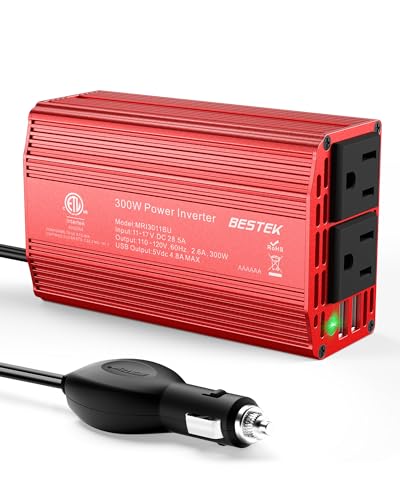
The BESTEK converts 12–17V DC to 110V AC and provides 300W of continuous output, with a listed 700W instantaneous peak. It has two AC outlets and two USB ports rated at 4.8A, plus a 32-inch cigarette-lighter plug cord. The compact, phone-sized design is suited to trips where storage space matters.
Best for: Drivers who want a portable inverter for laptops, tablets, and USB devices. Its combination of two AC outlets and two USB ports makes it useful when several smaller electronics need charging at once.
Limitation: The continuous rating is 300W, so it is not the right pick for loads above that level. Check the vehicle socket’s stated limit before using the inverter.
PiSFAU 200W Inverter With Four USB Ports

This PiSFAU model converts 12V DC to 110V AC and includes two standard U.S. AC outlets and four USB charging ports. The manufacturer describes its circuit design as high-efficiency and its heat-dissipation design as intended to reduce heat and operating noise. Its listed dimensions are 2.7 by 1.4 by 5 inches, and its weight is 8.5 ounces.
Best for: Travelers who want multiple USB connections for phones and other small electronics, alongside a pair of AC outlets for compatible devices. The compact size also suits drivers who prefer a portable unit.
Limitation: Its 200W output is lower than the 300W and 400W options in this guide. Check the wattage of each device before connecting it.
Pro Chaser 400W Inverter With USB-C PD

This Pro Chaser inverter provides 400W of continuous output and up to 800W of peak power. It has two 110V AC outlets, a USB-A QC 18W port, and a USB-C PD 65W port. The product listing describes a compact design and a 30-inch cord, allowing the unit to reach beyond the immediate area of the vehicle’s power socket.
Best for: Road-trip users who want a higher output rating than 200W or 300W models and a dedicated USB-C PD port. It can be a practical option for charging phones, tablets, and other compatible electronics while also supplying AC power to appropriately rated devices.
Limitation: The 400W rating does not mean every vehicle socket can supply that much power. Confirm the vehicle outlet’s limit and the inverter’s operating requirements before use.
Vansoet 400W Inverter With Six Ports

The Vansoet offers 400W of output, two standard U.S. AC outlets, one 30W USB-C PD port, one 15W USB-C port, and two 15W USB-A ports. Its dedicated AC switch can turn the AC outlets on or off without unplugging the inverter. The product also lists a temperature-controlled fan that activates when needed.
Best for: Travelers who want a variety of charging connections in one unit. The combination of AC outlets, two USB-C ports, and two USB-A ports helps accommodate different device cables and charging needs.
Limitation: The product’s 400W output is a total power ceiling, not a separate 400W allowance for every outlet. Add the power requirements of devices used at the same time.
OLTEANP 1000W Vehicle Power Inverter

The OLTEANP converts 12V DC to 110V or 120V AC and lists 1000W of continuous output with a 2000W peak. It is marketed for vehicle use, camping, tailgating, van life, and job sites. Listed safety features include undervoltage, overvoltage, overload, short-circuit, and overheat protection. Its temperature-controlled fan activates as internal temperature rises.
Best for: Buyers with higher-power needs who have confirmed their vehicle power source and inverter setup can support the load. The 1000W continuous rating is substantially higher than the compact 200W–400W options.
Limitation: Do not assume a standard dashboard or cigarette-lighter socket can provide enough power for a 1000W load. Verify the required connection method and vehicle electrical limits in the product instructions before purchase or use.
Buying Guide: How To Choose Car AC Power
How much wattage do your devices need?
Start with the input wattage printed on each device or listed in its manual. Add the wattage of devices you expect to run at the same time, then choose an inverter whose continuous output meets or exceeds that total. A device with a motor or other startup surge may briefly require more power than its normal operating wattage, so check its instructions and the inverter’s peak rating.
Do not treat peak output as the inverter’s everyday capacity. For example, a 400W inverter with an 800W peak rating is generally specified for 400W continuous output, not 800W continuous output. Leave a margin where possible, especially if several devices will operate together.
Will a cigarette-lighter inverter work for your setup?
Compact inverters commonly plug into a vehicle’s 12V accessory socket, but the socket and its circuit have limits. Compare the vehicle manual’s accessory-socket rating with the inverter instructions and planned load. A high wattage printed on an inverter does not establish that a particular vehicle outlet can supply it.
For higher-output models, confirm the specified connection method before buying. Do not assume a product can be connected directly to a battery unless its instructions say so. Follow the manufacturer’s directions and the vehicle manual, and stop using the inverter if the socket, plug, or cord becomes unusually hot.
Do you need AC outlets, USB ports, or both?
Choose AC outlets for devices that use a household-style plug, such as many laptop chargers. USB-A and USB-C ports are convenient for phones and other USB-powered devices, but their charging speeds differ. Check the port’s listed output and your device’s charging requirements; a USB-C connector alone does not guarantee a particular charging speed.
Count the connections you will use at once. A unit with multiple USB ports can reduce the need for separate adapters, while a model with two AC outlets may help when charging several plug-in devices. The total inverter output still applies across simultaneous loads.
What size and cord length fit your vehicle?
A compact inverter can be easier to store and move between vehicles, while a longer cord can help place the unit closer to passengers. Measure the space around the power socket and consider where devices will rest while charging. Keep cords clear of pedals, moving parts, and areas where they could be pinched.
Consider heat and ventilation, too. Inverters convert power and can become warm during operation. Use the product as directed, keep ventilation openings unobstructed, and avoid placing the unit under clothing or other materials.
Which features matter for safer use?
Look for clear continuous and peak ratings, operating-voltage information, and instructions for the intended connection. Some products list protections such as overload, overheat, or short-circuit protection, but those features do not replace correct sizing and proper use. Read the full instructions for the selected model and the vehicle’s manual.
Also check whether the device you plan to power is suitable for use with a car inverter. Medical equipment and appliances can have specific electrical requirements. Consult the equipment manufacturer if those requirements are not clear; do not rely on an inverter’s wattage rating alone.
Frequently Asked Questions
What does a car power inverter do?
A car power inverter converts DC electricity from a vehicle’s power source into AC electricity for compatible household-style plugs. Many models also include USB ports for charging USB-powered devices.
Can I run a laptop from a car inverter?
Often, if the laptop charger’s requirements are within the inverter’s output and the vehicle socket or connection can support the load. Check the charger wattage, inverter rating, and vehicle instructions before connecting it.
Can a 1000W inverter plug into a car’s cigarette-lighter socket?
Do not assume it can. The vehicle socket may not support the current required for a 1000W load. Check both the inverter’s connection instructions and the vehicle’s electrical limits.
Can I charge several devices at the same time?
Yes, if the inverter has enough outlets and ports and the combined load stays within its ratings. Check each device’s power requirements and account for the inverter’s total output limit.
What is the difference between continuous and peak watts?
Continuous watts describe the output an inverter is rated to provide during normal operation. Peak watts describe a higher short-duration output. Use the continuous rating when matching an inverter to a device’s ongoing power needs.
Should I leave a car inverter plugged in when the vehicle is off?
Follow the inverter and vehicle instructions. An inverter connected to a vehicle battery can draw power, so unplug it when not in use unless the manufacturers state otherwise.