
The best acoustic guitar preamp DI depends on how much tone shaping, feedback control, and stage-level flexibility you need. The L.R. Baggs Venue DI is best for detailed EQ and feedback adjustment, while the Fishman Platinum Pro EQ/DI suits players who want compression and a footswitchable boost. The SONICAKE combines a preamp, reverb, and balanced XLR output. Caline CP-40 and LR Baggs Para Acoustic D.I. are relevant options, but the supplied product details do not specify their features.
| Product | Best suited for | Listed highlights |
|---|---|---|
| L.R. Baggs Venue DI | Detailed tone and feedback control | Five-band EQ, adjustable gain, notch filter |
| SONICAKE Acoustic Guitar Effects Pedal | Preamp, reverb, and XLR output in one pedal | Notch filter, mute, balanced XLR output |
| Fishman Platinum Pro EQ/DI | Players wanting compression and boost | Balanced XLR, compression, boost switch |
| Caline CP-40 DI-Box | Shoppers considering a named acoustic DI | Feature details not provided |
| LR Baggs Para Acoustic D.I. | Shoppers considering a dedicated acoustic DI | Feature details not provided |
L.R. Baggs Venue DI

The L.R. Baggs Venue DI is an acoustic guitar preamp and direct box with controls aimed at adapting a pickup signal for performance. Its listed features include adjustable gain for passive and active pickups, a five-band EQ with tunable low-mid and high-mid bands, and a Garret Null notch filter for feedback control.
Best for: Players who need to adjust different pickup output levels, shape several parts of the frequency range, or address feedback during a performance. The tunable mid bands offer more specific tone adjustment than a basic set of broad EQ controls.
Why it was selected: It combines gain adjustment, detailed EQ, and a named feedback-control feature in one product. That makes it a strong fit for guitarists who need hands-on control at the instrument signal stage.
Limitation: The supplied details do not describe its power requirements, connections beyond its DI designation, or dimensions. Check the full product listing for setup details before purchase.
SONICAKE Acoustic Guitar Preamp Pedal
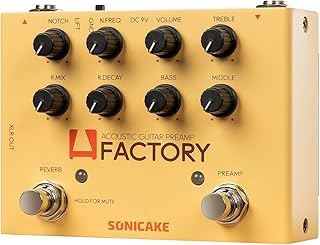
The SONICAKE acoustic guitar effects pedal combines an analog preamp with digital reverb and provides a balanced XLR output. Its listed features also include a high-impedance input, a built-in notch filter, and a mute function. Gain and filter-frequency adjustment are included for shaping the signal and addressing whistling or feedback.
Best for: Acoustic players who want preamp and reverb functions together and need an XLR output for a balanced connection to compatible sound equipment. The built-in mute can also be useful when the instrument signal needs to be silenced between playing moments.
Why it was selected: It offers a distinct combination of tone shaping, reverb, feedback control, and a balanced output. Compared with a preamp focused mainly on EQ, it is better suited to buyers who also want an onboard effect.
Limitation: The supplied description does not specify the reverb types, exact EQ controls, or power method. Confirm those details if they are important to your setup.
Fishman Platinum Pro EQ/DI

The Fishman Platinum Pro EQ/DI is an analog preamp pedal with a balanced XLR output. The listed features include a pre/post EQ switch, a footswitchable boost with level control, and a DI with onboard compression. These functions support both signal shaping and performance-level control.
Best for: Players who want compression and a boost function as part of an acoustic preamp and DI setup. The footswitchable boost is useful for buyers seeking a way to change level during a performance, while the pre/post EQ switch provides an additional routing choice.
Why it was selected: Its listed feature set addresses more than basic signal connection: it includes compression, a controllable boost, and a balanced XLR output. Choose it if those functions matter more than having a prominently specified notch filter.
Limitation: The provided feature list does not describe the EQ bands, boost range, or compression controls. Review the complete specifications if you need precise settings or a particular EQ layout.
Caline CP-40 Acoustic DI-Box

The Caline CP-40 is identified in the supplied product information as a DI box for acoustic guitar. No feature list was provided, so specific claims about its EQ, gain controls, feedback management, outputs, or other functions cannot be confirmed from the available details.
Best for: Shoppers comparing acoustic DI-box options who are willing to inspect the complete listing before deciding. Its stated product name identifies the intended instrument category, but does not establish how its controls or connections compare with the other options here.
Why it was selected: It is explicitly presented as an acoustic guitar DI-box, making it relevant to this search. It may be worth comparing when the buyer is looking beyond products with extensive preamp feature lists.
Limitation: The available information is too limited to judge whether it includes a preamp, tone controls, or a balanced output. Verify the full specifications and connection needs before purchase.
LR Baggs Para Acoustic D.I.
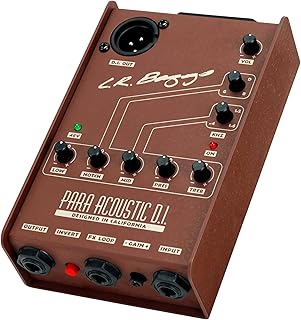
The LR Baggs Para Acoustic D.I. is identified by name as an acoustic direct input product. The supplied product data does not include a feature list, so this article cannot confirm its EQ design, gain range, feedback controls, outputs, or power requirements.
Best for: Buyers who are considering an acoustic-focused DI and want to compare this model with preamps that have more detailed feature descriptions available here. Check the full listing to establish whether its controls match your instrument and performance needs.
Why it was selected: The product name directly identifies an acoustic D.I., so it is relevant to searches for acoustic guitar preamp and DI equipment. Its specific advantages over the other models cannot be established from the information provided.
Limitation: No technical features were supplied for comparison. Do not assume it has particular EQ, feedback, or output options without verifying them in the product listing.
Buying Guide: How To Choose An Acoustic Guitar Preamp DI
An acoustic preamp and DI can help connect a pickup-equipped instrument to a performance sound system while providing controls for the signal. Products vary: some emphasize EQ and feedback control, while others add reverb, compression, or a boost. Start by identifying the problems you need the device to solve, then check that its documented features and connections suit your setup.
Do you need a preamp, a DI, or both?
A preamp provides controls that shape or manage an instrument signal. A DI is intended to send an instrument signal to other audio equipment through a direct connection. Many products combine these roles, but the label alone does not confirm every feature. Check for the functions you need, such as gain adjustment, tone controls, and a balanced XLR output.
If your main requirement is connecting an acoustic instrument to a compatible sound system, prioritize clearly specified output connections. If you also need to adjust tone or signal level at the pedal, look for a product with documented preamp controls.
Which features help with feedback?
Feedback can occur when amplified sound interacts with an instrument pickup. A notch filter is a feature to consider if feedback control is a priority. The L.R. Baggs Venue DI lists a Garret Null notch filter, and the SONICAKE lists an adjustable built-in notch filter. The available product details do not establish that every model here has this function.
Feedback control is not a guarantee that feedback will disappear in every room or setup. Positioning, stage volume, pickup type, and sound-system settings can also affect the result. Choose a pedal with clearly described controls, and verify how those controls operate in its full specifications.
How much EQ control is useful?
EQ adjusts the balance of frequency ranges in the instrument signal. A five-band EQ with tunable low-mid and high-mid bands, as listed for the Venue DI, may suit players who want more detailed adjustments. If you only need a particular effect or basic signal handling, compare the specific controls rather than choosing by the number of features alone.
For the Fishman Platinum Pro EQ/DI, the supplied information confirms an EQ-related pre/post switch but does not list its EQ bands. The Caline and LR Baggs Para Acoustic D.I. feature details were not provided. Review the complete listings before comparing their tone-shaping options.
Do you need reverb, compression, or a boost?
Extra functions can reduce the need for separate devices, but they are only useful if they fit your playing and signal chain. The SONICAKE lists digital reverb, while the Fishman lists onboard compression and a footswitchable boost with level control. The Venue DI information provided here emphasizes gain, EQ, and feedback control instead.
Decide whether an effect should be built into the preamp or supplied elsewhere in your setup. For a live player who wants a level change during a song, a footswitchable boost may be relevant. For a buyer seeking an acoustic signal with reverb, the SONICAKE is the only option in this list with reverb specifically identified in the supplied details.
Why check the outputs and input?
Match the product’s connections to the instrument and equipment you plan to use. The SONICAKE and Fishman feature descriptions specifically mention balanced XLR output. The supplied information for other products does not give the same level of connection detail, even when the product name includes “DI.” Check the complete specifications for input and output types, along with any connection requirements for your sound system.
The SONICAKE also lists a high-impedance input. This is a stated feature, but the information provided does not describe all instrument compatibility scenarios. Confirm the input requirements for your pickup and any other equipment in your signal chain.
What should you verify before buying?
- Pickup type: Check whether the product’s listed gain controls support your active or passive pickup. The Venue DI specifically lists adjustable gain for both types.
- Performance controls: Decide whether you need a mute switch, boost, EQ, compression, reverb, or feedback filter.
- Connections: Confirm that the input and output types match your instrument and destination equipment.
- Missing specifications: For the Caline CP-40 and LR Baggs Para Acoustic D.I., consult the full listing because feature information was not supplied here.
- Setup requirements: Verify power and operating details in the product documentation before adding a pedal to your rig.
Frequently Asked Questions
What does an acoustic guitar DI box do?
A DI box connects an instrument signal to compatible audio equipment through a direct signal path. Some acoustic DI products also include preamp and tone-shaping features, so check each model’s listed functions rather than assuming all DIs offer the same controls.
Is a preamp DI useful for a passive pickup?
It can be useful when the device provides gain adjustment suited to the pickup. The L.R. Baggs Venue DI specifically lists adjustable gain for passive and active pickups. Check the specifications of other models for their supported input types and gain controls.
Which option lists a feedback filter?
The L.R. Baggs Venue DI lists a Garret Null notch filter, and the SONICAKE lists a built-in notch filter with gain and frequency adjustment. The available details do not confirm a notch filter for the other products.
Which product includes reverb?
The SONICAKE acoustic guitar effects pedal lists digital reverb alongside its analog preamp. Reverb is not listed in the supplied feature information for the other products.
Which product includes a footswitchable boost?
The Fishman Platinum Pro EQ/DI lists a footswitchable boost with level control. Check the full product specifications for additional details about its controls and setup.
Can I choose between these products using the supplied details alone?
The Venue DI, SONICAKE, and Fishman have several stated features that support a direct comparison. The Caline CP-40 and LR Baggs Para Acoustic D.I. have no feature lists in the supplied information, so their detailed capabilities should be verified before choosing.