
An acoustic sound hole plug is a removable cover that fits into a guitar’s sound hole to help reduce feedback during amplified playing. The best choice depends first on the sound hole’s diameter: the Ernie Ball 3 3/8-inch model is for smaller openings, while its 4-inch model and several other options are intended for standard 4-inch openings. Choose the smaller Ernie Ball for a measured 3 3/8-inch hole, the larger model for a measured 4-inch hole, or a rubber option if you want a simple tool-free insert.
| Product | Best For | Fit Information |
|---|---|---|
| Ernie Ball P09630 | Guitars with smaller sound holes | 3 3/8 inches |
| Ernie Ball P09618 | Guitars with 4-inch sound holes | 4 inches |
| WHTCHSU Soundhole Cover | Tool-free installation and removal | Most standard 4-inch sound holes |
| Brown Rubber Soundhole Cover | Players seeking a brown rubber cover | 4 inches; listed for 40- and 41-inch guitars |
| Black Rubber Feedback Buster | Players who also want dust protection | 10 cm cover; check the guitar opening before ordering |
Ernie Ball 3 3/8-Inch Sound Hole Cover
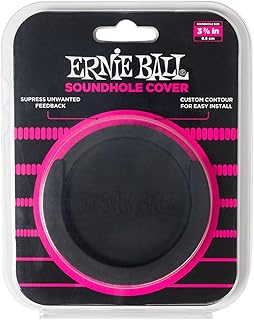
The Ernie Ball P09630 is designed for acoustic guitars with a 3 3/8-inch sound hole. Its stated purpose is to fight unwanted feedback and noise, and installation does not require tools. The defining selection point is its specific diameter, so measuring the guitar opening before ordering is important.
Best for: Players who have measured a 3 3/8-inch sound hole and want a purpose-sized cover for managing feedback. Choose this model if the opening matches that measurement. The product information specifically directs owners of guitars with 4-inch openings to choose the larger Ernie Ball size instead.
Limitation: It is not the right listed size for a 4-inch sound hole. A mismatch in diameter can make fit uncertain, so do not select it based only on the guitar’s overall body size.
Ernie Ball 4-Inch Sound Hole Cover

The Ernie Ball P09618 is the larger of the two Ernie Ball options here. It is intended for 4-inch sound holes and is described as a way to fight unwanted feedback and noise. The cover is designed for easy installation without tools, making it a straightforward option when its listed size matches the guitar.
Best for: Acoustic guitar players who measure a 4-inch opening and want an Ernie Ball cover with a clearly specified fit. It is the better choice than the P09630 when the sound hole is 4 inches.
Limitation: The manufacturer’s sizing information says to choose the 3 3/8-inch model if the guitar has that smaller opening. Confirm the opening diameter rather than assuming all acoustic guitars use this size.
WHTCHSU Standard 4-Inch Soundhole Cover

This black WHTCHSU soundhole cover is described as fitting most standard 4-inch sound holes. Its features focus on reducing feedback and allowing greater stage volume. A soft rubber insert is intended to provide a secure fit without damaging the guitar’s finish, and the cover can be installed or removed without tools.
Best for: Players with a standard 4-inch opening who value tool-free handling and a soft rubber insert. It is a useful comparison against the Ernie Ball 4-inch model if the stated fit and material features are priorities.
Limitation: “Most standard 4-inch sound holes” is not a guarantee of fit for every guitar. Measure the opening and check its shape before choosing this cover, particularly if the sound hole is not a standard round size.
Brown 4-Inch Rubber Soundhole Cover
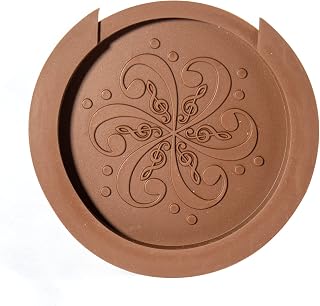
This brown rubber cover is listed for 40- and 41-inch acoustic guitars and has a stated 4-inch diameter. Its feature description says the rubber has a smooth surface and is intended for durable use. Installation and removal are described as simple: place the cover on the sound hole without using tools. It is also presented as a feedback-reduction option for guitar enthusiasts and performing guitarists.
Best for: Players looking for a brown rubber cover and whose guitar has a 4-inch sound hole. The color and simple placement distinguish it from the black options in this list.
Limitation: The listing’s reference to 40- and 41-inch guitars does not replace measuring the sound hole. Overall guitar length alone cannot confirm that a 4-inch cover will fit a particular opening.
Black Rubber Sound Hole Feedback Buster

This black sound hole cover is described as a 10 cm rubber protector. The supplied features say its material is intended not to damage the guitar’s surface or break easily. They also describe reducing speaker resonance and unnecessary echoes, along with helping keep dust from falling into the guitar case.
Best for: Players who want a rubber cover with dust protection as an additional stated function. The product may suit buyers comparing a basic feedback-focused cover with one described as serving a protective role as well.
Limitation: The listing gives a 10 cm measurement rather than a sound-hole fit range. Since 10 cm is not the same as a 4-inch specification, measure the guitar opening and verify fit details before ordering.
Buying Guide: How to Choose an Acoustic Sound Hole Plug
An acoustic sound hole plug, also called a soundhole cover or feedback buster, is fitted into the guitar’s sound hole. The products here are described as helping control feedback, noise, resonance, or echoes. Some also mention dust protection. Fit is the first practical consideration: a cover that does not match the opening may not sit securely.
What size sound hole plug do I need?
Measure the sound hole itself, not the guitar’s body length. The Ernie Ball products specify two distinct sizes: 3 3/8 inches and 4 inches. The WHTCHSU cover is described as fitting most standard 4-inch holes, and the brown rubber cover is listed as 4 inches. The black rubber feedback buster is listed as 10 cm, so compare its measurement with the guitar opening before buying.
Use a ruler or tape measure to check the opening across its diameter. For a round hole, measure from one inner edge to the opposite inner edge through the center. If the opening is close to a listed size, check the product’s detailed fit information rather than assuming the measurement is interchangeable.
Are sound hole covers universal?
No product in this selection should be treated as universally compatible. Even a cover described as fitting “most standard 4-inch sound holes” may not fit a guitar with a different opening size or shape. The Ernie Ball sizing notes specifically distinguish between 3 3/8-inch and 4-inch holes. Measure first, and use the listed size as the main comparison point.
Should you choose rubber or another listed material?
Several options are specifically described as rubber. The WHTCHSU model has a soft rubber insert that is intended to provide a secure fit without damaging the guitar’s finish. The brown cover is described as high-quality rubber with a smooth surface, while the 10 cm black cover is also identified as rubber and is described as a surface-protective material.
These descriptions can help narrow a choice, but they do not establish that one material will suit every guitar better. Consider the stated material and fit features alongside the measured diameter. Avoid assuming a product has additional construction or finish-protection properties that are not listed.
Which features matter for amplified playing?
If feedback control is the main reason for buying a plug, compare products that explicitly mention that purpose. Both Ernie Ball sizes are described as fighting unwanted feedback and noise. The WHTCHSU and brown rubber options are also presented as feedback-reduction choices, while the 10 cm black cover mentions reducing speaker resonance and unnecessary echoes.
Descriptions such as “enhance stage volume” or “better sound quality” are product claims, not a guarantee of a particular result in every venue or setup. A sound hole cover is a fit-dependent accessory, so consider the intended use alongside the correct diameter.
How important are installation and removal?
Each product description emphasizes straightforward handling. The Ernie Ball and WHTCHSU models are described as requiring no tools, and the brown rubber cover is described as being placed over the sound hole without tools. This can matter to players who expect to remove the cover between playing situations. Follow the product’s instructions and avoid forcing a cover into an opening that appears too small.
Do color and dust protection matter?
Color can help narrow the selection if you prefer the brown rubber cover or one of the black options. The 10 cm black cover is the only product in this group whose supplied features explicitly mention preventing dust from falling into the guitar case. That detail may interest players who want a cover for storage as well as playing, but check the measurements carefully because its stated size differs from the 4-inch models.
Frequently Asked Questions
What does an acoustic sound hole plug do?
It covers the guitar’s sound hole. The products in this guide are described as helping reduce feedback or noise; some also mention resonance, echoes, or dust protection.
How do I measure a guitar sound hole?
Measure across the center of the opening from one inner edge to the opposite inner edge. Compare that diameter with the cover’s stated measurement before ordering.
Is a 3 3/8-inch cover interchangeable with a 4-inch cover?
No. The Ernie Ball models are specified for different opening sizes. Choose the one that matches the guitar’s measured sound hole.
Can I install these covers without tools?
The listed features describe the Ernie Ball covers, WHTCHSU cover, and brown rubber cover as easy to install without tools. The 10 cm black cover’s supplied details do not specify an installation method.
Can a sound hole plug help reduce feedback on stage?
The products are described as feedback-control accessories, and several specifically mention reducing feedback. The result can depend on the guitar and playing setup; the product details do not promise a specific level of reduction.
Is the 10 cm cover the same size as a 4-inch cover?
They are different listed measurements. Check the actual sound hole and the product’s fit information rather than treating 10 cm and 4 inches as identical specifications.