
Best Active Studio Monitor Speakers for Home Audio and Production
Find the right active studio monitor speakers for your desk, budget, and room. This guide highlights five well-rounded options, explains who each is best for, and compares key features to help you buy with confidence. Whether you’re a songwriter, podcaster, video editor, or gamer seeking accurate sound, these monitors are selected to balance clarity, depth, and ease of use in small to mid-sized setups.
Summary table of selected products:
| Product | Best For | Key Benefit | Typical Setup |
|---|---|---|---|
| PreSonus Eris 3.5 | Music production and gaming on a small desk | Compact, accurate 3.5″ woofer with silk-dome tweeter | 2-channel desktop setup |
| JBL 305P MkII | Professional-grade home studios and podcasts | Image Control Waveguide for wide sweet spot | Near-field monitoring |
| Mackie CR3.5 | Budget-friendly desk monitoring | Desk-friendly pair with tonal control knob | Compact, entry-level |
| Edifier MR3 | Hi-Res audio and multi-device connections | Hi-Res certified with multiple inputs | Desktop or small office |
| Yamaha HS4 | Focused, transparent mixing for small rooms | 2-way design with flat response | Critical monitoring in tighter spaces |
PreSonus Eris 3.5 Powered Studio Monitors

Best for compact desk setups and beginners seeking true studio sound without crowding the space. The pair delivers 50 watts of built-in amplification for clear, distortion-free output across 80 Hz–20 kHz. The 3.5” woven-composite woofer and 1” silk-dome tweeter balance bass response with smooth highs, making it suitable for music production, gaming, streaming, and everyday listening.
Why selected: Small footprint, reliable PreSonus sound signature, and easy-to-use near-field monitoring. This is a practical choice for a first desktop workflow where space matters and you want honest translation across genres.
Best for: Beginners and compact studios needing accurate, room-filling sound without a large footprint. Caution: The compact woofer has limited deep-bass extension in very large rooms or tracking dense, low-end-heavy material.
JBL 305P MkII 5″ 2-Way Monitors

Best for more immersive listening with a wide sweet spot in mid-sized studios and home setups. The 305P MkII uses dual 41-watt Class-D amps, a 5″ woofer, and JBL’s Image Control Waveguide for precise imaging and depth. It’s a solid step up for mixing podcasts, music, and multimedia work where accurate channel separation matters.
Why selected: Strong imaging and broad listening area help you translate mixes across devices. Caution: The bigger footprint compared to smaller models, and placement near walls affects bass perception if space is cramped.
Mackie CR3.5 Studio Monitors

Best for budget-conscious buyers who still want desk-friendly monitoring with practical controls. The Mackie CR3.5 is a compact pair designed for near-field listening, offering a tone knob to adjust the voicing from your desk. It’s well-suited for basic music production, video editing, and casual listening in tight spaces.
Why selected: Value-focused option with easy tonal adjustments. Caution: The smaller drivers mean thinner bass in louder, bass-heavy sessions; placement away from walls is advisable to maximize bass response.
Edifier MR3 Powered Studio Monitor
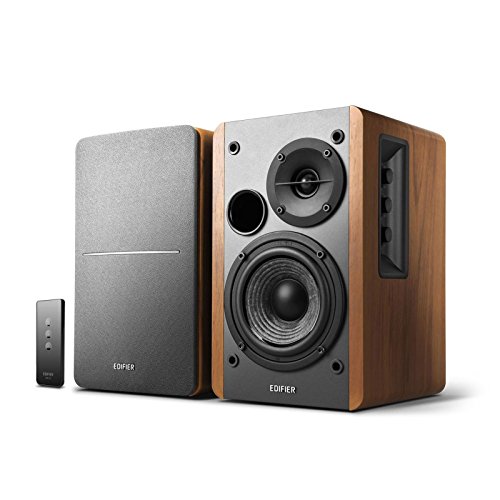
Best for users seeking Hi-Res certified monitoring with multi-device connectivity. The Edifier MR3 delivers 18W x 2 RMS output with a 3.5″ mid-low driver and 1″ tweeter, plus balanced TRS, RCA, AUX inputs and Bluetooth. This makes it versatile for desktop studios, casual listening, and quick project checks.
Why selected: Flexible input options and Hi-Res certification provide reliable translation for everyday production tasks. Caution: Bluetooth pairing may introduce slight latency; for critical mixing, consider a wired connection.
Yamaha HS4 Powered Studio Monitor

Best for focused critical listening in small rooms where a flat, uncolored response is desired. The HS4 is a 2-way, 4.5″ cone woofer with a 1″ dome tweeter and a frequency response aimed at faithful mixing, roughly ideal for near-field work in compact studios.
Why selected: Trusted Yamaha reference for neutral monitoring in tight spaces. Caution: Smaller woofer may require careful room treatment to avoid bass nulls; placement matters for consistent imaging.
Buying Guide: How To Choose Active Studio Monitors
- Room size and desk layout: Smaller rooms benefit from near-field monitors to minimize reflections. Larger desks may tolerate bigger woofers for deeper bass.
- Woofer size and low-end needs: 3.5″ to 4″ woofers are common for desks; 5″ woofers extend low frequencies better in larger spaces, but require more room and proper placement.
- Frequency response: Look for monitors with a flat or honest response in the 60 Hz–20 kHz range. Flat responses translate to more reliable mixes.
- Input options and compatibility: Consider devices you’ll connect (PC, laptop, audio interface, gaming console). AUX, RCA, TRS, and Bluetooth inputs add flexibility.
- Imaging and sweet spot: Waveguides and well-designed drivers improve imaging and a wider sweet spot, aiding consistency when you move around your desk.
- Budget and future-proofing: A slightly higher initial investment can yield better clarity and room translation for longer-term use.
Frequently Asked Questions
- What is the main difference between near-field and in-room monitors? Near-field monitors are designed for close listening with less room reflection impact, while larger in-room monitors aim for broader room coverage and deeper bass.
- Can Bluetooth monitors be used for critical mixing? Bluetooth can be convenient for casual listening but wired connections are generally preferred for accurate mixing due to potential latency and codec limitations.
- Do I need subwoofers with these monitors? If your work involves heavy bass content or you’re working in a larger room, a subwoofer may help; otherwise, many 3.5″ to 5″ monitors provide adequate low-end for most desktop tasks.
- How should I place monitors on a small desk? Place them at ear level and form an equilateral triangle with your listening position. Keep them away from walls if possible to reduce bass buildup.
- Is Hi-Res certification important for studio monitors? Hi-Res certification can indicate high-fidelity components, but accurate monitoring depends on overall system design, not certification alone.