
To add USB charging to a car, plug a cigarette-lighter adapter into its 12V outlet, or install a wired USB outlet for a built-in setup. The LISEN 69W Mini is best for a compact fast-charging option, while the JUNVANG 4-port adapter suits drivers who need to charge several devices. The Hapytrip wired outlet is a better fit for buyers seeking a permanent installation. Compare the connection type, port count, and listed output before choosing.
| Product | Best For | Connection |
|---|---|---|
| LISEN 69W Mini | Compact everyday charging | 12V socket |
| JUNVANG 4-Port 90W | Charging several devices | 12V socket |
| LISEN 69W Dual Port | USB-C and USB-A charging | 12V socket |
| AILKIN Dual USB-A | Basic two-device charging | 12V socket |
| Hapytrip 3-Port Outlet | Built-in, wired installation | 12V wiring |
LISEN 69W Mini Car Charger

This compact plug-in adapter is best for drivers who want USB charging without installing new wiring. It fits standard 12V and 24V cigarette-lighter sockets and provides USB-C and USB-A charging for phones, tablets, GPS devices, and other listed USB devices.
- The product features describe a 36W maximum USB-C PD output and PPS support.
- It supports PD 3.0, QC 3.0, AFC, FCP, and SCP charging protocols.
- The aluminum-alloy shell is described as offering improved heat dissipation compared with plastic.
Choose this if you want a small adapter with both USB-C and USB-A ports. Its listed features say that only one port provides maximum fast charging at a time, so it is not the best choice if two devices need top-speed charging simultaneously. The product name says 69W, while its feature description specifies a total of 54W and a 36W USB-C maximum; check the stated port limits when comparing it with other chargers.
JUNVANG 4-Port 90W Car Charger

The JUNVANG adapter is best for families, carpools, or drivers carrying several USB devices. It plugs into a cigarette-lighter socket and offers two USB-C ports and two USB-A ports, allowing up to four devices to connect at once.
- The listing describes 90W total output and PD/QC charging technology.
- It identifies a maximum of 45W for PD and 45W for QC.
- Its stated device range includes phones, tablets, power banks, cameras, and GPS devices.
Choose this if port count is more important than keeping the adapter minimal. The product listing describes simultaneous four-device charging but does not specify the precise power allocation to each port when all are in use. Charging speed also depends on the connected device and cable, so do not assume every device will receive the maximum listed output at the same time.
LISEN 69W Dual-Port USB Charger
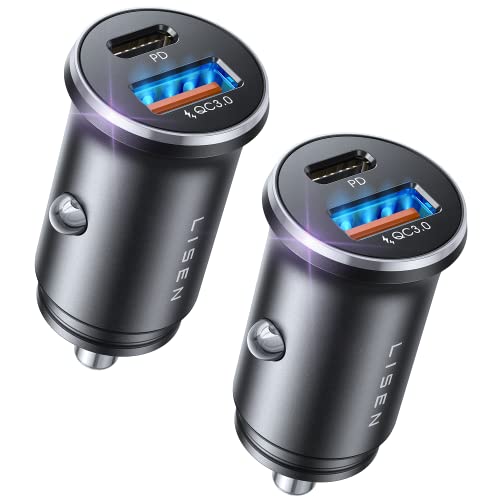
This LISEN adapter is best for drivers who want one USB-C port and one USB-A port in a simple plug-in charger. It is a practical match for a car with a working 12V outlet and for people who need to connect a mix of newer and older charging cables.
- The listing describes a 36W USB-C PD port and an 18W USB-A QC port.
- The USB-C port is listed for fast charging compatible iPhone models.
- The USB-A port is described for Android phones, tablets, and accessories.
Choose this if two different port types cover your everyday charging needs. Its listed feature details say one port delivers full speed at a time, so it may be less suitable for drivers who expect both connected devices to receive their maximum fast-charging output simultaneously. It uses the existing cigarette-lighter socket rather than adding a permanent built-in USB outlet.
AILKIN Dual USB-A Car Charger

The AILKIN is best for buyers who need two standard USB-A ports for basic phone and accessory charging. It plugs into a vehicle’s cigarette-lighter socket and is a straightforward option when USB-A cables are already in use.
- The listing gives a maximum combined output of 5V/3.4A.
- One port is specified at 5V/1A and the other at 5V/2.4A.
- Features include a blue LED indicator and stated protection against overcurrent, overheating, overcharging, and short circuits.
Choose this if you want two USB-A ports and do not need USB-C Power Delivery. The listing explicitly says it is not a PD USB-C charger. Its output is specified at 5V, so buyers seeking higher-power USB-C fast charging should compare it with a suitable USB-C adapter instead.
Hapytrip 3-Port Wired USB Outlet

The Hapytrip outlet is best for buyers who want a built-in USB charging point rather than an adapter occupying a cigarette-lighter socket. The product is described for use in cars, boats, RVs, marine vehicles, and ATVs, making it a fit for projects where a wired outlet is appropriate.
- It has two USB-C PD 3.0 ports and one USB-A Quick Charge 3.0 port.
- The listing says its three ports can charge devices at the same time.
- It is described as using a chip to identify connected devices and adjust charging output.
Choose this if you are prepared to install a wired outlet and want three charging ports in one location. Unlike a cigarette-lighter adapter, this is not simply a plug-in accessory; installation requires a suitable power connection. The supplied features do not state detailed per-port wattage, so confirm the output requirements of your devices before buying.
Buying Guide: How To Add USB Charging To Your Car
Should you use a plug-in adapter or install a wired outlet?
A cigarette-lighter USB adapter is the simplest way to add charging when the vehicle has a working 12V outlet. It plugs in without replacing or modifying the outlet, and it can be removed or moved to another compatible vehicle. Models such as the LISEN and AILKIN adapters use this approach.
A wired USB outlet is a better fit when you want a more permanent installation or want to use a dedicated mounting location. The Hapytrip product is a wired unit, so it requires an appropriate power connection rather than just a free cigarette-lighter socket. Check installation requirements and vehicle power connections before purchasing.
How many ports do you need?
Count the devices that may need charging at the same time, including phones, tablets, and navigation devices. A two-port charger may be enough for a driver and passenger. A four-port model can serve more passengers, but check how its total output is distributed across ports. More ports do not automatically mean that every connected device receives maximum charging speed.
USB-C or USB-A: Which port type should you choose?
USB-C is useful for newer devices and chargers that support protocols such as USB Power Delivery. USB-A remains helpful for older cables and accessories. A mixed-port adapter, such as one with USB-C and USB-A, can accommodate both cable types. Confirm that you have a compatible cable and that your device supports the charging protocol before expecting fast charging.
What do wattage and charging protocols tell you?
Wattage indicates the power a charger can provide under its specified conditions, while charging protocols help determine how a charger communicates with a device. Compare the output for each port, not just the largest number in the product name. A device, cable, and charger must support compatible charging for the device to use the advertised fast-charging capability.
Pay particular attention to whether a listing gives total output, per-port output, or a limit that applies when only one port is active. If the information is unclear, avoid assuming that all ports deliver their maximum output simultaneously.
Will a USB adapter fit every car?
Plug-in adapters in this guide are designed for cigarette-lighter or 12V vehicle sockets. The LISEN mini listing also specifies 24V sockets. Before buying, check the vehicle outlet type and the product’s stated voltage range. A wired outlet has different installation and power-connection requirements from a plug-in adapter.
What should you check before installing a wired outlet?
Confirm where the outlet will be mounted, how it will connect to the vehicle’s electrical system, and whether the installation suits your car, boat, or RV. Follow the product’s installation instructions and vehicle guidance. If you are uncertain about wiring, seek help from a qualified installer rather than improvising a connection.
Frequently Asked Questions
What is the easiest way to add a USB charger to a car?
Use a USB car charger that plugs into the vehicle’s cigarette-lighter or 12V socket. It is a removable option and does not require a built-in outlet installation.
Can I charge two phones from one car charger?
Yes, if the charger has two or more ports. Check the listed total and per-port output, because some chargers limit maximum fast charging to one port at a time.
Is a wired USB outlet better than a cigarette-lighter adapter?
Neither is best for every driver. A plug-in adapter is easier to add and remove, while a wired outlet suits buyers seeking a permanent installation and willing to connect it to vehicle power.
Do I need USB-C to fast-charge my phone?
Not in every case. Fast charging depends on the phone, cable, charger, and supported protocol. USB-C PD is one common option, but check your device’s charging requirements.
Can I use a car USB charger in an RV or boat?
Use a plug-in adapter only if the vehicle has a compatible socket and its voltage matches the charger’s stated range. The Hapytrip wired outlet is listed for cars, boats, RVs, marine vehicles, and ATVs, but installation suitability still needs to be checked.