
The best AM/FM component tuner depends on whether you need HD Radio, professional-style outputs, or straightforward station presets. The Sangean HDT-20 is best for listeners who want AM, FM stereo, HD Radio, and remote control. The Rolls HRS84 suits systems that need XLR and RCA outputs, while the Speco models are options to compare when a basic digital tuner is the priority. Check each model’s listed connections and features against your receiver before buying.
| Product | Best suited for | Key listed features |
|---|---|---|
| Sangean HDT-20 | Home systems seeking HD Radio and remote operation | AM/FM, analog or digital outputs, presets, direct frequency entry |
| Rolls HRS84 | Setups needing XLR and RCA connections | FM tuning, output-level control, XLR and RCA outputs |
| Rolls Digital FM Tuner | Buyers considering a basic FM component | Product listing provides limited feature details |
| Speco Digital AM/FM Tuner | Buyers prioritizing digital presets | Digital AM/FM tuner; other specifications are not provided |
| Speco AM/FM Tuner | Buyers comparing a straightforward AM/FM model | AM/FM tuner; listing provides limited feature details |
Sangean HDT-20 HD Radio Tuner

Best for: Listeners adding AM, FM stereo, and HD Radio tuning to an existing stereo receiver or preamplifier. The listing specifies analog or digital outputs for connecting to a separate audio system.
The HDT-20 has 20 memory presets, divided into 10 AM and 10 FM stations. Its 10-key buttons support direct AM or FM frequency input, and an included infrared remote provides another way to operate it. These details make it the most feature-specific choice here for listeners who want station memory and remote access.
This listing is for a Certified Refurbished unit. The description says it is tested and inspected, ships with relevant accessories, and includes a minimum 90-day warranty; it may arrive in a generic box. Limitation: It is not described as new, and the listing does not specify which cables are included. Confirm the output type and accessory needs before purchase.
Rolls HRS84 FM Digital Tuner
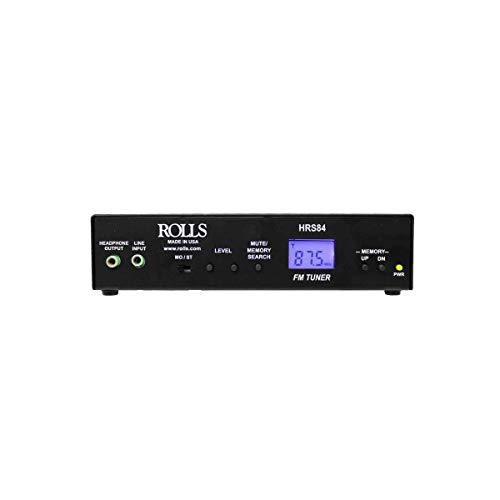
Best for: Buyers who specifically need an FM tuner with both XLR and RCA outputs. The listed output-level control is useful to note when planning how the tuner will connect with the rest of an audio system.
The Rolls HRS84 is described as a digital FM tuner. Its listed connections are XLR and RCA outputs, and the product includes output-level control. Those details make it a better fit for a setup where balanced XLR connections are required than a product listing that mentions only standard consumer outputs.
Limitation: The available feature information identifies FM, not AM, so do not choose it if AM reception is essential. The listing mentions a 90-day parts-and-labor warranty. It does not provide further details about station presets, remote control, or antenna inclusion, so check the complete listing if those features matter.
Rolls Digital FM Tuner

Best for: Buyers comparing a Rolls-branded digital FM component who can verify the connection and control details before ordering. The provided listing identifies the product as a digital FM tuner, but does not describe its performance or tuning functions.
The supplied product information also gives a package weight of six pounds and lists China as the country of origin. These are product-listing details rather than indicators of reception quality. This model is included as an FM-only comparison, not as a substitute for an AM/FM tuner when both bands are needed.
Limitation: The feature information is sparse and does not confirm the output types, preset count, remote control, or included accessories. Choose this only after checking the current product details for the connections and controls your system requires. If confirmed XLR and RCA outputs are essential, compare the HRS84 listing, which explicitly names both.
Speco Digital AM/FM Tuner

Best for: Buyers looking for an AM/FM model described as having digital presets. The product name and supplied feature text identify it as a digital AM/FM tuner with digital presets, making station storage the main stated point of comparison.
Having presets can make it easier to return to saved stations than retuning manually, but the listing does not specify how many presets are available. It also does not provide connection types or describe whether a remote, antenna, or installation accessories are included. Verify those details before deciding whether it fits a home stereo or another audio setup.
Limitation: The only supplied feature detail is “Price For: Each,” which does not answer technical questions about the tuner. Do not assume a particular output, display, preset capacity, or receiver compatibility from the product name alone. This is best treated as a candidate for further specification checking rather than a fully documented option.
Speco AM/FM Tuner

Best for: Buyers comparing a plainly identified AM/FM tuner who are willing to confirm specifications with the seller or full product page. The supplied information identifies the brand and product category but does not provide a detailed feature list.
The listing notes that the product is made in the Republic of Korea. That is a country-of-origin detail, not a specification about tuning, sound, or connectivity. Compared with the Speco digital AM/FM model above, this listing does not explicitly mention digital presets in the supplied information.
Limitation: The feature data does not confirm outputs, preset storage, direct frequency entry, remote control, or included accessories. Choose this model only if the complete listing confirms the features and connections your setup needs. For buyers who need documented controls or output options, the Sangean and Rolls HRS84 listings provide more specific details.
Buying Guide: How to Choose an AM/FM Component Tuner
Do you need AM, FM, or both bands?
Start by identifying the stations you want to receive. A tuner described as FM-only may not meet a requirement for AM broadcasts. In this group, the Sangean HDT-20 and both Speco products are identified as AM/FM options, while the two Rolls listings are described as FM tuners. Check the full specifications before buying if the exact supported bands are important.
Which outputs will connect to your system?
Match the tuner’s outputs to an available input on your receiver, preamplifier, or other audio equipment. The Sangean listing specifies analog or digital outputs, and the Rolls HRS84 specifically lists XLR and RCA outputs. The other listings do not provide enough supplied detail to confirm their connections. Do not assume that similarly named components use the same output types.
Also distinguish between a tuner and a receiver. A component tuner receives radio broadcasts and sends audio to another device. A receiver combines a tuner with amplification and speaker connections. If you need a standalone tuner, confirm that the product is not a receiver being presented as a comparable alternative.
Are presets and direct tuning important?
Preset memory is useful if you regularly switch among familiar stations. The Sangean HDT-20 lists 20 presets, with 10 each for AM and FM, plus direct frequency input using its 10-key buttons. The Speco digital model is described as having digital presets, but its preset count is not supplied. Ask for that specification if the number of saved stations affects your decision.
For occasional listening, manual tuning may be sufficient. For a household with several preferred stations, compare the preset count, whether presets are separated by band, and how stations are selected. These details can matter more in everyday use than the word “digital” in a product title.
Would a remote control make operation easier?
The Sangean listing explicitly includes an infrared remote. The supplied details for the other models do not confirm remote operation. If the tuner will sit inside a cabinet, across a room, or in a system that is difficult to reach, verify that a remote is included and that the front-panel controls still provide the functions you need.
What should you verify when product details are limited?
Before ordering a sparsely documented tuner, check the full listing for supported bands, output connectors, preset capacity, power requirements, included accessories, and physical dimensions. This is especially important for the Rolls Digital FM Tuner and the two Speco listings, whose supplied descriptions leave several technical questions unanswered.
- Confirm whether the unit receives AM, FM, or both.
- Match RCA, XLR, or digital outputs to available system inputs.
- Check preset count and frequency-entry methods if station access matters.
- Verify whether an antenna, remote, or connection cables are included.
- For refurbished products, read the condition and warranty details carefully.
How should you compare refurbished and other listings?
A refurbished product is not the same purchase condition as a new unit. The Sangean listing describes a Certified Refurbished process that includes testing, cleaning, inspection, and repackaging, and it states a minimum 90-day warranty. Review the current seller and listing terms, including included accessories and packaging expectations, before choosing a refurbished option.
Frequently Asked Questions
What does an AM/FM component tuner do?
An AM/FM component tuner receives radio broadcasts and sends the audio signal to a separate audio device, such as a receiver or preamplifier. It does not necessarily power speakers on its own.
Can I connect a tuner to any stereo receiver?
Not necessarily. The receiver needs a compatible input, and the tuner’s output type must match it. Check the tuner’s connectors and the receiver’s available inputs before buying.
Is the Rolls HRS84 an AM/FM tuner?
The supplied product description identifies the Rolls HRS84 as an FM digital tuner. It does not state that it receives AM, so confirm the full specifications if AM reception is required.
Which listed tuner includes a remote?
The Sangean HDT-20 listing explicitly includes an infrared remote. The provided descriptions for the other products do not confirm a remote.
How many presets does the Sangean HDT-20 have?
The listing specifies 20 total memory presets: 10 for AM and 10 for FM. It also lists 10-key direct frequency input for AM and FM.