
Best Amps With Built-in Crossover for Cleaner Car Audio Bass
Answering your search for an amp with built-in crossover, this guide highlights five solid options tailored for different vehicle sizes and listening goals. These amps integrate crossovers so you can dial in bass and sub frequencies without extra DSP gear. Best for: compact cars needing space-saving bass, larger builds seeking precise frequency control, and DIY installers prioritizing simple wiring.
| Product | Best For |
|---|---|
| Timpano 400W Mono Subwoofer Amplifier (TPT-BASS400) | Compact setups needing a powerful, space-efficient mono amp |
| Rockville RG212CA v2 Dual 12″ Sub Enclosure | Small-to-mid vehicles needing a built-in amp in a sub enclosure |
| Taramp’s TS 400X4 4-Channel | Full-range systems with built-in crossovers for multiple channels |
| PRV Audio RS900 Bass Mono Amp | High-power mono bass with integrated crossover |
| Timpano Mono 3000W Sub Amp (TPT-BASS3000) | Higher-power bass systems with integrated tuning |
Timpano 400 Watts Mono Subwoofer Car Audio Amplifier

This monoblock Class D amplifier provides 400 Watts RMS dedicated to bass with built-in crossover filters. A SUBSONIC filter ranges 5–35Hz and an LPF from 35–250Hz, letting you tune without external DSP. The unit includes a variable gain control and a bass boost up to +15 dB for extra impact. Best for users who want a compact, high-efficiency bass amp with straightforward tuning and minimal wiring.
Best for: small to mid-sized vehicles seeking strong bass with simple, on-board crossover control. Caution: at high bass boost, power demand may increase; ensure your electrical system can handle the load.
Rockville RG212CA V2 Dual 12″ Sub Enclosure With Built-in Amplifier
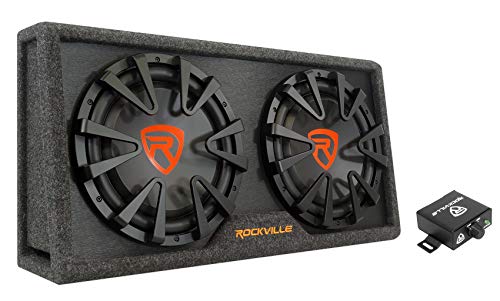
This slim, dual-12″ sub enclosure integrates a 500W RMS Class D amplifier and a built-in low-pass crossover with a tuned 40 Hz response. It’s ideal for compact trucks or tight cabins where space is at a premium. The enclosure uses a 3/4″ MDF construction with a vinyl finish for durability and a side-vented design to promote cooler operation.
Best for: buyers wanting a ready-to-run sub system that fits narrow spaces while preserving trunk or cargo area. Caution: slim design may limit deep bass in very large rooms or open-air setups; check fitment before purchase.
Taramp’s TS 400X4 Black 2 Ohms 400W 4-Channel Car Amplifier

This 4-channel Class D amplifier delivers 400W RMS total, with stable 2-ohm operation for flexible speaker configurations. Built-in crossovers include HPF, LPF, and Full Range modes to optimize tweeters, midranges, and subwoofers without extra gear. The model supports high-level auto turn-on and RCA inputs for OEM compatibility.
Best for: car owners who want a single amp to drive multiple speakers with precise crossover control. Caution: ensure your wiring supports 2-ohm loads; mis-sizing may affect performance or stability.
PRV Audio RS900 Bass Mono 2 Ohm 900W with Built-In Crossover

Equipped with 900W RMS at 2 ohms and built-in crossover, this mono amp emphasizes efficient power delivery with protective circuitry including high/low voltage and current safeguards. The design prioritizes reduced electrical strain and includes high-quality Tiffany RCA inputs for dependable signal integrity. A wired remote level (bass knob) is included for convenient bass control from the listening seat.
Best for: bass-focused systems needing robust power and reliable protection. Caution: high power requires adequate vehicle electrical capacity to prevent dimming or fusing under deep bass.
Timpano Mono 3000 Watts Sub Amp (TPT-BASS3000)

This 3000W RMS mono block is designed for large bass installations. It provides an adjustable SUBSONIC filter (8–40Hz) and a broad LPF range (30–250Hz) with a selectable bass boost up to +10 dB. A compact Class D design minimizes heat while maximizing power output, with a footprint suitable for many under-seat or trunk placements.
Best for: enthusiasts building a high-output bass system in larger vehicles or vans. Caution: higher output demands more from the electrical system; plan for adequate charging and wiring capacity.
Buying Guide: Key Considerations For Built-In Crossover Amps
- Power needs: Match RMS power to your subwoofer or speaker array. Higher power delivers deeper bass but requires compatible electrical wiring and alternator capacity.
- Built-in crossover range: Look for adjustable SUBSONIC and LPF/HPF controls to tailor frequency response to your enclosure and listening preferences.
- Impedance compatibility: Ensure the amp supports your subwoofers or speaker impedance (2 ohms or 4 ohms are common). Low-impedance plans demand careful wiring.
- Installation space: Slim designs fit tight trunks and under-seat areas, but check dimensions to ensure proper clearance and airflow.
- Protection features: Fuses, thermal protection, and short-circuit safeguards protect both amp and vehicle electricals during heavy bass periods.
- Inputs and integration: High-level inputs simplify OEM integration; RCA inputs offer direct connections to aftermarket head units. Remote bass control is a plus for on-the-fly adjustment.
- Sound goals: Decide between a single-mono bass amp for deep sub-bass or a multi-channel amp with built-in crossovers for full-range systems.
Frequently Asked Questions
- What is a built-in crossover on an amp? It is a circuit inside the amplifier that splits audio frequencies to subwoofers or full-range speakers, reducing the need for external crossovers.
- Do I need external DSP if I have a built-in crossover? Not necessarily; built-in crossovers handle basic to moderate tuning, but DSP can offer more precise, room-specific corrections.
- Can a single amp power both subwoofers and speakers? Some four-channel amps can power multiple channels with crossovers, while a dedicated mono amp is often best for subs.
- Is higher wattage always better for bass? More power can improve headroom and bass impact, but must align with enclosure design and electrical capacity to avoid strain.
- What installation considerations matter most? Wiring gauge, proper grounding, fuse sizing, and ensuring the amp’s cooling path remains unobstructed.
- Which option is best for a small car? A compact mono amp with built-in crossover (like the Timpano or PRV options) minimizes space while delivering solid bass.