
If you specifically need an amplifier with a built-in cooling fan, the Sundown Audio SIA-1250D and Pyle PTA1000BT are the clearest matches in this selection because their product names identify a fan. The Sundown is a car-audio mono amp with a three-speed fan; the Pyle is a two-channel rack-mount amp with a cooling fan. The other three are car amplifiers, but the supplied product information does not confirm a built-in fan, so compare them as alternatives rather than fan-equipped choices.
| Product | Best For | Fan Information |
|---|---|---|
| Sundown Audio SIA-1250D | Car subwoofers and speakers | Three-speed fan stated |
| Pyle PTA1000BT | Rack-mount and Bluetooth audio | Cooling fan stated |
| AUDIOZERONE ZE1000.1 | One-ohm car subwoofer systems | Not specified in supplied features |
| ORION CEA400.4D | Four-channel full-range audio | Not specified in supplied information |
| Taramps Smart 3 Bass | High-output car subwoofer systems | Not specified in supplied information |
Sundown Audio SIA-1250D

Best for: Car-audio buyers who need a mono amplifier for subwoofers or speakers and want a fan specifically identified in the product name. Its listed three-speed fan makes it one of the two strongest matches here for the search “amp with built in fan.”
The product name specifies 1,250 watts RMS at 1 or 2 ohms and identifies a smart full-bridge design. Listed controls and features include a subsonic filter, variable high-pass and low-pass filters, bass boost, and a three-speed fan. Those adjustment options can help buyers tailor the amplifier’s filtering to the connected audio system.
Why it was selected: The product information directly states that it has a three-speed fan, unlike the other car amplifiers in this list. It is a better fit for buyers seeking a car subwoofer amplifier with additional filtering controls.
Consider: This is a mono car-audio amplifier, not a two-channel home or rack-mount model. Check the full product specifications and system requirements before choosing it.
Pyle PTA1000BT Rack-Mount Amplifier

Best for: Buyers looking for a two-channel rack-mount power amplifier with a stated cooling fan and several input options. Its product name lists Bluetooth, TRS and XLR inputs, USB-A input with an MP3 player, Speakon outputs, bridge mode, and LED level meters.
The PTA1000BT is described as a 2,000-watt bridgeable amplifier. Its listed connections and playback features make it distinct from the car-focused mono amplifiers in this selection. The built-in cooling fan is explicitly mentioned in the product name, which makes this the clearest choice for a rack-style amplifier when fan inclusion matters.
Why it was selected: It combines a named cooling fan with a two-channel format and multiple listed connection and playback features. Choose this if you need a rack-mount-style amplifier rather than a car subwoofer amp.
Consider: This is not described as a car amplifier. Confirm that its format, connections, and output arrangement suit your intended speakers and installation.
AUDIOZERONE ZE1000.1 Monoblock
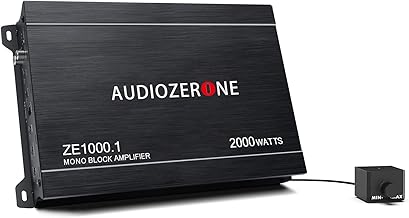
Best for: Car-audio buyers building a one-ohm-stable subwoofer system who want a Class D monoblock. The listed RMS output is 1,000 watts at 1 ohm, 650 watts at 2 ohms, and 400 watts at 4 ohms. The product description also lists a low-pass crossover and MOSFET power supply.
The product information describes Class D efficiency and a compact design, as well as the ability to operate continuously with a one-ohm load. These details make it a relevant alternative for buyers comparing subwoofer amplifiers by impedance and RMS output.
Why it was selected: It is a subwoofer-focused car amplifier with clearly stated output at several impedances. It can be compared with the fan-equipped Sundown and Pyle models, but the supplied features do not state that this amplifier has a built-in fan.
Consider: Do not assume that it includes a fan based on its power rating or Class D design. Verify the product listing if integrated fan cooling is essential.
ORION CEA400.4D Four-Channel Amp

Best for: Buyers who need a compact, four-channel, full-range car amplifier rather than a mono subwoofer-only model. Its product name lists 400 watts RMS, variable high-pass and low-pass filters, a MOSFET power supply, and support for 2- and 4-ohm loads.
Four channels make this a different kind of option from the mono amplifiers in this roundup. The variable filters and stated full-range design may be relevant to buyers comparing amplifiers for a multi-channel car-audio setup. The supplied product information does not include further details about fan cooling.
Why it was selected: It is a relevant car-amplifier alternative for shoppers whose system needs four channels. It should not be treated as a confirmed built-in-fan model because the provided information does not say that it has a fan.
Consider: If an integrated fan is a nonnegotiable requirement, verify the fan specification before selecting this model.
Taramps Smart 3 Bass Amplifier

Best for: Car-audio buyers seeking a high-output, one-channel amplifier for a subwoofer system. The product name specifies 3,000 watts RMS, Class D operation, multi-impedance support from 0.5 to 2 ohms, a low-pass crossover, and bass boost.
This is the highest stated RMS-output option among the five listed products. Its subwoofer-oriented design and impedance range make it a comparison point for buyers selecting a powerful mono amplifier. The supplied details do not confirm that it has a built-in fan.
Why it was selected: It is a clearly defined high-output car subwoofer amplifier, relevant to buyers comparing output and impedance alongside fan-equipped options. Choose it based on system requirements, not on an unverified assumption about its cooling hardware.
Consider: Confirm the fan specification directly if you require active fan cooling. The information provided here does not list a fan.
Buying Guide: How To Choose An Amplifier With A Built-In Fan
Does the product listing explicitly say it has a fan?
Start by checking the manufacturer’s product details for direct language such as “built-in fan,” “cooling fan,” or a stated fan speed. In this selection, the Sundown Audio SIA-1250D lists a three-speed fan, and the Pyle PTA1000BT lists a cooling fan. The supplied details for the AUDIOZERONE, ORION, and Taramps models do not confirm a fan.
Do not treat a high power rating, a Class D design, or the word “cooling” as proof of an integrated fan. Amplifiers can use different approaches to manage heat, and the product information provided for each model should be checked rather than inferred.
Should you choose a car amplifier or a rack-mount amplifier?
Match the amplifier category to the installation. The Sundown, AUDIOZERONE, ORION, and Taramps models are described as car-audio amplifiers. The Pyle is a rack-mount, two-channel power amplifier with Bluetooth and other listed inputs. These formats and features are not interchangeable by default; consider where the amp will be installed and which connections your system uses.
For a car subwoofer system, compare mono models such as the Sundown, AUDIOZERONE, and Taramps. For a multi-channel car setup, the ORION is the four-channel option in this group. For a rack-mount setup with the listed Bluetooth and USB-A features, consider the Pyle.
How much amplifier power do you need?
Compare the amplifier’s RMS output at the impedance your speakers or subwoofer will present. A maximum-watt figure is not the same as an RMS figure. For example, the AUDIOZERONE listing provides separate RMS ratings at 1, 2, and 4 ohms, while the Taramps product name gives a 3,000-watt RMS rating and an impedance range.
Do not select an amp from its largest wattage number alone. Check the connected speaker or subwoofer requirements and the amplifier’s supported load. If the impedance and output details are unclear, consult the full manufacturer specifications before purchase.
What do the channel count and filters change?
A mono amplifier is a one-channel option commonly positioned for subwoofer use in the listed product descriptions. A four-channel amp, such as the ORION, serves a different role when a system needs multiple amplified channels. The Pyle is described as a two-channel amplifier and also lists bridge mode.
Filter controls can also influence suitability. The Sundown lists variable high-pass and low-pass filters plus a subsonic filter. The ORION lists variable high- and low-pass filters, while the AUDIOZERONE and Taramps descriptions mention low-pass crossover features. Compare these controls against the components and frequency range in your system.
What should you verify before buying?
- Fan confirmation: Look for explicit fan language in the listing or product documentation.
- Installation type: Make sure a car amp or rack-mount amp matches your intended setup.
- Channels: Choose mono, two-channel, or four-channel based on the system design.
- Impedance: Verify that the amplifier supports the load presented by the connected speakers or subwoofer.
- Power rating: Compare RMS ratings at the relevant impedance instead of relying only on maximum power.
- Controls and connections: Check the listed filters, inputs, outputs, and playback features against your equipment.
Frequently Asked Questions
Which products in this list explicitly include a built-in fan?
The Sundown Audio SIA-1250D lists a three-speed fan. The Pyle PTA1000BT lists a cooling fan. The supplied details for the other three models do not confirm a built-in fan.
Is the Pyle PTA1000BT a car amplifier?
No. It is described as a two-channel rack-mount power amplifier with Bluetooth and multiple listed inputs and outputs. The other four products are described as car-audio amplifiers.
Which listed option is a four-channel car amplifier?
The ORION CEA400.4D is the four-channel car amplifier in this selection. Its product name also lists full-range operation and variable high- and low-pass filters.
Does a Class D amplifier automatically have a built-in fan?
No. Class D design does not confirm that a product includes a fan. Check the product specifications for an explicit fan statement.
What should I compare when choosing a car subwoofer amp?
Compare RMS output at the system’s impedance, channel format, supported load, and relevant filter controls. If fan cooling is required, verify that the listing explicitly identifies a built-in fan.