Best Audio DSPs for Precision Car and Home Sound Systems in 2026
Looking for the best audio digital signal processor (DSP) to tailor your sound exactly how you want? This guide highlights top DSPs that balance advanced tuning with practical use, aiming at two main buyers: car audio enthusiasts who want precise on-road sound, and home-audio or multimedia setups needing flexible EQ and crossover control. The following selections emphasize clear 15-band or better EQs, selectable crossovers, sequencers, and mobile app control where available. A quick buying table follows to help you compare at a glance.
| Product | Best For | Key Benefit |
|---|---|---|
| Taramp’s Pro 2.4 BT | Car audio fans seeking wireless control | Bluetooth app control with 15-band EQ and 2-in/4-out capabilities |
| PRV AUDIO 2.4X | Budget-conscious multi-channel setups | 2 inputs, 4 outputs, 15-band EQ, multiple presets |
| PRV AUDIO 2.8X | Expanded-channel installations | 8-channel outputs, 2 inputs, extensive EQ |
| Timpano TPT-SP4BT | Remote, app-driven tuning | Bluetooth DSP with sequencer and built-in remote features |
| Dayton Audio DSP-408 | Home or car with GUI ease | 4-in, 8-out with built-in EQ and time alignment |
Taramp’s Pro 2.4S DSP Crossover Full Digital Signal Processor

The Taramp’s Pro 2.4S is a full digital signal processor and equalizer with a built-in sequencer. It features a 15-band graphic equalizer with up to ±12 dB boost at ISO-standard center frequencies (25 Hz to 16 kHz, 2/3 octave) and a parametric EQ band that can affect inputs A and B simultaneously. It also provides selectable high-pass and low-pass crossover filters on the outputs, with cutoff frequencies from 10 Hz to 22 kHz and multiple filter types (Butterworth, Bessel, Linkwitz-Riley) in varied slopes from -6 to -48 dB/Octave. Best for car audio fans who want precise, flexible tone shaping across multiple outputs, including options for different filter slopes. A potential limitation is the complexity of configuration for beginners, given the dual-input processing and multiple filter choices.
PRV AUDIO Car Audio DSP 2.4X Digital Crossover and Equalizer

The PRV AUDIO 2.4X provides a straightforward 2-in, 4-out digital crossover with a built-in 15-band graphic equalizer and access to 12 presets (Flat, Loudness, Bass Boost, Mid Bass, Treble Boost, Powerful, Electronic, Rock, Hip Hop, Pop, Vocal, Pancadão). This unit supports real-time adjustments via its LCD interface and is suitable for users seeking a practical, ready-to-tune solution for car audio. Choose this if you want a compact, easy-to-navigate DSP with robust preset options; avoid if you need more than four outputs or extensive multi-source routing beyond A, B, or A+B per output.
PRV AUDIO Car Audio DSP 2.8X Digital Crossover
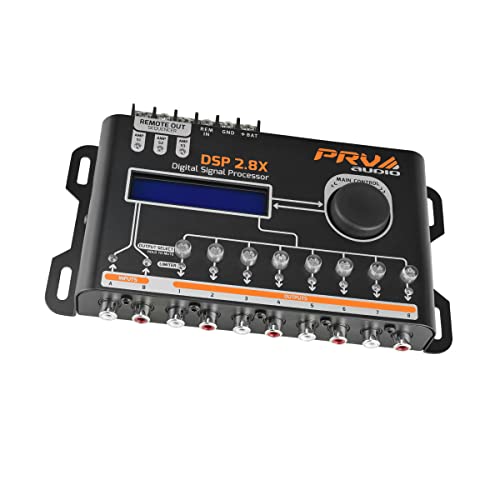
The PRV AUDIO 2.8X expands to 8-channel independent outputs with the same two inputs and a 15-band graphic EQ, plus 12 presets. This setup suits more complex installations where multiple speaker zones require separate tuning. Best for multi-speaker cars or dedicated sound setups, better for users who want per-output customization. A limitation is the larger footprint and more involved wiring compared to smaller 2-in units.
Timpano TPT-SP4BT Bluetooth DSP 4 Output

The compact TPT-SP4BT is a DSP with Bluetooth control from a mobile device. It supports a remote sequencing feature (SEQUENCER) to automate startup and shutdown of up to three connected devices. Best for users who want hands-free tuning and remote operational control via app; use caution if you require a high number of physical inputs beyond the four outputs, since this is tuned primarily for Bluetooth-enabled tuning workflows.
Taramp’s Pro 2.4 BT Bluetooth DSP Crossover
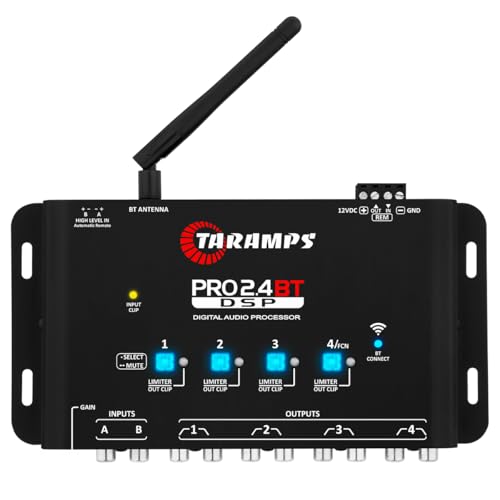
The Taramp’s Pro 2.4 BT mirrors the 2.4S line with app-based Bluetooth control, a 15-band graphic EQ, and 2-in/4-out architecture plus gain up to 9V. It supports a 15-band EQ, parametric options, and full crossovers with adjustable high/low pass filters. Best for enthusiasts who prioritize wireless tuning and flexible gain management; better than wired-only units if you value real-time mobile adjustments. A caveat is potential latency or connectivity hiccups in crowded Bluetooth environments.
Dayton Audio DSP-408 4×8 DSP

The Dayton Audio DSP-408 offers 4 inputs and 8 outputs with built-in equalization, crossovers, and time alignment features, packaged with a user-friendly GUI. Its real-time processing supports application-specific installations in home or vehicle environments. Best for users who want comprehensive GUI-driven DSP control without extraneous frills; avoid if you require more than eight outputs or more advanced sequencer features not stated in the product data.
Banda Audioparts X8AiR DSP
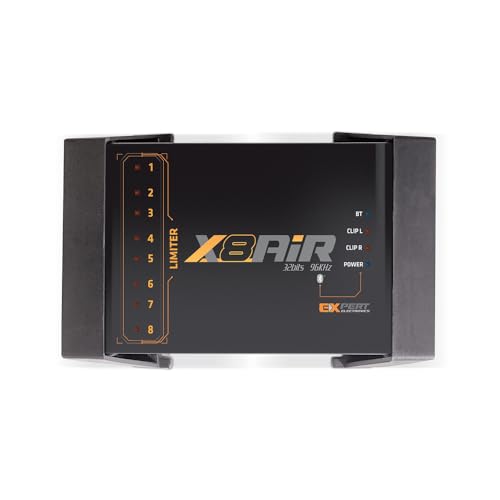
The Banda Audiopart X8AiR DSP features a 32-bit/96 kHz processing engine with 79-band per-channel equalization, Bluetooth-based app control, and advanced crossovers with time alignment and peak limiter. This unit is best for users who demand high-resolution tuning and wireless control across multiple channels; meanwhile, its complexity and bandwidth requirements may be challenging for casual users. Choose this if you need a premium, app-controlled multi-channel system and are comfortable with in-depth setup.
Stetsom STX2448 FLOATING PRO

The Stetsom STX2448 FLOATING PRO is a full professional DSP with a floating mode, multiple input types (RCA and high signal), and a built-in sequencer for remote control of connected devices. It emphasizes flexible routing and audio quality for professional installations. Best for users needing a floating DSP arrangement with advanced sequencing; consider that the floating mode adds a level of configuration complexity compared to standard fixed-DSP setups.
Buying Guide
What should you consider when choosing an audio DSP?
- Channels and outputs: Do you need 2-in/4-out, 4-in/8-out, or more? Multi-channel setups benefit from higher output counts for zone-specific tuning.
- Equalization and crossovers: Look for a minimum of 15-band graphic EQ and adjustable HPF/LPF with multiple slopes (Butterworth, Bessel, Linkwitz-Riley). More bands and flexible slopes enable finer control over tonal balance.
- Control method: Bluetooth or app control adds convenience but ensure reliable connectivity in your environment. Some units also provide LCD interfaces for direct editing.
- Sequencer and remote features: Sequencers automate startup/shutdown or phase alignment across multiple devices, which is useful in complex installations.
- Input types and compatibility: Check for RCA, high-level inputs, or both. Some units support factory radio integration, while others suit aftermarket systems.
- Time alignment and phase management: Essential for coherent sound across multiple speakers and listening positions, both in cars and rooms.
FAQ
- What is a DSP in audio systems?
A DSP processes digital audio signals to adjust tone, timing, and routing. It enables precise EQ, crossover filtering, time alignment, and level control across multiple channels.
- Is Bluetooth control reliable for car audio DSPs?
Bluetooth control is convenient for real-time tuning, but ensure the device supports stable connectivity and low-latency operation in your vehicle’s environment.
- Do I need time alignment in a car audio setup?
Time alignment helps align sound from different speakers to a single listening position, improving imaging and clarity, especially in multi-speaker configurations.
- What does a 15-band EQ offer?
A 15-band EQ provides more precise tonal shaping at fixed centers, allowing targeted boosts or cuts across the audible spectrum. Some units also include parametric EQ bands for more flexible adjustments.
- Should I choose a multi-output DSP or a simpler two-channel unit?
Choose a multi-output DSP if you need separate tuning for different speaker zones or channels. A two-channel unit is often sufficient for a basic stereo car install.
- Are built-in sequencers important?
Sequencers automate sequencing of devices and can simplify startup/shutdown and routing in complex systems, reducing manual setup time.