Best Audio Interfaces With 4 Mic Inputs for Home Studios
Answering the need for multiple-mic recording, these interfaces provide four mic inputs, reliable preamps, and solid conversion at a reasonable price. They suit small-band setups, podcast rooms, home studios, and streaming rigs where simultaneous multi-mic capture is essential. Below, find five capable options and practical guidance to choose the right one for your workflow.
| Product | Brand | Inputs | Best For |
|---|---|---|---|
| Behringer U-PHORIA UMC404HD Audiophile 4×4 | Behringer | 4 mic/4 line | Budget multi-mic recording |
| Behringer UMC404HD Audiophile 4×4 | Behringer | 4 mic/4 line | Podcasting with multiple guests |
| Focusrite Scarlett 4i4 4th Gen | Focusrite | 4 mic/4 line | Musicians and podcasters needing low latency |
| CIXUN 4×4 USB-C Audio Interface | CIXUN | 4 mic/4 line | Bands and complex sessions |
| Fender Quantum LT 4 | Fender | 2 mic/4 line (4 inputs total) | Growing creators with hybrid needs |
Behringer U-PHORIA UMC404HD Audiophile 4×4

The Behringer UMC404HD provides four combo mic/line inputs with Midas-designed mic preamps and 24-bit/192 kHz conversion. It’s a compact, USB 2.0 interface that supports recording microphones and instruments simultaneously. The four-input design makes it suitable for small bands, podcast rounds, and home studios needing multi-mic capture without breaking the budget.
Who it’s best for: budget-conscious home studios needing reliable 4-mic input capability for podcasts, voiceovers, and small-band recordings. Why selected: strong value per channel with Midas preamps and broad software compatibility.
Limitation: USB 2.0 bandwidth can constrain extremely large multi-track projects on slower systems; ensure your computer supports 24-bit/192 kHz reliably for all channels.
Behringer UMC404HD Audiophile 4×4
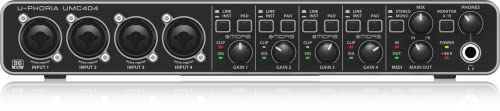
This model emphasizes four XLR/TRS inputs with dedicated Level/Pad controls and direct monitoring options. It’s apt for small studios needing to route four inputs through a single USB interface with minimal latency. The device’s Midas mic preamps deliver clean vocal and instrument capture when paired with appropriate microphones.
Who it’s best for: users building a multi-mic gaming or podcast setup on a budget. Why selected: two units in the set show how this family scales well for four-mic configurations.
Limitation: physical controls are basic; advanced users might want more precise metering and software control per channel.
Focusrite Scarlett 4i4 4th Gen

The Scarlett 4i4 4th Gen offers two mic preamps plus four line inputs and MIDI I/O, all with Focusrite’s celebrated converter quality and a dynamic range around 120 dB. Air mode lifts the vocal and guitar presence for a brighter, more open mix, making it a strong choice for songwriters and producers needing professional studio results with flexible inputs.
Who it’s best for: musicians and content creators seeking pro studio sound with reliable, transparent preamps and integrated MIDI. Why selected: high-quality converters and Air mode provide consistent, studio-grade results across four inputs.
Caution: while it handles multiple sources well, this model may be overkill for purely two-mic voiceovers and smaller podcast setups.
CIXUN 4×4 USB-C Audio Interface

The CIXUN B-004 provides four XLR/TRS combo inputs with Class A preamps and 24-bit/192 kHz conversion. Built-in FX Reverb/Delay and a dedicated FX knob help you shape real-time monitoring during recording and streaming, reducing post-production time. The USB-C connection makes it a forward-compatible option for modern setups.
Who it’s best for: bands and multi-mic setups requiring on-the-fly effects and straightforward workflow. Why selected: integrated FX and four preamps streamline complex recording sessions.
Limitation: effects processing can add latency in some software configurations; use direct monitoring to avoid echo during performance.
Fender Quantum LT 4
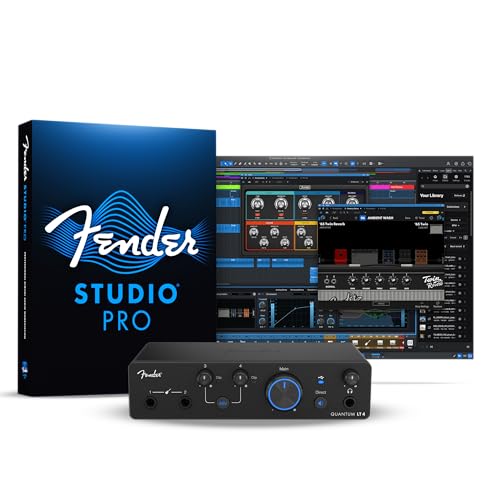
The Fender Quantum LT 4 delivers four inputs in total, including two high-quality mic preamps, plus dual instrument inputs. It includes low-latency drivers and loopback features for content creators who combine guitar, voice, and computer streaming. This makes it a versatile option for growing studios needing hybrid input capability.
Who it’s best for: aspiring multi-instrument writers and streamers wanting expansion without moving to a larger interface. Why selected: solid line-in options and strong Fender software integration for tone shaping.
Limitation: only two mic preamps may limit more traditional four-mic recording sessions without additional mic preamps or routing equipment.
Buying Guide: Four Key Points To Pick The Right 4-Mic Interface
- Number and type of inputs: Confirm four mic/line inputs and whether they are combo XLR/TRS. Consider whether you need Hi-Z guitar inputs in addition to mics.
- Preamps and headroom: Look for transparent mic preamps with adequate gain for your microphones. Higher headroom helps avoid clipping on loud sources.
- AD/DA quality and sample rate: Choose interfaces that support at least 24-bit/192 kHz for future-proof recording clarity and accurate monitoring.
- Monitoring options: Direct monitoring and latency controls are essential for real-time performance without odd delays.
- Software and compatibility: Ensure drivers work with your OS and DAW of choice. Consider bundled software if you value an all-in-one package.
Frequently Asked Questions
- Do I need four mic preamps to justify a 4-input interface? Not always. If you only record a few sources at once, you can work with two preamps and use line inputs for additional sources.
- Which interface offers the best value for four inputs? Budget-conscious options like the Behringer UMC404HD provide solid four-mic capability with good preamps for multi-mic recording.
- Is USB-C better than USB-A for audio interfaces? USB-C generally offers higher power and faster data transfer, which can improve latency and compatibility with newer computers.
- What is “Air” or similar modes in Focusrite interfaces? These modes simulate enhanced high-frequency presence, adding brightness to vocals and guitars without distortion.
- Do built-in FX on interfaces help a recording session? Built-in FX can provide quick vocal effects and space reverb during tracking, but for final mixes, many producers rely on DAW plugins.
- Should I choose a 4×4 or a 4×2 interface? If you routinely record four microphones at once, a true 4×4 setup simplifies routing and reduces the need for extra preamps or external gear.