Best Audio Interface With S/Pdif for Clear, Studio-Quality Sound
Answering the search for an audio interface with S/PDIF, this guide highlights options that support digital input/output for clean, synchronized recordings. Ideal buyers include home studio producers, podcasters who require reliable digital routing, and musicians who want tight sync with other gear. The top five picks balance digital capability, preamp quality, and ease of use across Windows, macOS, and even iOS when applicable. A quick comparison is provided below to help you choose quickly based on needs and workflow.
| Product | Brand | Key Features |
|---|---|---|
| Focusrite Scarlett Solo 3rd Gen | Focusrite | Air mode, two instrument inputs, 24-bit/192kHz |
| Focusrite Scarlett Solo 4th Gen | Focusrite | Air mode, 120dB dynamic range, studio-grade converters |
| Focusrite Scarlett 2i2 4th Gen | Focusrite | Auto Gain, Clip Safe, 4x inputs |
| M-Audio M-Track Duo | M-AUDIO | Dual XLR/Line/DI inputs, 48kHz, versatile monitoring |
| Behringer U-PHORIA UMC404HD | Behringer | Midas mic preamps, 4×4, USB 2.0 |
Focusrite Scarlett Solo 3rd Gen USB Audio Interface

The Focusrite Scarlett Solo 3rd Gen emphasizes pro preamps and clean, bright recordings. It features two high-headroom instrument inputs and Gain Halos to prevent clipping, making it ideal for solo guitarists and vocalists who want studio-like results in a compact setup. The Air mode adds presence to acoustic instruments, improving clarity in the mix. Best for solo artists who need simple, reliable USB connectivity and superior preamps. Limitation: It provides fewer inputs than 2i2 or 4×4 models, which can constrain multi-mic or multi-instrument setups.
Focusrite Scarlett Solo 4th Gen USB Audio Interface

Scarlett Solo 4th Gen offers enhanced digital headroom and a 120dB dynamic range with the same acclaimed Air mode for vocal and guitar tracks. This model is best for solo creators who want larger-scale, studio-grade recordings with the latest generation’s converters. It’s a solid step-up for voice work and guitar-centric setups. Caution: While it improves conversion quality, it still targets a two-input workflow; expanding to multiple mics requires a larger interface.
Focusrite Scarlett 2i2 4th Gen USB Audio Interface
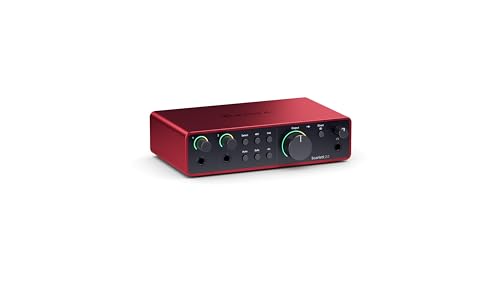
The Scarlett 2i2 4th Gen is designed for songwriting, streaming, and podcasting with two mic preamps and two instrument inputs. Its Auto Gain helps set optimal levels, and Clip Safe prevents clipping, making it beginner-friendly while still suitable for more advanced workflows. Best for creators who need reliable two-channel recording with easy software integration. Limitation: It lacks dedicated S/PDIF I/O, which may matter for users needing digital routing to external gear.
M-Audio M-Track Duo USB Audio Interface

The M-Track Duo combines two XLR/Line/Instrument inputs with monitoring options, including a dedicated headphone output and stereo outputs for flexible monitoring. It’s well-suited for podcasters and musicians who want a compact, portable interface with simple control and direct monitoring. Best for users who value portability and straightforward setup. Caution: While versatile, it does not emphasize high-end preamps as strongly as premium brands, which may influence overall gain and noise for critical vocal work.
Behringer U-PHORIA UMC404HD

The Behringer UMC404HD delivers a 4×4 USB interface with Midas mic preamps, offering more input flexibility and solid performance for home studios. It’s best for users who need multiple inputs for simultaneous recording and MIDI I/O in a budget-friendly package. Limitation: Behringer’s hardware may vary in consistency across units, so careful setup is advised for critical projects. Ideal for project studios seeking value and expandability.
Buying Guide: Key Considerations For S/PDIF Interfaces
- Number of inputs and outputs: Determine needed channels for mics, guitars, and line-level devices. S/PDIF models help with digital synchronization but ensure you have compatible gear to utilize it.
- Mic preamp quality: Look for transparent, low-noise preamps to preserve vocal and instrument detail. Air or similar circuit options can add presence on acoustic recordings.
- Conversion quality: 24-bit/192kHz is common in higher-end models; this affects headroom and detail in mixes.
- Digital routing and monitoring: Auto Gain and Clip Safe features can ease setup, while direct monitoring helps with latency-free recording.
- Software bundle: Included DAW, plug-ins, and control software can affect workflow; verify compatibility with your system.
- Portability vs. expandability: Compact 2-input interfaces suit mobile setups; 4×4 interfaces offer flexibility for multi-mic sessions or small bands.
- Build and reliability: Durable metal chassis and secure USB connections reduce failure risk in home studios.
- Future-proofing: If you plan to grow, consider interfaces with additional inputs, S/PDIF, and robust drivers for long-term use.
FAQ
- Do I need S/PDIF if I already have USB audio?
– S/PDIF provides digital input/output for clean data transfer and sync with other digital gear; use it if you own digital gear that supports it or want a clean digital path alongside analog I/O. - What’s the difference between 2i2 and 4×4 models?
– 2i2 models have two inputs; 4×4 adds more inputs and often more routing options, making them suitable for larger setups or multi-mic recording. - Is Air mode only for acoustic instruments?
– Air mode emphasizes vocal and guitar signals; it can improve presence on a variety of instruments, especially in vocal-forward sessions. - Should I prioritize preamp quality over features like Auto Gain?
– For critical vocals and instruments, preamp quality is essential. Auto Gain is helpful for beginners, but reliable, clean preamps remain foundational. - Can these interfaces work with iOS devices?
– Some models offer compatibility with iOS via appropriate adapters or hubs; check the specific model’s documentation for iPhone/iPad use. - Is latency a concern with USB audio interfaces?
– Latency depends on buffer settings and CPU performance. Most interfaces provide low-latency monitoring and driver support to minimize this issue.