
The best audio recorder for DSLR video depends on how many microphones you need, whether you want a recorder mounted near the camera, and how much control you need over separate tracks. The Tascam DR-70D is best suited to DSLR production with multiple microphones, while the Zoom H1 XLR suits a simpler two-input setup. The Zoom H4 Essential and H5 offer flexible handheld recording, and the Zoom Q2n-4K is a video-recording alternative rather than a dedicated DSLR audio recorder.
| Product | Best suited to | Key reason to consider it |
|---|---|---|
| Zoom H4 Essential | Filmmakers needing several recording options | Built-in stereo mics, two XLR/TRS inputs, and four-track recording |
| Zoom H1 XLR | Interviews and compact two-mic setups | Two XLR/TRS inputs and a waveform display |
| Tascam DR-70D | DSLR shoots with multiple microphones | Four balanced XLR inputs and camera-mountable design |
| Zoom H5 | Filmmakers who value interchangeable input capsules | Four-track recording and a detachable X/Y capsule |
| Zoom Q2n-4K | Creators recording video and sound in one device | Captures 4K video and uses built-in X/Y microphones |
Zoom H4 Essential Handheld Recorder
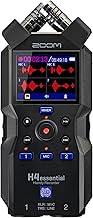
The Zoom H4 Essential is a flexible choice for DSLR filmmakers who want both onboard stereo microphones and connections for external audio gear. It records up to four tracks and has two XLR/TRS inputs, so a production can use its built-in microphones or connect external microphones, instruments, a mixer, or a soundboard.
Best for: Solo creators, interviewers, and small production teams that need a portable recorder capable of handling more than one type of audio source. Its combination of built-in microphones and two combo inputs makes it more adaptable than a recorder limited to a single input approach.
- Four-track recording supports larger recording projects.
- Built-in stereo microphones can capture sound without a separate mic connection.
- Two XLR/TRS inputs accept external microphones or other audio sources.
Limitation: It has two XLR/TRS inputs, so choose a recorder with more microphone inputs if your shoot requires four separate XLR microphone connections. The product information does not specify camera-mounting dimensions or a direct camera audio connection; check your intended setup before buying.
Zoom H1 XLR Two-Channel Recorder
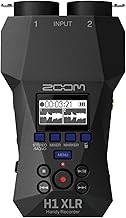
The Zoom H1 XLR is a straightforward option for DSLR video projects that need two external microphone or instrument connections. Its two XLR/TRS combo inputs accommodate different sources, and the recorder supports 32-bit/96kHz recording. An OLED waveform display provides a visual way to monitor the recording at a glance.
Best for: Interview recording, podcasts, and small video shoots where two inputs are enough. It is a more focused choice than a four-input production recorder when the setup does not require multiple separate microphones.
- Two XLR/TRS combo inputs support microphones, instruments, and other compatible sources.
- 32-bit/96kHz recording is specified for detailed audio capture.
- An OLED waveform display makes the recorded signal visible during monitoring.
Limitation: This is a two-channel recorder, not the best match for a production that needs four independent microphone inputs. The listed features do not describe built-in microphones or camera mounting, so plan on using suitable external mics and a separate mounting solution if required.
Tascam DR-70D Four-Channel Recorder

The Tascam DR-70D is the most directly DSLR-oriented option in this group. Its compact design can be mounted above or below a camera, and it provides four balanced XLR microphone inputs with phantom power. Two built-in microphones also provide an onboard recording option for sound on set.
Best for: DSLR video crews that need to connect several microphones, including production teams recording dialogue with multiple sources. Its four XLR inputs make it better suited to multi-mic setups than the Zoom H1 XLR, which has two combo inputs.
- Four balanced XLR microphone inputs include phantom power.
- The compact body can be mounted above or below a camera.
- Two internal microphones can capture sound on set.
- Listed features include a limiter and high-pass filter.
Limitation: Its four XLR inputs are useful when a shoot needs multiple wired microphone connections, but may be more than a simple one- or two-mic project requires. Confirm the camera rig and mounting arrangement you plan to use; the listed details do not specify included mounting accessories.
Zoom H5 Four-Track Handheld Recorder

The Zoom H5 is a four-track handheld recorder with an interchangeable input capsule system. It comes with a detachable XYH-5 X/Y capsule, and its shock-mounted microphones are designed to reduce handling noise. The capsule system gives this model a different kind of flexibility from recorders that rely only on fixed built-in microphones.
Best for: Filmmakers who want a handheld recorder with four-track simultaneous recording and the option to swap input capsules. It is worth considering when microphone configuration flexibility is a higher priority than the Tascam DR-70D’s camera-oriented mounting design.
- Records four tracks simultaneously.
- Uses interchangeable input capsules.
- Includes a detachable X/Y capsule with shock-mounted microphones.
Limitation: The product details do not specify the number or type of additional inputs included beyond the supplied capsule, so verify the connection requirements for your microphones before choosing it. Its stated handling-noise reduction does not remove the need to handle or mount the recorder carefully.
Zoom Q2n-4K Video Recorder

The Zoom Q2n-4K is not a dedicated audio recorder for DSLR use. It is a compact video recorder that captures 4K video and sound with built-in X/Y microphones, making it a possible alternative when a creator wants one device to record a separate video clip with its own audio.
Best for: Musicians, streamers, and creators recording rehearsals, performances, or other footage directly with the Q2n-4K. Its 150-degree wide-angle lens and five field-of-view settings offer framing options, while the microphones are rated to handle up to 120dB SPL.
- Captures 4K video with a 150-degree wide-angle lens.
- Offers five field-of-view settings.
- Includes HDR and 12 scene presets for different lighting environments.
- Built-in X/Y microphones are rated to 120dB SPL.
Limitation: Choose another product in this list if you specifically need a recorder to take external microphone feeds for a DSLR production. The listed features describe the Q2n-4K as a standalone video recorder, not a dedicated multichannel DSLR audio recorder.
Buying Guide: How To Choose An Audio Recorder For DSLR Video
A recorder for DSLR video should match the number of audio sources, the way you plan to mount or position it, and whether you need separate recorded tracks. A camera’s built-in microphone may capture general sound, but a separate recorder can give a production more options for using external microphones and managing audio sources. These five products vary considerably: the DR-70D is camera-oriented, the H1 XLR keeps the setup to two inputs, and the Q2n-4K records video as well as sound.
How many microphone inputs does your shoot need?
Count the microphones or other sources you expect to connect at the same time. The Zoom H1 XLR has two XLR/TRS combo inputs, while the Tascam DR-70D has four balanced XLR inputs. The Zoom H4 Essential has two XLR/TRS inputs plus built-in stereo microphones, and the H5 offers four-track simultaneous recording with an interchangeable capsule system.
Do not equate track count with connector count. A recorder’s listed number of tracks and its physical inputs describe different capabilities. Check the full product details to confirm how the inputs and tracks work together for your intended recording, particularly if you need to record separate dialogue sources.
Should the recorder mount on or near the DSLR?
For a camera-centered rig, the DR-70D has a stated advantage: its compact body can be mounted above or below a camera. That can keep the recorder within the camera setup, although the product information does not establish which mounting accessories are included. The H4 Essential, H1 XLR, and H5 are described as handheld recorders; check their mounting requirements separately if you plan to attach one to a rig.
Position also affects how you connect and monitor microphones. Consider whether the recorder will sit on the camera, on a separate support, or near the person speaking. A workable placement should give the microphone a useful position while keeping controls and connections accessible.
Do you want built-in microphones or external microphones?
Built-in microphones can be convenient for quick recordings, ambient sound, or capturing a general reference. The H4 Essential includes built-in stereo microphones, the DR-70D has two internal microphones, and the H5 comes with a detachable X/Y capsule. The Q2n-4K uses built-in X/Y microphones for its own video and audio capture.
External microphones are generally the priority when a project needs a particular placement or multiple dialogue sources. In that case, compare the number and type of inputs before choosing. The H1 XLR provides two combo inputs, and the DR-70D provides four balanced XLR microphone inputs with phantom power. Confirm that the recorder’s input connections match the equipment you already own.
When does multitrack recording matter?
Separate tracks can help keep multiple sources distinct during recording and later editing. The H4 Essential is specified as a four-track recorder, and the H5 supports four-track simultaneous recording. The DR-70D is designed for multitrack production and provides four XLR mic inputs. For a simple interview with two sources, the two-input H1 XLR may be a more direct fit.
Think about the editing workflow as well as the recording. More inputs may be useful for a crew capturing several voices, but they can add setup and monitoring work. If the production only needs one or two sources, extra input capacity may not be important.
How should you compare recording formats and monitoring?
The H1 XLR’s listed specification includes 32-bit/96kHz recording and an OLED waveform display. Those details may matter to buyers who want a visible recording display and a recorder specified for high-resolution capture. The other listed products have different stated strengths, such as multiple inputs, interchangeable capsules, or camera mounting.
Do not choose based on one specification alone. Input count, microphone placement, ease of monitoring, and the way you intend to transfer or sync audio should all fit the shoot. Review the complete product specifications for recording formats, outputs, power, storage, and camera connection details before purchase, because those details are not all provided in the product information here.
Which model fits common DSLR recording needs?
- For several wired microphones: Consider the Tascam DR-70D because it has four balanced XLR inputs with phantom power.
- For two external sources: Consider the Zoom H1 XLR for its two XLR/TRS combo inputs and waveform display.
- For onboard and external recording options: Consider the Zoom H4 Essential, which combines built-in stereo microphones with two XLR/TRS inputs.
- For a capsule-based handheld setup: Consider the Zoom H5 for its interchangeable input capsules and four-track recording.
- For separate video capture rather than DSLR audio input: Consider the Zoom Q2n-4K, which records 4K video and sound in one device.
Frequently Asked Questions
What is the best audio recorder for DSLR video with multiple microphones?
The Tascam DR-70D is a strong match among these options for multiple wired microphones because it has four balanced XLR microphone inputs with phantom power. Check your microphones’ connection and power requirements before purchase.
Is the Zoom H1 XLR suitable for DSLR interviews?
The Zoom H1 XLR can suit interviews that need two external audio sources. It has two XLR/TRS combo inputs and an OLED waveform display. Its listed features do not specify camera mounting or built-in microphones.
Can I use the Zoom Q2n-4K as a DSLR audio recorder?
The Q2n-4K is described as a video recorder with built-in X/Y microphones, not as a dedicated recorder for external DSLR microphone feeds. It may suit creators who want to record a separate 4K video clip with sound.
What is the difference between inputs and tracks?
Inputs are the physical connections for microphones and other audio sources. Tracks are the recorded audio channels or layers. Compare both specifications: a recorder’s track count alone does not tell you how many external microphones can be connected.
Should I choose a recorder with built-in microphones?
Built-in microphones can be convenient for ambient sound, quick recordings, or a reference track. External microphones may be more suitable when you need specific placement or separate voices. Choose based on the sound sources and recording setup required for your project.