
The best balanced audio switch box depends on whether you need to select between sources or send one source to different outputs. For switching several XLR sources into one destination, the Nobsound 3-in-1 or Cubilux 4-in-1 offers straightforward passive selection. The SOLUPEAK X103 is suited to routing one source to one of three outputs, while the Douk Audio KN102 2-in-1 model adds A/B, mix, and mute options. The reversible WisWinDa is a flexible choice for setups that need either direction of switching.
| Product | Best For | Configuration |
|---|---|---|
| Nobsound XLR Switcher | Three source devices | 3 inputs to 1 output |
| Cubilux AS-X2 | Four source devices | 4 inputs to 1 output |
| SOLUPEAK X103 | One source and three destinations | 1 input to 3 outputs |
| Douk Audio KN102 2-IN-1-OUT | Two sources with mix and mute controls | 2 inputs to 1 output |
| WisWinDa Pro XLR A/B | Reversible A/B routing | Two-way switching |
Nobsound 3-In-1-Out XLR Switcher

Best for: People who want to connect as many as three balanced XLR audio sources to one output device. This arrangement is useful when comparing sources or managing a home Hi-Fi or studio system without repeatedly changing cables.
The switcher uses a passive design and does not require external power. Its three input connections feed one output, and the listed features include gold-plated XLR connectors. The product is described as supporting balanced audio transmission and source selection between connected devices.
Why it was selected: Its clearly stated 3-in-1-out layout suits a common switching task: choosing one of multiple components for a single amplifier, monitor, or other destination. A passive selector also avoids adding a powered amplification stage to the signal path.
Limitation: This is a source selector, not a one-source-to-three-destinations switch. Choose another configuration if you need to route one output to multiple devices.
Cubilux AS-X2 4-In-1-Out Selector

Best for: Users with four XLR audio sources that need to feed one amplifier, speaker, monitor, or other destination. Listed examples of possible source types include microphones, mixers, DACs, and disc players.
The Cubilux AS-X2 switches among four XLR inputs and provides one output. Its listed features describe a passive, plug-and-play design that does not need a power supply. The aluminum-alloy case is identified in the product name, and the features state that phantom power passes through.
Why it was selected: It offers the highest stated source count among these five picks. That makes it a better fit than a two- or three-input box when several devices share one balanced input path. The phantom-power pass-through detail may matter in microphone setups, but users should confirm the full signal-chain requirements before connecting powered microphones.
Limitation: It is a 4-in-1-out selector, so it does not provide four independent outputs. Its passive design also means it does not amplify or control the audio signal.
SOLUPEAK X103 1-In-3-Out Switcher
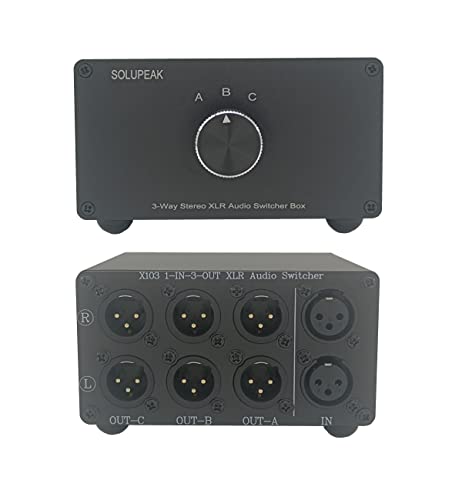
Best for: A setup with one XLR source and three possible destinations, such as choosing among connected audio components. Check the intended signal direction before buying: the X103 is listed as a 1-in-3-out selector, not a three-source-to-one-output switch.
This model uses a passive design with no amplification, volume control, or power circuit. SOLUPEAK states that it minimizes the signal path, with no internal wires and reduced circuit-board traces. A rotary switch on the unit selects the channel.
Why it was selected: Its output-oriented layout fills a different need from the multi-input selectors in this guide. It is better for someone deciding where to send one signal than for someone choosing which of several source devices to hear.
Limitation: The product features do not list a volume control or amplification. It cannot replace equipment needed to drive a signal or adjust listening level.
Douk Audio KN102 2-In-1-Out

Best for: People switching between two XLR balanced audio sources while using one output. The product is specifically the 2-in-1-out version of the KN102, so verify that configuration against your equipment before ordering.
The KN102 includes independent A and B selectors, a mix switch, and a one-key mute function. Its listed modes allow selecting A, selecting B, or sending A and B to the output at the same time. These controls make it more feature-oriented than a basic rotary source selector.
Why it was selected: Choose this model if you want two-source comparison plus the stated mix and mute options. It is a better match for that use than a selector whose listed features only describe choosing one channel at a time.
Limitation: The mix mode sends both A and B to the output, but the supplied product details do not explain how levels are combined. It should not be treated as a full mixer with separate level controls.
WisWinDa Pro Reversible XLR A/B Switch

Best for: Users who need an A/B switch that can work in either direction: one source routed to A or B, or two sources selected for one destination. The product also lists support for XLR and 1/4-inch TS/TRS connections.
The reversible operation is the main distinction. The listed features describe passive hot-swap operation without an extra power supply and full-duplex transmission. The product name identifies an aluminum shell. These details make it a flexible option when the desired signal direction may vary between setups.
Why it was selected: It is the better choice when a fixed input-to-output layout would be limiting. Confirm the intended wiring and connector arrangement for your equipment, particularly if your setup combines XLR and 1/4-inch connections.
Limitation: This is an A/B switch, not a multi-input selector for three or four sources. The provided information does not specify additional mixing or volume-control functions.
Buying Guide: How To Choose A Balanced Audio Switch Box
Do you need to switch sources or destinations?
Start by drawing the signal path. A box labeled “3-in-1-out” generally selects among three source devices and sends the chosen signal to one destination. A “1-in-3-out” box starts with one source and selects among destinations. These arrangements are not interchangeable, so match the direction to the task before comparing other features.
If your system has multiple DACs, mixers, or other source components feeding one monitor or amplifier, look for a multi-input selector. If one source needs to connect to different audio destinations, look for an output selector. For flexible A/B use, a reversible design may suit either direction, but check its connection details.
How many inputs or outputs do you need?
Count the devices you plan to connect now, then consider whether the system may expand. The Nobsound model offers three inputs to one output, while the Cubilux offers four inputs to one output. A two-input box can be simpler for an A/B comparison, and the SOLUPEAK X103 provides one input with three selectable outputs.
More connections do not necessarily make a box better for every setup. A selector with unused ports may add unnecessary complexity, while a box with too few ports can require frequent cable changes. Match the port count to the actual signal path and leave room only for likely additions.
Is passive switching right for your system?
All the listed products are described as passive, or have passive operation among their features. Passive boxes do not require an external power supply for switching, and the SOLUPEAK models specifically list no amplification or volume control. They are selectors, not powered preamps or mixers.
Do not assume a passive box can solve a low-level signal or gain problem. Check whether the connected source and destination already provide the functions your system needs. Also review whether you want a simple selector, a mute function, or a stated mix mode.
Which controls and signal details matter?
Choose controls based on how you will operate the system. A rotary selector offers channel selection, while the Douk Audio KN102 lists separate A/B selection, mix, and mute options. The WisWinDa listing describes reversible A/B operation and support for XLR and 1/4-inch TS/TRS inputs.
Review connector type, channel layout, and signal direction together. For microphones, the Cubilux listing states that phantom power passes through. Because phantom power and microphone connections depend on the complete signal chain, check the product’s current documentation and confirm that every connected device supports the intended setup.
What should you check before connecting equipment?
- Confirm that the box’s input and output direction matches your signal path.
- Check the number and type of connectors required by every source and destination.
- Verify whether the unit has the controls you need; do not expect passive selectors to provide amplification or volume adjustment.
- For microphone setups, confirm phantom-power requirements and pass-through behavior across the entire chain.
- Follow the product’s connection guidance, and avoid assuming that features not listed are included.
Frequently Asked Questions
What does a balanced audio switch box do?
A balanced audio switch box lets you select or route balanced audio connections between devices. The exact function depends on its layout: an input selector chooses among sources, while an output selector chooses among destinations.
Does a passive XLR switch box need power?
The passive models in this guide are described as not requiring an external power supply. Passive switching does not provide amplification or volume control unless those features are separately specified.
Can I use a 3-in-1-out box to connect one source to three devices?
No. A 3-in-1-out layout is intended to select among three inputs for one output. For one source and several selectable destinations, look for a 1-in-3-out selector such as the SOLUPEAK X103.
Is an audio switch box the same as a mixer?
No. A switch box selects or routes connections. A mixer combines signals and commonly provides level controls. The Douk KN102 lists a mix mode, but its supplied features do not describe separate channel-level controls, so it should not be assumed to replace a full mixer.
Can an XLR switch box pass phantom power?
Only rely on phantom-power pass-through when the product information explicitly says so. The Cubilux AS-X2 listing states that phantom power passes through; verify the complete setup’s requirements before connecting microphones or other equipment.