
A battery-powered headphone splitter can amplify audio while sending it to more than one listener, but the products in this selection are not all battery powered. The Upbeat Audio Boostaroo is the closest match for a portable, battery-oriented listening setup; the LZSIG is a powered four-channel amplifier that uses a 12V adapter. The remaining three are passive 3.5 mm splitter cables, best for simple sharing when amplification is not the goal. Check the power source and microphone support before choosing.
| Product | Best for | Power approach |
|---|---|---|
| Upbeat Audio T613-BNC Boostaroo | Portable audio boosting and sharing | Advertised with long battery life |
| LZSIG Four-Channel Amplifier | Several headphone listeners at one source | 12V power adapter |
| 3.5 mm Stereo 2-Way Cable | Basic two-listener stereo sharing | Passive cable |
| 3.5 mm TRRS Splitter, 2-Pack | Sharing audio and microphone connections | Passive cable |
| SYNCWIRE Headphone Splitter | Simple stereo splitting with a braided cable | Passive cable |
Upbeat Audio T613-BNC Boostaroo

Best for: Listeners who want a portable audio booster and a product described as having long battery life. The listing says it increases audio output from PCs, MP3 players, laptops, DVD players, and other audio sources.
Why it was selected: A passive Y-cable divides a signal but does not provide amplification. The Boostaroo is the closest option here to a battery-powered headphone splitter because its product name emphasizes boosted output and long battery life. It may suit travelers or people sharing audio who need more output than a basic cable provides.
What to check: The provided product information does not specify battery type, runtime, number of headphone outputs, or microphone support. Confirm those details in the current listing before buying, especially if you need a particular number of listeners or a headset microphone.
Choose this over a passive splitter if audio boosting and battery-oriented use are priorities. Avoid assuming that “long battery life” guarantees a particular runtime or that the unit has a specific number of outputs; those details are not provided here.
LZSIG Four-Channel Headphone Amplifier

Best for: A stationary setup that needs one audio input and up to four headphone output channels. The listed connections include a TRS audio input and both 1/4-inch and 1/8-inch TRS headphone outputs.
Why it was selected: This product is more suitable than a simple two-way cable when several people need individual headphone connections. Its listing also identifies bass boost and a metal stereo amplifier, which may matter to buyers who want an amplified, multi-output device rather than a pocket-size passive splitter.
Power and limitation: This is not a battery-powered choice based on the supplied details. It is listed as a 12V amplifier with a power adapter. Choose it if access to adapter power is acceptable; avoid it if you specifically need a battery-operated unit for travel or places without an outlet. The supplied information does not state microphone support.
The LZSIG is the clearest option in this group for four-channel headphone distribution, but its adapter-powered design makes it a different solution from a portable battery splitter.
3.5 mm Stereo 2-Way Audio Cable

Best for: Two listeners who want to hear stereo audio from a device with a 3.5 mm connection. The listing describes a 20 cm cable with dual headphone and speaker audio output and compatibility with 3.5 mm devices such as phones, tablets, and laptops.
Why it was selected: It offers a direct, compact way to share a stereo source without adding a powered amplifier. For basic listening, the short cable avoids the need to carry a separate powered unit or adapter.
Limitation: This is a cable, not a battery-powered amplifier. The supplied product description does not identify microphone support or amplification. Choose it when you need simple audio splitting; avoid it if your main requirement is boosting volume, powering multiple amplifier channels, or sharing headset microphone input.
Before purchasing, confirm that the source has a compatible 3.5 mm audio output and that the listening setup only requires the connections the listing describes. A passive splitter is the simplest option in this group, but it does not replace an amplifier.
3.5 mm TRRS Splitter, 2-Pack
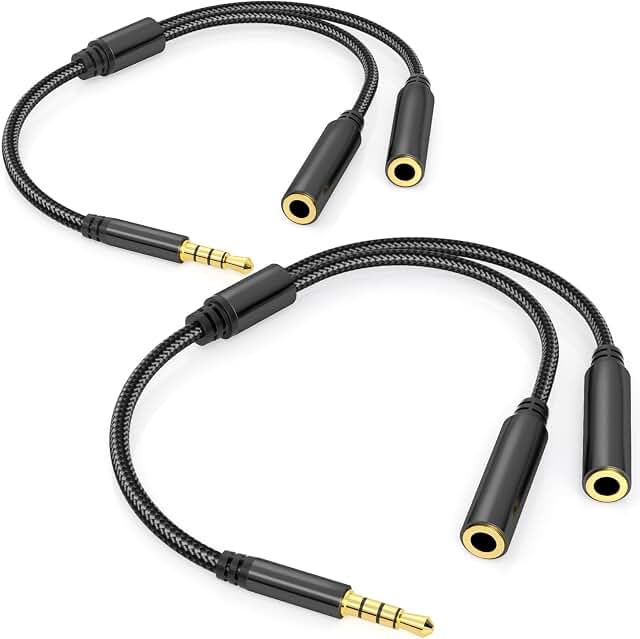
Best for: Buyers who want two splitter cables and need the product description to include support for both audio and microphone connections. The listing describes 1-foot cables with one 3.5 mm input and two outputs, intended for phones, tablets, laptops, PCs, and MP3 players.
Why it was selected: Unlike the stereo-only descriptions of some basic splitters, this product specifically identifies TRRS and dual support for audio and microphone. That makes it a relevant option when headset mic connections are part of the intended setup. The two-pack may also be useful when a spare cable is wanted.
Limitation: It is a passive Y-cord, not a battery-powered or amplifying device. The listing’s mic-support wording does not establish compatibility with every headset, device, or app. Check the connector requirements of both the source and headsets before relying on microphone functions.
Choose this if microphone support and a two-cable pack matter more than amplification. If you only need headphone audio and want the simplest cable, a stereo splitter may be sufficient.
SYNCWIRE 3.5 mm Nylon-Braided Splitter

Best for: Buyers who want a stereo headphone splitter cable with a nylon-braided exterior. The listing describes a 3.5 mm male connector to two female connectors and names Apple, Samsung, tablets, and other devices as intended device categories.
Why it was selected: The male-to-two-female layout makes it a straightforward choice for connecting two headphone plugs to one 3.5 mm source. The braided cable construction is a distinguishing listed feature for shoppers comparing cable designs.
Limitation: The listing explicitly says “No Mic.” This cable is therefore a poor choice if you need headset microphone functions. It is also a passive splitter, not a battery-powered audio booster; select it for sharing stereo audio rather than increasing output.
Choose SYNCWIRE when a simple audio-only Y cable and braided construction fit the task. If microphone support is essential, compare it with a splitter that explicitly lists TRRS or mic support instead.
Buying Guide: How to Choose a Headphone Splitter
Do you need battery power or just a second headphone connection?
Start by separating two different needs. A passive splitter cable divides an audio connection so more than one pair of headphones can be connected. It does not add a battery-powered amplifier. A powered headphone amplifier is designed to provide amplified output, but it needs its stated power source. In this selection, the Boostaroo is described with long battery life, while the LZSIG uses a 12V power adapter. The other options are cables.
If portability is essential, verify the exact battery requirements and output configuration in the product listing. Do not assume every device called a splitter runs on batteries. If you will use the setup near an outlet and need several outputs, an adapter-powered amplifier may be a better fit.
How many listeners need to connect?
Match the number of outputs to the number of listeners. The LZSIG is explicitly described as a four-channel, one-input, multi-output amplifier. The basic stereo and SYNCWIRE cables are described as two-way splitters. The TRRS option describes one input and two outputs. When output count is not clear in the available product details, confirm it before ordering rather than inferring it from the product name.
Also consider whether everyone will listen at the same time. A splitter intended for two headphone plugs may not serve a larger group, while a multi-channel amplifier is designed for more output connections.
Do you need microphone support?
For listening only, a stereo splitter may meet the need. For calls, gaming, recording, or voice chat, microphone support can be important. The TRRS splitter is described as supporting audio and microphone, while SYNCWIRE explicitly states that it has no mic. The other supplied descriptions do not establish microphone support, so check the current listing and device requirements instead of assuming.
TRRS describes a connector format commonly associated with combined audio and microphone connections, but devices and headsets can use different wiring arrangements. Confirm that the source and headset connections match the splitter’s intended use.
Which connector and cable details should you compare?
Check the source jack, headphone plugs, and any adapter needs. Several products here use 3.5 mm connections. The LZSIG lists both 1/4-inch and 1/8-inch TRS headphone outputs, which provides more than one output-jack size according to its description. Cable length also affects placement: the 3.5 mm stereo cable is listed at 20 cm, while the TRRS cable is listed at 1 foot.
Choose a length that works between the source and listeners without pulling on the connectors. A short cable can be convenient for nearby devices but may limit seating distance. Avoid assuming a connector will fit a device just because both are described as audio products; check the device’s physical port.
When is an amplifier a better choice than a passive splitter?
Choose an amplifier when the need includes increased audio output or a multi-channel arrangement. The Boostaroo listing specifically describes increased audio output, and the LZSIG is identified as a four-channel amplifier. Choose a passive cable when the source already provides suitable output and the goal is simply to connect two listeners.
A passive cable should not be treated as a volume booster. Also, the available product details do not establish how loud a particular headphone will sound with any device. Consider the source output, headphone requirements, and the amplifier’s stated connections before making a choice.
What should you verify before ordering?
- Confirm whether the product is battery powered, adapter powered, or passive.
- Check the number and size of input and output connectors.
- Look for explicit microphone support if a headset mic is required.
- Confirm whether the listed cable length suits your seating arrangement.
- For a powered product, verify the power supply details in the current product listing.
- Do not assume compatibility beyond the devices and connection types identified by the product information.
Frequently Asked Questions
Is every headphone splitter in this selection battery powered?
No. The Boostaroo is described as having long battery life. The LZSIG uses a 12V power adapter, and the other listed choices are passive splitter cables.
Which option is best for four headphone outputs?
The LZSIG is the product explicitly described as a four-channel, one-input, multi-output headphone amplifier. It uses a 12V power adapter rather than being identified as battery powered.
Which splitter lists microphone support?
The 3.5 mm TRRS splitter two-pack is described as supporting audio and microphone. SYNCWIRE explicitly states “No Mic,” and the supplied details for the other products do not confirm mic support.
Will a passive splitter make audio louder?
A passive splitter divides the audio connection; it is not described as an amplifier. For a product intended to increase audio output, consider an amplifier such as the Boostaroo or the adapter-powered LZSIG, after checking the required power and connections.
What is the difference between a stereo splitter and a TRRS splitter?
A stereo splitter is intended to share audio. A TRRS splitter may carry both audio and microphone signals when the product and connected devices support the required wiring. Confirm headset and device compatibility before relying on microphone functions.