
The best brass nut for a bass guitar is the one that matches your instrument’s nut dimensions, string spacing, and fingerboard curvature. The Metallor nut is best for a 43 mm nut slot, while the OVSAL standard nut and Guyker adjustable-height nut are options for 38 mm slots. The OVSAL roller nut adds adjustable height, and the River set includes two pre-slotted nuts. Measure your existing nut and compare every listed dimension before choosing a replacement.
| Product | Best For | Key Listed Dimensions |
|---|---|---|
| Metallor Pre-Slotted Brass Nut | A 43 mm nut slot | 43 × 9 × 6 mm; 34 mm string spacing |
| OVSAL Brass Bass Nut | A compact 38 mm replacement | 38 × 3 × 6.2 mm; 29.3 mm string spacing |
| OVSAL Adjustable Roller Nut | Players seeking adjustable nut height | 38 × 6 × 7 mm; 35.6 mm string spacing |
| Guyker Adjustable-Height Brass Nut | A 38 mm nut with height adjustment | 38 mm length; 3.5 mm thickness |
| River Two-Piece Brass Nut Set | Buyers who want a two-piece set | 42 × 3 mm; 5.6–4.5 mm height |
Metallor Pre-Slotted Brass Bass Nut
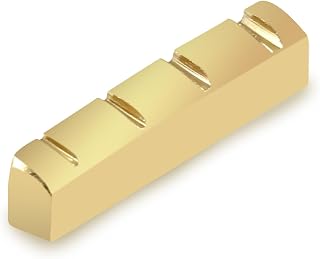
The Metallor replacement nut is a pre-slotted brass option sized for a wider 43 mm nut slot. Its listed measurements are 43 mm long, 9 mm wide, and 6 mm high, with 34 mm string spacing. It has a flat bottom and a satin-polished finish.
Best for: Bass owners whose existing nut measures close to the listed dimensions and whose instrument uses the stated string spacing. The pre-cut grooves are intended to simplify installation, although accurate fit still depends on the bass’s nut slot and setup.
The product description characterizes brass as strong and slippery and associates it with a bell-like tone. These are material and sound claims from the listing, not a guarantee that every bass will sound or play differently in the same way.
Check before buying: The 43 mm length and 34 mm string spacing are specific measurements. Avoid choosing this nut based only on the fact that the bass has four strings; verify the width, height, thickness, and slot shape too.
OVSAL 38 mm Brass Bass Nut
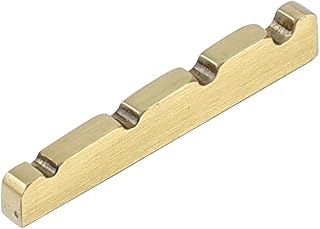
This OVSAL brass nut is listed as a replacement part for a four-string electric bass. It measures 38 mm long, 3 mm wide, and 6.2 mm high. The stated string spacing is 29.3 mm, and the listing gives a fingerboard curvature radius of 354 mm.
Best for: Buyers who need a compact 38 mm nut and have confirmed that the narrow 29.3 mm string spacing and listed curvature suit their instrument. Its straightforward brass construction makes it a simpler option than an adjustable roller design.
The measurements matter more than the general description “four-string bass.” String spacing affects how the strings sit across the fingerboard, while nut width and height affect whether the part fits the slot and supports the strings appropriately.
Check before buying: The 29.3 mm spacing is notably different from the 34 mm and 35.6 mm spacing listed for other products here. Do not assume this nut will match a bass simply because its overall length is 38 mm.
OVSAL Adjustable Brass Roller Nut

This OVSAL model combines a brass nut and base plate with four rollers. Its listed dimensions are 38 mm long, 6 mm wide, and 7 mm high, with 35.6 mm string spacing. The listing also specifies a 1 mm base plate and a 306 mm fingerboard curvature radius. The rollers have grooves in corresponding widths for strings one through four, and screws adjust nut height.
Best for: Players whose bass matches the listed dimensions and who want height adjustment at the nut. The roller construction and screw adjustment distinguish it from a fixed, pre-slotted brass replacement.
Adjustability can be useful when the specified design fits the instrument, but it does not remove the need to check the nut slot, string spacing, and radius. A roller nut is also a more involved design than a simple slotted nut.
Check before buying: Its 35.6 mm string spacing and 306 mm radius may not match a bass built around another layout. Confirm the base plate and overall height can work with the existing slot before ordering.
Guyker Adjustable-Height Brass Nut

The Guyker Nut-4BX is a solid brass replacement nut for four-string bass. The listing gives a length of 38 mm, a thickness of 3.5 mm, and a height of 4.8 mm. It describes the nut as adjustable in height and advises buyers to consult the parameter drawing shown with the product.
Best for: A buyer looking for a 38 mm brass nut with height adjustment, provided the dimensions in the product drawing match the bass. It offers another adjustable option to compare with the OVSAL roller nut, but the listed construction and measurements differ.
The product description says brass can improve sustain, clarity, tone, brightness, and tune-ability. These are claims in the listing; the result depends on the instrument and the completed fit and setup.
Check before buying: The supplied feature details do not specify string spacing or fingerboard radius. Review the parameter drawing and compare it with the existing nut before deciding that the 38 mm length alone is sufficient.
River Two-Piece Slotted Brass Nut Set

This River listing includes two pre-slotted brass nuts for four-string electric bass. Each nut is listed as 42 mm long and 3 mm wide, with a height that ranges from 5.6 mm to 4.5 mm. The product description says preset string grooves are included for installation.
Best for: Buyers who want two pieces in one set and whose bass calls for a 42 mm nut. The listed height variation is also useful to compare against the existing nut’s profile when checking whether the part can sit correctly in the slot.
The listing describes brass as durable and says the material provides sound clarity and ductility. It also says the design helps keep pitch stable; treat these as product claims rather than a substitute for proper fitting and setup.
Check before buying: The supplied features do not state the string spacing or fingerboard radius. Confirm those details and the exact slot fit before ordering, especially if the current nut has a different spacing pattern.
Buying Guide: How To Choose A Brass Bass Nut
A replacement nut needs to fit the instrument, not just match its number of strings or material. Brass is the shared material across these five options, but their lengths, thicknesses, heights, string spacing, and designs vary. Start by measuring the existing nut and slot, then compare those measurements with the product listing.
Which dimensions should you measure?
Record the nut’s length across the fingerboard, its front-to-back thickness, and its height. Also note the string spacing and the curvature of the fingerboard if that information is available. A nut can have the right length but still be a poor match if its grooves are too close together or its base does not sit correctly.
- Length: Compare the listed 38 mm, 42 mm, or 43 mm length with the existing nut.
- Thickness: Check whether the replacement’s width from front to back suits the slot.
- Height: Compare the full nut height and the height of the string grooves.
- String spacing: Look for an exact or suitably close match to the current layout.
- Radius: Compare the listed fingerboard curvature where the seller provides it.
Is a pre-slotted nut easier to install?
Pre-slotted grooves can reduce some of the work involved in positioning strings, but “pre-slotted” does not mean universally ready to install. Groove depth and width must suit the strings and the bass, and the nut still needs to fit the slot. If the part requires reshaping or adjustment, a qualified repair technician can help prevent fit or playability problems.
Should you choose a roller or fixed nut?
A fixed, pre-slotted nut has a simpler design. The Metallor, standard OVSAL, and River products are presented as slotted replacement nuts. The OVSAL roller model uses four rollers and screw-adjustable height. Choose an adjustable design only if its dimensions and construction suit the instrument and you want those adjustment features.
How should you compare string spacing?
Compare the distance between the outside string grooves, not only the nut’s total length. The products list spacing from 29.3 mm to 35.6 mm, with some listings providing no spacing figure. Those differences can affect string placement across the fingerboard. If spacing is not supplied, inspect the product’s measurement drawing or ask the seller to confirm it before ordering.
What does brass change?
These listings describe brass as durable and associate it with brightness, clarity, sustain, or a bell-like tone. Such descriptions are not a promise of a specific sound on every bass. The practical first requirement is a correct fit. Material preference should come after confirming the nut’s dimensions and the way the strings are positioned.
When should a technician install it?
Consider professional installation if the nut slot needs cutting, the replacement does not sit flat, or the string grooves need work. Incorrect nut height or groove placement can affect how a bass plays and how strings sit near the first fret. Replacing a nut is a fit-sensitive repair, so use the instrument’s measurements rather than relying on a broad model description.
Frequently Asked Questions
Will any four-string brass nut fit any four-string bass?
No. Four-string models can have different nut lengths, thicknesses, heights, string spacing, and fingerboard curvature. Match those measurements to the existing nut and slot before buying.
Which product listed here has the widest stated string spacing?
The OVSAL adjustable roller nut lists 35.6 mm string spacing. The Metallor nut lists 34 mm, and the standard OVSAL nut lists 29.3 mm. The Guyker and River feature details do not provide spacing measurements.
Which option has adjustable height?
The OVSAL roller nut and Guyker Nut-4BX are described as adjustable in height. The OVSAL model specifies adjustment by screws; check the Guyker product’s parameter drawing for its adjustment details.
Does a pre-slotted brass nut need no fitting?
Not necessarily. Pre-cut grooves may simplify installation, but the nut still has to match the slot, string layout, and instrument dimensions. The grooves or overall fit may require adjustment.
What should I do if I cannot find my bass’s nut measurements?
Measure the existing nut and string spacing, or ask a guitar technician to identify the required dimensions. Do not select a replacement based only on the bass having four strings or a similar-looking nut.