
The best budget stereo tube amp depends on your speakers and sources: the Fosi Audio MC331 is best for an all-in-one system, the Dayton Audio HTA100 suits buyers seeking a stated 50 watts RMS per channel, and the compact Douk Audio ST-01 PRO offers tone controls and digital inputs. The AIYIMA T9 is another flexible 2.0/2.1 option, while the Juson Audio JTA200 is better for buyers who want more inputs and outputs. Compare the listed features before choosing, especially whether you need speaker amplification, a DAC, or phono connectivity.
| Product | Best For | Notable Features |
|---|---|---|
| Fosi Audio MC331 | Multiple sources in one system | DAC, headphone output, Bluetooth, USB, optical, coaxial, and RCA |
| Dayton Audio HTA100 | Buyers comparing stated RMS output | 50 watts RMS per channel and phono input |
| Douk Audio ST-01 PRO | Compact setups with tone controls | USB drive playback, digital inputs, treble and bass controls |
| AIYIMA T9 | 2.0 or 2.1 speaker systems | Bluetooth, USB, coaxial, optical, RCA, and tone controls |
| Juson Audio JTA200 | Systems needing varied connections | Phono, coaxial, optical, Bluetooth, headphone, and subwoofer outputs |
Fosi Audio MC331 Integrated Tube Amplifier
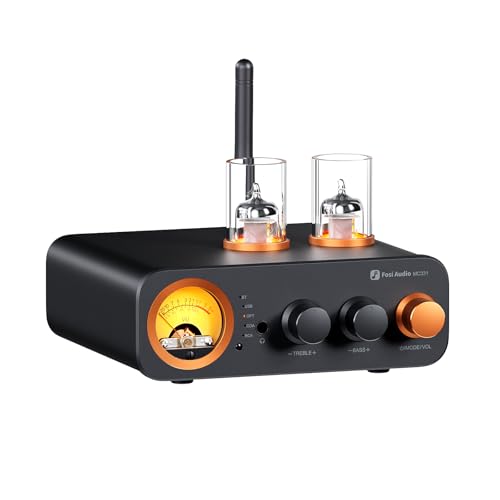
The Fosi Audio MC331 combines a DAC, amplifier, preamplifier, and headphone amplifier in one component. Its listed connections include Bluetooth, USB, coaxial, optical, and RCA, making it a strong choice for a system that switches between a computer, phone, CD player, or other listed sources. It also includes a remote for changing audio sources.
Best for: Buyers who want one compact component to handle several source types and both speakers and 3.5mm headphones. The built-in DAC and broad input selection are the main reasons to choose it over a simpler amp.
The vacuum tubes and VU meter provide a vintage visual style. The product listing describes the tube stage as adding warmth, but does not provide a power rating in the supplied details. Check the full specifications and speaker requirements before buying.
Limitation: The provided product information does not state its speaker output rating, so it is harder to compare its power directly with amps that list RMS output.
Dayton Audio HTA100 Hybrid Tube Amplifier

The Dayton Audio HTA100 is a hybrid stereo amplifier with a tube preamplifier section and a stated 50 watts RMS per channel. Its inputs include RCA, Bluetooth, USB DAC, and a phono preamp, so the listed connection options cover wireless playback, digital sources, and a record player.
Best for: Buyers who want a clear published RMS-per-channel figure and a phono input in the amplifier. It is also a practical option for listeners who want a tube preamp stage with modern connections rather than an entirely tube-based signal path.
The front-panel VU meters and exposed tubes give it a vintage-inspired appearance. The manufacturer describes the preamp as adding subtle warmth, while the hybrid design combines that tube section with the amplifier’s other circuitry.
Limitation: It may not be the best match if you specifically want a fully tube-powered amplifier. Confirm that the listed inputs and output specifications suit your speakers and source components.
Douk Audio ST-01 PRO Bluetooth Amplifier

The Douk Audio ST-01 PRO is a two-channel vacuum-tube amplifier with Bluetooth, USB DAC, coaxial, and optical inputs. The upgraded version also supports playback from a USB drive, according to the product details. Treble and bass knobs let listeners adjust tonal balance at the amplifier instead of relying only on source-device settings.
Best for: Buyers who want a compact-looking stereo component with both digital inputs and basic tone adjustment. The VU meter, illuminated tubes, and vintage styling make it a fit for people who value the amplifier’s appearance as well as its listed connections.
The product listing says the VU meter sensitivity can be adjusted to better match different input signals. This may be useful for matching meter movement to a source, though it is a display adjustment rather than a speaker-power specification.
Limitation: The supplied features do not state an RMS output rating. Compare the full product specifications with your speakers before choosing it based on the advertised 200W nameplate figure.
AIYIMA T9 Bluetooth Tube Amplifier

The AIYIMA T9 is listed as a 2.0/2.1 home audio receiver that combines a DAC, stereo amplifier, and preamp functions. Its inputs include Bluetooth, USB, coaxial, optical, and RCA. The product details also describe adjustable treble and bass controls and a replaceable-tube design.
Best for: Buyers building a stereo or 2.1-channel setup who want several connection options in one unit. Its listed support for passive bookshelf speakers and its combination of digital and analog inputs make it a flexible candidate for a small home or desktop system.
The VU meter adds a visual feature, while the tone controls let listeners adjust bass and treble. A turntable can be connected only if it has a phono preamp, according to the supplied product information.
Limitation: Do not treat the listed 200W output as a directly comparable RMS-per-channel figure; the provided details do not give an RMS rating. Check the complete specifications and speaker matching requirements.
Juson Audio JTA200 Hybrid Tube Amplifier
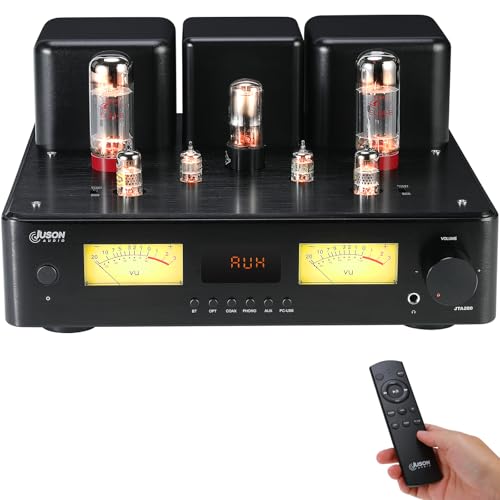
The Juson Audio JTA200 is a Class AB hybrid stereo amplifier with EL34 tubes and solid-state components. Its listed connections include AUX, coaxial, phono, optical, and Bluetooth 5.4. It also has headphone and subwoofer outputs, offering more connection choices than a basic speaker amplifier.
Best for: Buyers with a varied audio system who need a phono input, digital connections, wireless streaming, and separate headphone and subwoofer outputs. The listed 150 watts RMS per channel is a useful comparison point, but users should still verify speaker compatibility and the complete specifications.
The product details describe Bluetooth support and a remote for volume and source control. They also state that the remote does not include a battery, so a buyer should plan to supply one.
Limitation: Its many features and stated output may exceed what a simple, low-complexity budget setup needs. Compare its size, connections, and full specifications with more compact alternatives before selecting it.
Buying Guide: How To Choose A Budget Stereo Tube Amp
Do you need a power amp or a tube preamp?
A stereo power amplifier drives passive speakers. A preamp or phono preamp handles signal preparation and may not have the speaker-driving output needed for passive speakers. Check the product description carefully: a unit intended for active speakers or a headphone setup is not automatically a replacement for a speaker amplifier.
For a turntable, determine whether the amp has a phono input or whether the record player has a built-in phono preamp. The Dayton HTA100 and Juson JTA200 list phono connectivity. The AIYIMA T9 listing specifies a turntable with a phono preamp, so do not assume it accepts a raw phono signal directly.
Which inputs should you prioritize?
Choose inputs based on the devices you already own. Bluetooth is convenient for wireless playback; USB, optical, and coaxial inputs can connect compatible digital sources; RCA supports many analog components. A built-in DAC can reduce the number of separate boxes in a system. Verify the exact input requirements of each source before buying.
If you listen with headphones, check whether the amplifier has a headphone output and whether its details identify the connection type. The MC331 lists a 3.5mm headphone output. The JTA200 lists a headphone output, while the other products may require a separate headphone component depending on your setup.
How should you compare amplifier power?
Look for a clearly stated RMS output per channel and compare it with your speakers’ requirements. The Dayton HTA100 lists 50 watts RMS per channel, and the JTA200 lists 150 watts RMS per channel. Other listings include larger headline wattage figures without a corresponding RMS figure in the supplied details. Do not assume those numbers are directly comparable.
Speaker sensitivity, listening distance, room size, and desired volume also affect the power needed. When specifications are incomplete, consult the manufacturer’s full documentation rather than relying on a headline number alone.
What does “tube” or “hybrid” mean here?
These products combine tube components with other amplifier circuitry in different ways. A hybrid design uses tubes in part of the signal path alongside solid-state components. The supplied details identify the Dayton and Juson models as hybrid designs. Tube styling, illuminated valves, or a VU meter do not by themselves explain how much of the signal path is tube-based.
Are tone controls and VU meters essential?
Tone controls can adjust bass and treble without changing settings on a phone or computer. They are useful if you want direct tonal adjustment, but they are not required for every system. VU meters and exposed tubes are primarily visual features; choose them for the appearance or display behavior you prefer, not as proof of sound quality or power.
Frequently Asked Questions
Can a tube amplifier connect to a turntable?
Yes, if it has a suitable phono input or the turntable has a built-in phono preamp. Confirm the required connection before purchasing. The Dayton HTA100 and Juson JTA200 list phono connectivity.
Can I connect a phone to these amplifiers?
The listed models offer several possible connection methods, including Bluetooth or RCA, though the exact options vary by product. Check the individual input list and use a compatible cable or wireless connection.
Is a DAC included in every amp in this list?
No. The Fosi MC331 and AIYIMA T9 explicitly describe integrated DAC functions, and the Dayton and Douk listings include USB DAC features. Check the product details for the specific digital inputs and DAC functionality you need.
What is the difference between RMS watts and a headline wattage?
RMS output is a more useful stated power figure for comparison when the measurement conditions are provided. Headline wattage figures may not use the same measurement basis. Compare full specifications rather than assuming two wattage claims are equivalent.
Do I need a separate headphone amplifier?
Only if your chosen amplifier lacks a headphone output or does not meet your headphone needs. The Fosi MC331 lists a headphone amplifier and 3.5mm output. Check each product’s full specifications if headphone listening is a priority.