
A good cable for an acoustic-electric guitar should match the instrument’s output jack, provide a suitable connection to an amplifier or other audio gear, and offer enough length for your setup. These five 10-foot instrument cables have features such as right-angle plugs, shielding, or tangle-resistant jackets. The JSAUX is best for players who want a braided cable with an angled plug; Fender emphasizes flexibility and resistance to kinking; Amazon Basics offers a tweed jacket and right-angle connector.
| Cable | Best For | Notable Feature |
|---|---|---|
| JSAUX 10 ft | Braided-cable preference | Right-angle to straight TS plugs |
| New Bee 10 ft | Noise-conscious setups | Double shielding and two plug angles |
| Fender Professional 10 ft | Flexible everyday use | Anti-kink design |
| AA Audio Accessory 10 ft | Detailed conductor and shielding specs | 18-gauge conductor and dual-layer shielding |
| Amazon Basics 10 ft | Tweed-style jacket preference | Right-angle connector and OFC shielding |
JSAUX Guitar Cable 10 ft

The JSAUX cable is a 10-foot instrument cord with one right-angle connector and one straight connector. Its listed uses include electric guitar, mandolin, bass, amplifier, pedal, mixer, keyboard, and other audio equipment. The maker describes it as having oxygen-free copper and multiple insulating shields.
Best for: Acoustic-electric players who want a braided jacket and a right-angle plug at one end. The angled end may suit an instrument jack where a straight plug would stick out farther, while the straight end can connect to an amplifier or other device.
The nylon braid is described as tangle-resistant, and the cable includes a strap for wrapping it during storage. Choose this if cable organization and a mixed-angle plug layout matter to your setup.
Limitation: It is 10 feet long, so check that this reach is sufficient between your guitar and the connected equipment. Confirm that your guitar and destination accept the listed 1/4-inch TS connection.
New Bee Guitar Cable 10 ft

New Bee lists this as a 10-foot instrument cable with straight and right-angle 1/4-inch metal connectors. Its specifications include a 22 AWG oxygen-free copper center conductor, PVC insulation, and a high-density stranded copper double shield. The product is described as suitable for instruments, pedals, amplifiers, mixers, and other audio equipment.
Best for: Players who want two connector angles and shielding features specified in the product description. The right-angle end may be useful at an instrument or pedal jack where a low-profile connection is preferred; the straight end offers a conventional plug shape at the other end.
Choose this cable if its connector arrangement fits your guitar and signal chain. Its broad listed applications make it an option for players connecting an instrument to an amplifier or other compatible gear.
Limitation: The fixed 10-foot length may not suit a distant amplifier or a larger playing area. Measure the route before choosing it, and verify that your equipment uses a compatible 1/4-inch connection.
Fender Professional Instrument Cable
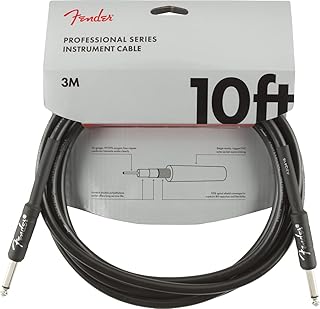
This 10-foot Fender instrument cable is described as designed to resist twisting, kinking, and retaining physical memory. Its listed construction includes resilient 95% oxygen-free spiral shielding, an 8 mm PVC jacket, a 22-gauge conductor, and nickel-plated connectors. The product description also identifies it for use as a guitar cord or amp cable with other instruments.
Best for: Acoustic-electric players who prioritize a flexible cable that is designed to resist kinks. This can be a practical choice for regular setup and pack-up, when a cable that coils and lays out more easily is desirable.
Choose this model if you prefer a straightforward 10-foot cable and value its stated shielding and jacket specifications. It is also a reasonable comparison point for cables that emphasize more specialized connector arrangements or braided outer jackets.
Limitation: The listed connector details do not specify a right-angle plug. If your guitar’s output jack is recessed or you need an angled connection, check the product listing and your instrument’s jack layout before buying.
AA Audio Accessory 10-Foot Cable

This cable’s listed specifications include an 18-gauge, 99.99% oxygen-free copper conductor, gold-plated 1/4-inch connectors, and dual-layer shielding made from aluminum foil and an OFC braided shield. The description identifies it for guitar, amplifier, and bass use and describes the PVC construction as anti-kink and reinforced with Kevlar.
Best for: Buyers who want detailed conductor and shielding specifications when comparing instrument cables. Its 10-foot length suits setups where that reach is adequate, and its listed 1/4-inch connectors are relevant to instruments and equipment with matching jacks.
Choose this if the stated materials and construction features are priorities. The gold-plated connectors and dual-layer shield distinguish it on paper from options that highlight a tweed or nylon-braided exterior.
Limitation: The product description does not specify whether either connector is right-angle. If plug orientation matters for your guitar, verify the connector shape before ordering.
Amazon Basics Tweed Guitar Cable

This 10-foot Amazon Basics instrument cable has a yellow-and-brown tweed cloth jacket and a right-angle connector. Its listed construction includes a 23 AWG oxygen-free copper center conductor, an OFC spiral shield, and a conductive PVC shield. The product is described for connecting an electric guitar, bass, or keyboard to an amplifier or PA system.
Best for: Players who want a right-angle plug and a visible tweed-style jacket. It is a simple option to compare with braided or standard PVC cables, particularly when the cable’s appearance and connector angle are part of the buying decision.
Choose this if the listed 10-foot length and right-angle connection match your setup. Its copper conductor and two listed shielding components provide specific construction details for comparison.
Limitation: The listing identifies a right-angle connector but does not state that both ends are angled. Check the product details if you need a particular plug orientation at each end.
Buying Guide: Choosing an Acoustic-Electric Guitar Cable
Which cable connection does an acoustic-electric guitar need?
Start by checking the output jack on your guitar and the input on the amplifier, PA system, pedal, or interface. These products are listed as instrument cables, and several specify 1/4-inch connectors. Match the cable to the actual jacks on both devices. Do not assume every acoustic-electric guitar uses the same output or that a cable with a 1/4-inch plug fits a different connection type.
A standard instrument cable is intended to carry an instrument signal to compatible audio equipment. If your setup uses a preamp, effects unit, or other device, check each connection in the signal path. The cable’s plug shape and connector size should fit without forcing or modifying the jack.
Should you choose a straight or right-angle plug?
A straight plug extends directly from the jack. A right-angle plug turns close to the connection point and may be preferable when a cable sticking straight out would be inconvenient. The JSAUX and New Bee listings specify one straight and one right-angle connector. Amazon Basics lists a right-angle connector, while the Fender and AA Audio Accessory descriptions do not specify an angled plug.
Consider the position of your guitar’s output jack, the cable’s route, and the equipment at the other end. If you need two angled plugs or two straight plugs, confirm the exact configuration in the listing rather than inferring it from a product image or general description.
How much cable length do you need?
All five options in this comparison are 10 feet long. That length can work for a compact practice or performance setup if the instrument and connected equipment are nearby. Measure the route the cable must follow, including space to move while playing. A cable that is only just long enough can pull against the guitar or equipment when the player changes position.
A longer cable may provide more freedom, but it can also leave more cable to manage. Because these choices are all 10 feet, select one only if that length fits your room, stage, or recording arrangement.
What shielding and conductor details matter?
Shielding helps limit unwanted interference picked up along a cable run. The product descriptions list different approaches: New Bee specifies a stranded copper double shield; Fender lists spiral shielding; Amazon Basics lists an OFC spiral shield and conductive PVC shield; and AA Audio Accessory specifies aluminum foil and braided shielding. JSAUX describes multiple insulating shields.
These specifications make the products easier to compare, but they do not establish a guaranteed noise level in every environment. Nearby electrical equipment, cable routing, instrument electronics, and other parts of the signal chain can affect noise. Keep the cable away from likely sources of interference where practical and assess the complete setup if unwanted noise persists.
Which outer jacket suits your routine?
Jacket design affects handling and storage. JSAUX describes a nylon-braided outer layer and includes a strap for wrapping the cable. Fender describes an anti-kink design and an 8 mm PVC jacket. AA Audio Accessory lists an anti-kink modified PVC construction with Kevlar reinforcement. Amazon Basics uses a tweed cloth jacket. New Bee lists PVC insulation and double shielding.
Choose based on the handling features you value and how you store the cable. A braided or tweed exterior may appeal to buyers who prefer those styles, while an anti-kink design may be useful for frequent setup and pack-up. Do not treat jacket appearance alone as proof of sound quality or service life.
How should you compare cables for low-noise use?
Compare the shielding information and conductor specifications, but keep the claims in perspective. New Bee lists a 22 AWG oxygen-free copper conductor and double shielding. Fender lists a 22-gauge conductor and 95% oxygen-free spiral shielding. Amazon Basics lists a 23 AWG OFC conductor with spiral and conductive PVC shielding. AA Audio Accessory lists an 18-gauge conductor and dual-layer shielding. JSAUX describes oxygen-free copper and multiple insulating shields.
These details can help narrow a shortlist, but the provided specifications do not offer a common test that proves one cable will sound quieter than another in your setup. If noise is a concern, also inspect the guitar, connectors, amplifier settings, and cable routing.
Frequently Asked Questions
Can I use an instrument cable with an acoustic-electric guitar?
Use a cable that matches the guitar’s output jack and the input on the connected equipment. These products are described as instrument cables for guitar and audio equipment, but check your instrument’s connection type before buying.
Is a 10-foot cable long enough for playing live?
It depends on the distance between your guitar and the connected equipment and how much room you need to move. Measure the cable route before purchase; all five options listed here are 10 feet long.
Does a right-angle connector improve the guitar’s sound?
The listed benefit is connector orientation, not a stated sound improvement. A right-angle plug may fit your setup better when a straight plug would extend awkwardly from the jack.
Which cable has a braided jacket?
JSAUX describes its cable as having a premium nylon-braided exterior. Amazon Basics lists a tweed cloth jacket, while other descriptions specify PVC or anti-kink construction.
Are all five cables suitable for connecting directly to an amplifier?
The product descriptions identify these as instrument cables and list guitar-to-amplifier use for several models. Check that the cable’s connector type matches the guitar output and amplifier input before connecting.
Can a guitar cable eliminate hum or crackle?
Some listings describe shielding or noise-reduction features, but a cable alone cannot guarantee that a complete setup will be free of hum or crackle. Noise can also come from the instrument, connected equipment, electrical environment, or cable routing.