
Best Car Battery Inverter for Road Trips and Outdoor Power
The best car battery inverter choices convert vehicle power into reliable 110V/120V AC for laptops, cameras, small appliances, and entertainment on the go. This guide highlights five top options that balance power, safety, and portability for drivers, campers, and field workers. Each pick suits a distinct scenario—from heavy-duty work sites to compact camping setups—so you can match your needs to the right inverter.
| Product | Continuous Power | Best For |
|---|---|---|
| OLTEANP 1000W | 1000W | Laptop-heavy trips, caravans, and general on-the-road use |
| Cantonape 3000W | 3000W | High-demand devices, multi-outlet power at campsites |
| ALEOPIX 1000W | 1000W | Worksites and mobile needs with robust cabling |
| Ampeak 750W | 750W | Essential devices with dual outlets and USBs |
| TWING 1000W | 750W (continuous) | Dual outlets with USB-C/PD for fast charging |
OLTEANP 1000W Power Inverter

Features include 1000W continuous DC to AC power with 2000W peak surge, converting 12V from a vehicle battery to 110V/120V AC. It supports laptops, small appliances, game consoles, TVs, routers, and more under 1000W. The unit is designed for car, truck, and camping use, making a vehicle battery a portable power source for road trips, camping, and remote job sites. Safety protections cover undervoltage, overvoltage, overload, short circuit, and overheating, with an automatic cooling fan for stable, quiet operation during extended use.
Best for: users needing a reliable 1000W inverter for laptops and everyday devices during travel or outdoor activities. Choose this if you want strong continuous power with comprehensive protections and a built-in display for quick monitoring.
Caution: The continuous 1000W rating means avoid running devices that briefly spike beyond 1000W to prevent triggering protections.
MOVFFGGRM 500W Peak 1000W Inverter
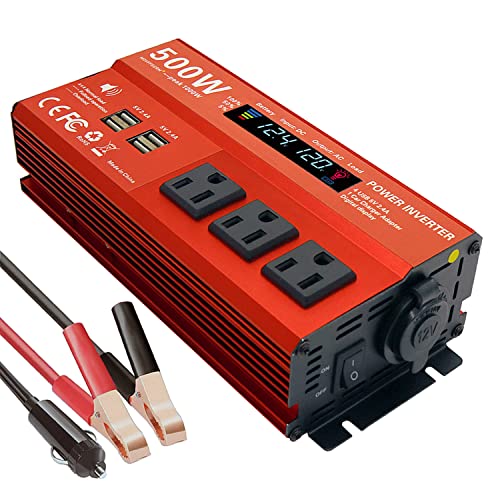
This inverter provides 500W continuous power with a 1000W peak, featuring three AC outlets and four USB 2.4A charging ports plus a cigarette lighter port. It emphasizes high efficiency (>90%) with an aluminum heat-dissipation body and a silent fan for quiet operation. Safety protections cover overheating, undervoltage, overvoltage, short circuits, and overloads. It’s well-suited for powering string lights, laptops, game consoles, and small devices on road trips or job sites.
Best for: users who need multiple USB charging options and more than one AC outlet for light-to-mid workloads. Choose this if you frequently power multiple USB devices at once and want a quiet cooling experience.
Caution: Modified sine wave output means some sensitive electronics may perform imperfectly compared to pure sine wave inverters.
TWING Car 1000W Inverter

TWING’s 1000W inverter provides dual 110V AC outlets plus two USB ports (including QC 3.0 and 30W PD3.0). It claims up to 750W continuous power and 1000W peak, with fast charging and a digital display. The unit includes a car cigarette lighter adapter, and a cooling system with a cooling fan to maintain performance. It’s designed as a portable solution for electronics, cameras, tablets, and portable devices during travel or camping.
Best for: travelers who want quick access to USB-C fast charging and dual AC outlets in a compact form. Choose this if you need reliable power for laptops and USB devices with straightforward operation.
Caution: Continuous power is lower than peak; avoid pushing heavy appliances near the 1000W peak for long periods.
ALEOPIX 1000W Inverter With 2 AC Outlets

ALEOPIX offers 12V DC to 110V/120V AC with 1000W continuous power and 2000W surge, plus 2 AC outlets and USB ports (36W USB-C and 18W USB-A). It emphasizes direct car battery connection for on-the-go power, with dual charging options for flexibility. The design prioritizes high copper core cables and efficiency (around 90%+), aiming for safer operation with robust protection and cooling.
Best for: users needing a strong, dual-outlet inverter with fast USB-C charging and a safe, copper-based build. Choose this if you want steady performance for laptops, cameras, and small appliances on the move.
Caution: Ensure battery cables and wiring are correctly installed to avoid voltage drops during high-load scenarios.
Buying Guide: Key Considerations For Car Inverter Buyers
Power needs: Determine your essential devices and their wattage. Choose an inverter with continuous power rating that comfortably exceeds your typical load, not just the peak surge.
Output type: Most inverters use modified sine wave; sensitive electronics may perform better with pure sine wave models. Consider this when powering audio equipment, medical devices, or precision electronics.
Outlets and ports: Count the number of AC outlets and USB ports you need. USB-C PD ports are increasingly valuable for fast laptop charging and mobile devices.
Protection features: Look for undervoltage/overvoltage, overload, short-circuit, and overheating protections. A cooling fan helps sustain performance on longer runs.
Connectivity and installation: Some models offer cigarette lighter connections; others require direct battery cables. Plan your installation to minimize voltage drop and ensure safe wiring.
Portability vs. capacity: Higher continuous power may mean larger, heavier units. Balance your need for mobility with your typical power draw.
Durability: For camping, construction sites, or heavy-road use, rugged housings and reliable cooling extend inverter life.
FAQ: Quick Answers For Buyers
- What wattage inverter do I need for a laptop? Most laptops draw 60-180W. A 300-500W inverter handles typical laptop setups safely, while 750-1000W covers larger devices and multiple peripherals.
- Is a pure sine wave inverter necessary? For sensitive electronics like advanced audio gear or medical devices, a pure sine wave is preferable; for basics, a modified sine wave often suffices.
- Can I run a refrigerator or heater from a car inverter? Small portable fridges may run on 1000W or less; heaters typically exceed inverter capacity and are not recommended for mobile setups.
- How should I connect an inverter to my car battery? Use proper gauge battery cables and follow the manufacturer’s grounding and safety instructions. Avoid daisy-chaining batteries or overloading outlets.
- What safety protections should I look for? Overload, short-circuit, under/over-voltage, and overheating protections, plus a reliable cooling system, are essential for safe operation.
- Do higher wattage mean better performance? Not always. Choose based on your typical load, peak demands, and portability preferences.