
Best Car Power Inverter Options for on-the-Go Power Needs
Looking for a reliable car power inverter to charge laptops, phones, or small appliances while you’re on the road? This guide highlights five top options that balance power, safety, and portability for everyday driving, road trips, and camping. Each choice is explained with who it’s best for, why it stands out, and any limitations to watch. Whether you need USB-C PD charging, multiple outlets, or compact “phone-sized” designs, these inverters offer practical solutions for different mobile lifestyles.
Buying quick reference
- PiSFAU 200W Car Power Inverter — Best for compact setups needing multiple USB ports and dual outlets.
- BESTEK Power Inverter 300W — Best for larger devices and longer trips; strong peak power and dual AC outlets.
- Ampeak 150W Car Power Inverter — Best for basic charging and compact use with solid USB ports.
- PiSFAU 150W Inverter — Best budget-friendly option with essential dual USB and AC outlets.
- ALLWEI 200W Car Power Inverter — Best all-in-one with USB-C PD and six-in-one design for versatility.
PiSFAU 200W Car Power Inverter – Dual Outlets And USB Ports

This inverter converts 12V DC to 110V AC, offering two U.S. standard outlets and four USB ports. It is suited for charging laptops, tablets, phones, and small lighting accessories on road trips or camping. The design emphasizes quiet operation and efficient heat dissipation, helping reduce noise and energy use. The compact, cellphone-sized form makes it easy to carry in a glove box or backpack for quick access.
Best for: travelers who need multiple charging options in a compact unit and frequently power small electronics. Caution: Verify that connected devices stay within the total 200W continuous limit to avoid overload.
BESTEK Power Inverter DC 12-17V to AC 110V – 300W

Bestek offers a power inverter with 300 watts continuous power and 700 watts peak, plus two AC outlets and two USB ports. Its design is aimed at larger devices such as laptops and tablets, making it suitable for longer trips or camping where multiple gadgets require charging. The unit uses a cigarette lighter plug and emphasizes compact, lightweight portability.
Best for: users who need higher sustained power for laptops or cameras during extended drives. Caution: Check vehicle electrical limits and ensure the 12V source can safely support the total load.
Ampeak 150W Car Power Inverter – 12V DC to 120V AC

Ampeak’s 150W inverter provides essential charging through two USB ports and a 120V AC outlet. It’s described as offering 11-layer protection for safety, focusing on reliable power for standard car devices, lighting, and small electronics. The compact form factor makes it easy to store and deploy on trips or in RVs and trucks.
Best for: drivers needing a compact, straightforward inverter for essential USB charging and occasional laptop or small device use. Caution: The 150W limit may be too low for higher-watt laptops or power-hungry appliances.
PiSFAU 150W Power Inverter – 2 USB Ports And 1 AC Outlet

This 150W inverter provides two USB ports and a single AC outlet, with a double-protection mechanism including a built-in fuse and smart chip. It’s positioned as a budget-friendly option for charging important devices during commutes, road trips, or camping. The built-in protections contribute to safer operation for everyday car electronics.
Best for: buyers seeking an affordable, light-duty inverter for phones, tablets, lights, and small peripherals. Caution: Limited continuous wattage means avoid using power-hungry devices simultaneously.
ALLWEI 200W Car Power Inverter – USB-C PD And More
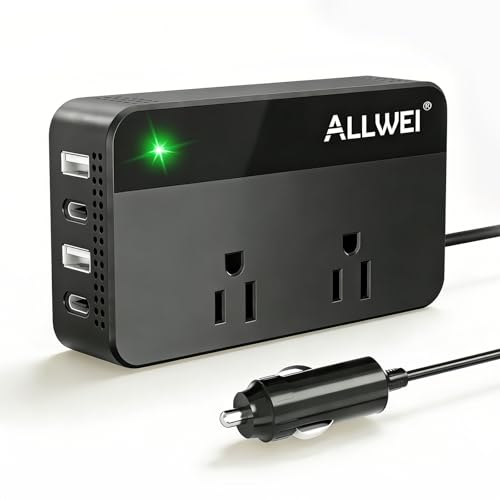
ALLWEI combines a 200W continuous power rating with a 6-in-1 socket design, including two AC outlets and four USB ports (PD 18W support on USB-C). The device is marketed as suitable for laptops, cameras, small TVs, and other portable electronics. It emphasizes safety protections (over-voltage, under-voltage, overload, overheat, short circuit, and overcharge) and a built-in 15A fuse for added protection. The device is designed for everyday car use while supporting modern USB-C fast charging.
Best for: users who want USB-C PD charging and a robust mix of outlets in one compact unit. Caution: Ensure your total draw remains under 200W for stable operation.
Buying Guide
What power level do you need?
Consider continuous wattage ratings (how much power the inverter can safely supply over time) versus peak wattage (the surge power for startups). Choose a model that supports your heaviest device’s wattage with room to spare to avoid tripping a fuse or overheating.
Outlets and charging options
Match your devices to the available outlets. If you rely on laptops or tablets, prioritize higher wattage and USB-C PD ports. If you mainly charge phones, USB ports and USB-C PD are key, along with at least one AC outlet for compatibility.
Safety protections
Look for smart protection features: over-voltage, under-voltage, overload, short circuit, overheat, and auto-shutoff. A built-in fuse adds an extra layer of safety against faults in the vehicle’s electrical system.
Portability and design
For travel, a compact, lightweight inverter is easier to store and access. If you frequently use the inverter on camping trips or in RVs, consider models with LED indicators or displays for real-time status and error codes.
Vehicle compatibility and setup
Most car inverters plug into the cigarette lighter or 12V port. Verify your vehicle’s socket rating and ensure the total inverter draw does not exceed what your car electrical system can safely supply. Some SUVs and trucks can handle higher loads; smaller cars may require care with heavier devices.
Usage scenarios to consider
- Work trips requiring power for laptops and devices during long drives.
- Road trips with multiple passengers charging phones, tablets, and cameras.
- Camping or emergency kits needing reliable USB-C PD charging and essential outlets.
Summary comparison
| Product | Best For | Key Perks | Limitations |
|---|---|---|---|
| PiSFAU 200W | Compact, multi-port charging | Dual outlets, four USB ports, compact | Total 200W limit |
| BESTEK 300W | Higher power for laptops | Two AC outlets, 2 USB ports, high peak | Bulkier |
| Ampeak 150W | Basic daily use | Two USB ports, one AC outlet, solid safety | Lower wattage |
| PiSFAU 150W | Budget-conscious charging | Two USB, one AC | Limited continuous power |
| ALLWEI 200W | USB-C PD and versatility | PD 18W, six-in-one design | Need careful load management |
FAQ
- Q: Can I power a laptop with these inverters? A: Yes, several models offer 110V outlets suitable for laptops, but verify the laptop wattage and the inverter’s continuous power rating.
- Q: Do these require any special installation? A: Most plug into the car’s 12V socket; no professional installation is typically needed.
- Q: Are USB-C PD ports worth it for car charging? A: USB-C PD charges compatible devices faster and can support modern phones and laptops efficiently.
- Q: What safety features should I expect? A: Look for over-voltage, under-voltage, overload, short circuit, and overheat protections, plus a built-in fuse.
- Q: How do I avoid overloading my inverter? A: Add up the wattage of connected devices and stay well below the continuous rating; avoid running several high-wattage devices at once.
- Q: Which inverter is best for road trips? A: It depends on device needs; for multiple USB ports and a balance of outlets, models like ALLWEI or PiSFAU with multi-port options are strong candidates.