
The best car DC-to-AC converter for a laptop depends on the laptop charger’s wattage and how many other devices you need to power. The Pro Chaser 400W model is best for buyers who want more AC capacity and multiple ports; the compact FOVAL and PiSFAU 150W models suit lighter laptop-charging needs. The PiSFAU 200W adds more USB ports, while the 3000W EGSCATEE is intended for broader battery-powered setups rather than a laptop alone.
| Product | Best For | Listed Continuous AC Output |
|---|---|---|
| Pro Chaser 400W | More AC capacity and two outlets | 400W |
| PiSFAU 150W | Basic laptop charging with protection features | 150W |
| PiSFAU 200W | Several USB devices plus AC devices | 200W |
| EGSCATEE 3000W | Direct-to-battery and larger power setups | 3000W |
| FOVAL 150W | Compact travel charging | 150W |
Pro Chaser 400W Vehicle Power Inverter

The Pro Chaser provides 400 watts of continuous DC-to-AC power and a listed peak output of 800 watts. It has two 110V AC sockets and two USB ports. The product description identifies laptops among devices its AC outlets can handle, alongside other devices in the 300W–400W range.
Best for: Travelers who want more listed AC capacity than a 150W adapter and may need to plug in more than one AC device. Its two AC outlets and two USB ports also allow separate USB charging.
Why it stands out: The 30-inch cord gives the unit additional placement flexibility, and its compact, cellphone-sized design is described as portable for travel and everyday use.
Consider: Check the laptop charger’s input requirements and leave room below the inverter’s continuous rating for any other connected equipment. The listed peak output is not the continuous rating.
PiSFAU 150W Inverter With Fault Protection
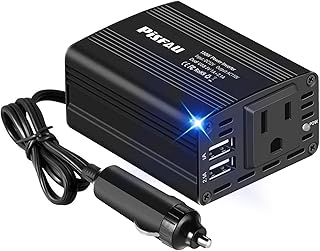
This PiSFAU model is rated for 150 watts of continuous output and 300 watts of peak power. It includes AC outlets for devices such as laptops and tablets, plus two USB charging ports. The description also lists a smart chip and built-in fuse as parts of its double-protection mechanism.
Best for: Someone whose laptop charger’s requirements fit within the inverter’s continuous output and who wants a relatively simple vehicle adapter with USB ports. The automatic shutoff and red fault indicator are useful listed features for identifying a detected fault.
Why it stands out: It pairs a modest continuous rating with a stated protective shutoff function, making it a practical option for basic charging rather than powering a collection of high-demand equipment.
Consider: A 150W continuous rating may not suit every laptop or simultaneous AC load. Confirm the charger’s wattage before choosing it, and do not treat the 300W peak figure as a sustained operating rating.
PiSFAU 200W Inverter With Four USB Ports
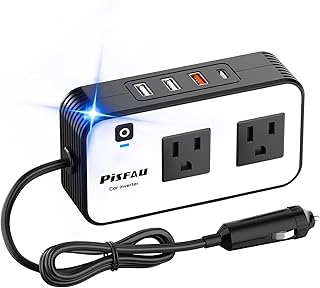
This 12V-to-110V model has two U.S.-standard AC outlets and four USB charging ports. Its listed features emphasize laptop, tablet, and phone charging, as well as a compact form measuring 2.7 by 1.4 by 5 inches. The product description also cites an efficient circuit design and heat-dissipation technology intended to reduce energy consumption and operating noise.
Best for: Drivers who want several USB charging connections alongside AC outlets, especially when multiple passengers have phones or other USB-powered devices. The 200W continuous rating offers more stated AC capacity than the 150W models in this selection.
Why it stands out: Four USB ports distinguish it from the other compact options here, while its small stated dimensions make storage easier in a vehicle.
Consider: The supplied features do not state a peak wattage or the individual output limits for the USB ports. Check the laptop charger’s wattage and the requirements of other connected devices before using multiple outlets at once.
EGSCATEE 3000W Direct-Battery Inverter

The EGSCATEE is rated for 3000 watts of continuous output, with a stated 6000W peak. It converts 12V DC to 110V/120V AC and includes two AC outlets, a 3.1A USB port, and an LCD display. The product description specifies direct-to-battery connection and lists common 12V battery types including LiFePO₄, AGM, GEL, and lead-acid.
Best for: Buyers building a broader RV, truck, van, off-grid, or emergency power setup who also need AC power for a laptop. Its high output rating is far beyond what many laptop-only buyers need.
Why it stands out: The listed five-layer protection covers under- and over-voltage, overload, overheating, and short circuits. The direct-battery design is intended for larger power setups rather than a small plug-in adapter.
Consider: This is not the compact cigarette-lighter-style choice among the products listed. Follow the product’s battery-connection instructions, and avoid selecting a high-capacity inverter solely for a laptop without considering installation and power needs.
FOVAL 150W Compact Laptop Inverter

The FOVAL is a 150W continuous inverter that plugs into a car cigarette lighter, according to its product description. It has one AC outlet and two USB ports with a combined maximum output of 3.1A. Its stated dimensions are 3.2 by 2.5 by 1.5 inches, and the description calls it credit-card-sized and lightweight.
Best for: Laptop owners who prioritize a compact unit for road trips, work, or storage and whose charger fits within the 150W continuous rating. The one AC outlet is suitable when the main goal is powering a single laptop charger.
Why it stands out: It combines an AC outlet with two USB connections in a small format, and the description identifies an aluminum shell design.
Consider: Its 150W rating is lower than the Pro Chaser and PiSFAU 200W options. Avoid this model if your laptop charger or combined AC load exceeds its continuous output.
Buying Guide: How To Choose A Car Inverter For A Laptop
How many watts does your laptop need?
Start by checking the label on the laptop’s AC adapter or the manufacturer’s specifications for its power requirements. Compare that figure with the inverter’s continuous output rating, not only its peak or surge rating. The continuous rating describes the output available for ongoing use; peak ratings refer to a higher short-duration figure as stated by the product listing.
For example, the two 150W options are the lowest-capacity choices in this group. The PiSFAU 200W offers a higher continuous rating, and the Pro Chaser is rated at 400W. Those numbers help narrow the selection, but they do not confirm compatibility with every laptop. Check the actual adapter requirements before buying.
Do you need only an AC outlet, or USB ports too?
A laptop that charges through its standard AC adapter needs an inverter with an AC outlet. USB ports can charge phones, tablets, and other USB-compatible devices, but they do not replace an AC outlet for a laptop charger unless the laptop and charging equipment specifically support USB charging.
For multiple USB devices, the PiSFAU 200W lists four USB ports. The Pro Chaser has two USB ports and two AC sockets, while the FOVAL has two USB ports and one AC outlet. The product information for the PiSFAU 150W confirms two USB ports but does not specify their combined output in the supplied features.
Should you choose a compact plug-in unit or a battery-connected model?
The FOVAL is explicitly described as plugging into a car cigarette lighter, and the 150W PiSFAU and compact 200W PiSFAU are presented as car plug adapters. This format is convenient for modest charging needs, but check the vehicle and inverter instructions for appropriate use.
The EGSCATEE is described as a direct-to-battery inverter for vehicles and larger setups. Its much higher output and battery connection make it a different category of choice. Consider it when you need broader AC power in a van, RV, truck, or off-grid arrangement—not simply because its headline wattage is largest.
How many devices will run at the same time?
Add up the power needs of devices that may operate simultaneously, then compare the total with the inverter’s continuous output. A laptop plus another AC appliance can require more capacity than the laptop alone. The Pro Chaser is the only product here with two AC sockets and a stated 400W continuous rating; the PiSFAU 200W also has two AC outlets but a lower listed rating.
Port count does not mean every port can deliver its maximum output at once. Review the product instructions for total-output limits, USB specifications, and any operating restrictions that apply to simultaneous charging.
What other specifications should you check?
- Input and output voltage: The products listed are designed around 12V DC input and provide AC output described as 110V or 110V/120V. Confirm that the inverter’s output suits the laptop adapter and intended use.
- Protection features: The PiSFAU 150W lists automatic fault shutoff and a red indicator. The EGSCATEE lists protection for voltage conditions, overload, overheating, and short circuits. Compare stated features rather than assuming all models offer identical safeguards.
- Size and cable arrangement: Compact dimensions may matter for storage and passenger-space access. The Pro Chaser lists a 30-inch cord, while the FOVAL and PiSFAU 200W list compact sizes.
- Use setting: A small vehicle adapter is aimed at portable charging. A direct-to-battery model calls for more consideration of installation and the complete power setup.
Frequently Asked Questions
Can a car inverter charge a laptop?
Yes. A car inverter converts vehicle DC power into AC power for a laptop’s AC adapter. Choose a model whose continuous output meets the adapter’s requirements and follow the inverter and vehicle instructions.
Is a 150W inverter enough for a laptop?
It depends on the laptop charger’s stated power requirements and any other devices running at the same time. A 150W model is appropriate only when the total demand stays within its continuous rating.
Should I compare peak watts or continuous watts?
Use continuous watts as the primary comparison for sustained laptop charging. Peak output is not the same as a continuous operating rating.
Can I charge a laptop and phone at the same time?
These products combine AC outlets with USB ports, so they are designed to support different charging connections. Check the inverter’s total output and port-specific limits, then ensure the combined load stays within its stated capacity.
Which listed inverter has the most USB ports?
The PiSFAU 200W model lists four USB charging ports. The Pro Chaser, PiSFAU 150W, and FOVAL each list two, while the EGSCATEE lists one 3.1A USB port.
Is the 3000W inverter the best choice for a laptop?
Not necessarily. Its 3000W continuous rating is intended for larger power setups, and its product description specifies direct battery connection. For laptop-only charging, compare compact options against the laptop’s actual power requirement and intended vehicle use.