
The best car stereo equalizer amplifier depends on whether you need simple tone adjustment, multiple amplifier outputs, or detailed digital signal processing. The Skar Audio SKA7EQ is best for a multi-output preamp setup, while the Stetsom EQX764 suits systems needing several inputs and high-voltage outputs. For detailed crossover and time-alignment control, the Taramps PRO 2.4S is the more feature-rich choice. These devices shape and route audio signals; check your system’s input and output requirements before buying.
| Product | Best For | Key Distinction |
|---|---|---|
| Skar Audio SKA7EQ | Multiple RCA outputs | Seven bands, three output pairs |
| Stetsom EQX764 | Multi-source, multi-amplifier systems | Four inputs, six outputs, up to 10 VRMS |
| Taramps PRO 2.4S | Advanced system tuning | Digital crossover, delay, and limiter |
| CT Sounds CT-7EQ | Basic seven-band adjustment | Half-DIN format and 20 Hz–20 kHz coverage |
| Taramps TEQ 7.4 | Stereo RCA installations | Main and auxiliary inputs with front, rear, and sub outputs |
Skar Audio SKA7EQ
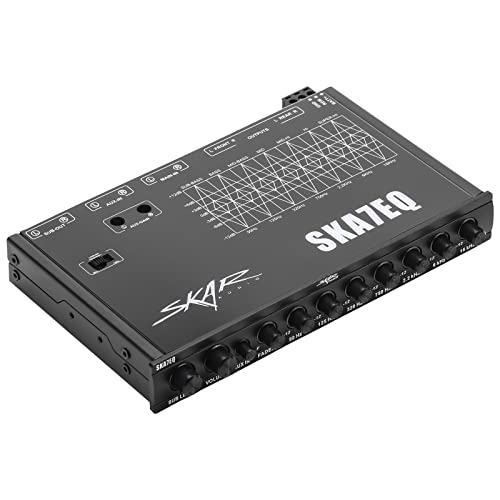
The Skar Audio SKA7EQ is a 1/2-DIN, seven-band preamp equalizer designed for systems that need separate front, rear, and subwoofer outputs. Its three output groups make it easier to route the processed signal to different amplifier sections. The product lists a maximum output voltage of 7 volts and gold-plated RCA outputs.
It has two selectable RCA inputs: a main input and an auxiliary input with variable gain. Its subwoofer level control is located on the front of the unit, so users can adjust sub level without changing the equalizer’s other band settings.
- Best for: Installations using front, rear, and subwoofer amplifier channels.
- Why it stands out: It combines seven-band adjustment, auxiliary input gain, and dedicated output routing.
- Consideration: It uses RCA connections, so check that the rest of the signal chain supports the required connection type.
Choose this model if you want a conventional preamp equalizer with several RCA output groups. It is less suited to buyers specifically seeking digital delay alignment or advanced crossover processing, which are not listed among its features.
Stetsom EQX764

The Stetsom EQX764 is a strong option for a car audio system with multiple sources and amplifiers. It lists four input channels and six output channels, giving it more routing capacity than a basic stereo equalizer. Its outputs can reach up to 10 VRMS, and the manufacturer describes the unit as a line driver that supplies more signal voltage to amplifiers.
The seven equalization bands are centered at 50 Hz, 125 Hz, 315 Hz, 750 Hz, 2.2 kHz, 6 kHz, and 16 kHz. Each band has a stated adjustment range of 12 dB. This range lets a listener make changes across bass, midrange, and treble frequencies rather than relying on a single bass or treble control.
- Best for: Systems that need several source inputs and outputs for multiple amplifiers.
- Why it stands out: Four inputs, six outputs, seven bands, and high-voltage output are listed features.
- Consideration: Confirm the system’s input and output layout before choosing a unit with this many connections.
Choose the EQX764 if routing flexibility and output voltage are priorities. It may be more equipment than needed for a simple system with one source and a small number of amplifier channels.
Taramps PRO 2.4S DSP Equalizer

The Taramps PRO 2.4S is a digital signal processor for buyers who want more than broad graphic EQ adjustments. Its listed features include a 15-band graphic equalizer, parametric EQ, active crossover, delay alignment, and a limiter. These tools can support more detailed tuning of a multi-speaker setup, including frequency distribution and timing adjustments.
RCA and high-level inputs are listed, offering two ways to bring an audio signal into the processor. The product also specifies high-pass and low-pass filters, multiple crossover slopes, and routing options. That feature set makes it the most processing-focused pick in this group.
- Best for: Drivers building a system that needs detailed signal processing and speaker-specific tuning.
- Why it stands out: It combines parametric EQ, crossover functions, delay alignment, and limiting in one processor.
- Consideration: Its many adjustment options may be unnecessary if you only want straightforward tone controls.
Choose this model when crossover and delay settings matter as much as equalization. Buyers should review the system’s channel needs and plan for the additional setup involved in configuring a DSP.
CT Sounds CT-7EQ
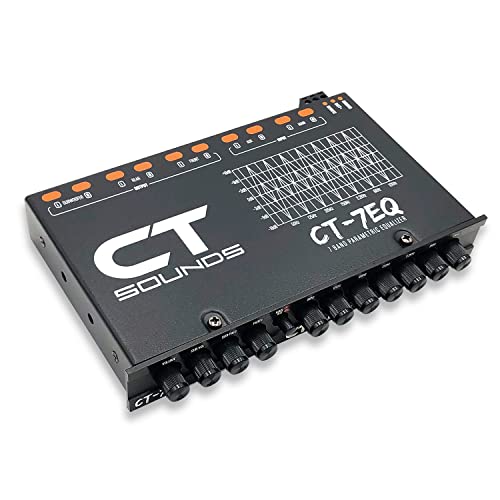
The CT Sounds CT-7EQ is a 1/2-DIN, seven-band equalizer for buyers seeking frequency adjustment in a compact format. Its listed range spans 20 Hz to 20 kHz, covering low bass through high treble. The specified band frequencies include 50 Hz, 125 Hz, 315 Hz, 750 Hz, 2.2 kHz, and 12 kHz.
The product description calls the unit a parametric car audio equalizer and says it is designed to divide and enhance frequency segments. The listed details do not specify the number of RCA inputs or outputs, so buyers should verify the connection layout before planning an installation around multiple amplifiers.
- Best for: Buyers who want seven frequency adjustment points in a half-DIN unit.
- Why it stands out: Its stated frequency coverage runs from 20 Hz to 20 kHz.
- Consideration: The provided feature information does not detail its input and output configuration.
Choose the CT-7EQ if its form factor and band coverage fit your needs. If routing flexibility is a deciding factor, compare its connection details with models that explicitly list multiple inputs and outputs.
Taramps TEQ 7.4

The Taramps TEQ 7.4 is a stereo graphic equalizer with two RCA inputs and three RCA output groups: front, rear, and subwoofer. Its main and auxiliary inputs provide a way to connect two stereo sources, and the auxiliary input has a gain adjustment. The product also lists fader control.
Seven adjustment bands cover frequencies from 50 Hz to 12 kHz, with gain adjustment from -12 dB to +12 dB. The specified frequency response is 6 Hz to 55 kHz, and the listed signal-to-noise ratio is greater than 100 dB. These published specifications may help buyers compare it with other stereo preamp equalizers.
- Best for: Stereo RCA systems needing front, rear, and subwoofer outputs.
- Why it stands out: It combines two source inputs, three output groups, auxiliary gain, and fader control.
- Consideration: It is a seven-band stereo equalizer, not the DSP-focused choice for delay alignment or parametric processing.
Choose the TEQ 7.4 if you want clearly specified RCA routing and front-panel sound adjustments. For a system needing more extensive crossover or timing control, consider a digital processor instead.
Buying Guide: How To Choose A Car Stereo Equalizer Amplifier
Do you need an equalizer, a DSP, or an amplifier?
These terms describe different functions. An equalizer adjusts the level of selected frequency ranges. A preamp equalizer also routes a signal toward an amplifier. A DSP can add tools such as crossovers, delay alignment, and limiting. An amplifier supplies power to speakers or subwoofers; the products listed here are presented primarily as equalizers, preamps, or signal processors, not as speaker-power amplifiers.
Start by identifying the job you need the device to do. For tone shaping and signal routing, a graphic equalizer may be sufficient. For precise speaker tuning and frequency separation, a DSP with crossover and delay features can be a better match.
How many inputs and outputs does your system need?
Count the sources that will feed the unit and the amplifier channels or groups that need a signal. The Stetsom EQX764 lists four inputs and six outputs. The Skar Audio SKA7EQ lists main and auxiliary inputs plus front, rear, and subwoofer RCA outputs. The Taramps TEQ 7.4 specifies two stereo inputs and three stereo output groups.
Do not assume that products with similar names have the same connections. Check whether your source and downstream equipment use RCA or high-level connections. The Taramps PRO 2.4S explicitly lists both RCA and high-level inputs, while the other models should be assessed against their stated connection details.
How many equalizer bands are useful?
More bands provide more frequency adjustment points, but they do not automatically guarantee better sound. A seven-band graphic EQ offers broad control over several parts of the audible spectrum. A 15-band graphic EQ and parametric EQ, as listed for the PRO 2.4S, provide more extensive adjustment choices for users who need detailed tuning.
Look at the frequencies each band covers, not only the band count. The Stetsom EQX764 lists seven specific centers from 50 Hz to 16 kHz. The CT Sounds CT-7EQ states overall coverage from 20 Hz to 20 kHz. These specifications describe different aspects of equalization, so compare the individual band centers when precise adjustments matter.
Should you prioritize output voltage?
Output voltage is one factor when matching a preamp or line driver to an amplifier. The Skar Audio SKA7EQ lists a maximum output voltage of 7 volts, while the Stetsom EQX764 specifies outputs up to 10 VRMS. Compare those figures with the input requirements of your amplifier and the rest of the signal chain. A higher listed output figure alone does not determine which unit is right for every installation.
What controls matter for a subwoofer setup?
Look for a dedicated subwoofer output and any controls you expect to use regularly. The Skar Audio model lists variable subwoofer level control. The Taramps TEQ 7.4 has a dedicated subwoofer output. The Lnrueg model in the supplied product list specifies subwoofer volume and frequency adjustments from 30 Hz to 120 Hz, while the Planet Audio PEQ10 lists a variable subwoofer filter from 45 Hz to 180 Hz.
Subwoofer controls differ by model. Check whether the listed feature changes output level, crossover frequency, or both. Do not treat a subwoofer output as proof that a device includes every filter or adjustment your system needs.
How should you compare installation and setup needs?
Check the product’s dimensions and mounting format against the available space in your vehicle. Two models in this selection are explicitly identified as 1/2-DIN units. Also plan the signal path before installation: source to equalizer or DSP, then to the appropriate amplifier inputs. The exact wiring and mounting requirements depend on the vehicle and equipment, so use the product documentation and consult an installer when needed.
Finally, balance feature depth against ease of use. A simple seven-band equalizer may be easier to operate for everyday adjustments. A DSP can offer more control, but that control is most useful when you are prepared to configure its crossover, routing, and delay options.
Frequently Asked Questions
Does a car equalizer amplifier increase speaker power?
Not necessarily. An equalizer changes or routes the audio signal. An amplifier provides power to speakers. Some equalizers describe themselves as preamps or line drivers and may provide higher-voltage outputs, but that is not the same as supplying speaker-level power.
Can I connect an equalizer to a factory stereo?
It depends on the equalizer’s input type and the stereo’s output. The Taramps PRO 2.4S lists both RCA and high-level inputs. For other models, confirm the stated input connections and check that they match the signal available from your stereo.
Is a seven-band equalizer enough for a car audio system?
A seven-band equalizer can provide broad adjustments across bass, midrange, and treble. It may suit listeners who want straightforward tone shaping. A DSP with more bands, parametric EQ, crossover settings, and delay alignment is better suited to detailed system tuning.
What is the benefit of front, rear, and subwoofer outputs?
Separate output groups let the equalizer route signals to front speakers, rear speakers, and a subwoofer amplifier. This layout can simplify signal distribution in a multi-channel system. The exact functions available for each output vary by product.
Should I choose the equalizer with the most bands?
Choose based on the control and connections your system needs, not band count alone. Input type, output count, crossover features, subwoofer controls, and setup complexity also matter. A unit with more adjustment options may be unnecessary for a basic stereo installation.