
The TEAC W-1200B is the clearest fit if you need a dedicated cassette deck with documented pitch adjustment: its listed features include 12% pitch control, dual decks, recording, and USB output. The Jensen system also advertises pitch control, though its supplied feature details do not explain the control’s range or whether it adjusts cassette playback. The other picks are alternatives for dubbing, digital conversion, or all-in-one listening—not verified pitch-control decks.
| Product | Best For | Pitch-Control Information |
|---|---|---|
| TEAC W-1200B | Dedicated deck and tape digitizing | 12% control listed |
| Jensen Stereo Music System | Multi-format home listening | Advertised in product name; details limited |
| Pyle Dual Cassette Deck | Basic dubbing and recording | Not listed in supplied features |
| TEAC AD-850 | CD, cassette, and USB conversion | Not listed in supplied features |
| TOMASHI Boombox | Portable-style, multi-source playback | Not listed in supplied features |
TEAC W-1200B Dual Cassette Deck

The TEAC W-1200B is the strongest match for shoppers specifically seeking a cassette deck with pitch control. Its listed specifications explicitly state 12% pitch control, making it a more clearly documented option than the other cassette-focused products in this selection.
- Two independent cassette mechanisms support recording and playback on both decks.
- One-touch dubbing, parallel recording, and A-B repeat support tape copying and repeated playback.
- A USB output sends audio to a PC or Mac as 48 kHz/16-bit PCM for digital recording.
- Mic mixing, a microphone input, and a remote are included.
Best for: Buyers who want pitch adjustment alongside dual-deck recording, dubbing, and computer-based digitizing. The deck supports Type I and Type II recording and playback, and Type IV playback, according to the supplied features.
Limitation: The listed USB output is for digital recording; the supplied details do not describe USB playback or a standalone file-recording function. It is a component deck, so it does not list built-in speakers.
Jensen Bluetooth Stereo Music System

The Jensen system combines a dual cassette deck with a turntable, CD changer, Bluetooth, and remote control. Its product name specifically advertises pitch control, so it is relevant to this search. However, the supplied feature details do not state the adjustment range or identify whether pitch control applies to cassette playback, the turntable, or another function.
- Includes a dual cassette deck and a three-disc CD changer.
- Supports MP3 CDs and CD-R/RW discs, with skip, search, repeat, random, and programmable playback functions.
- Features Bluetooth and a backlit multifunction LCD display.
Best for: Buyers seeking one home music system for multiple formats who also want a product advertised with pitch control. It offers broader source options than a standalone cassette deck.
Limitation: The available feature list does not clarify pitch-control operation or provide a pitch range. Confirm the control’s intended use before choosing it specifically for cassette speed adjustment.
Pyle Dual Cassette Deck

The Pyle is a dual-deck cassette recorder designed around dubbing and tape production. Its supplied features do not mention pitch control, so it is an alternative for shoppers who value copying functions over adjustable tape speed—not a confirmed match for a must-have pitch-control requirement.
- Offers normal- and high-speed cassette dubbing.
- Includes a three-digit tape counter and CrO2 and automatic tape selectors.
- Provides RCA line inputs and outputs, plus a digital link interface for a PT600A amplifier.
- Removable rack-mounting hardware is listed.
Best for: Buyers focused on making tape copies or connecting a cassette deck to audio equipment through RCA connections. High-speed dubbing is a distinct convenience from pitch adjustment: the supplied features describe copying speed options, not a variable pitch control.
Limitation: No pitch-control feature is listed, and the PT600A amplifier is not included. Avoid this choice if adjustable cassette playback speed is essential.
TEAC AD-850 Cassette Deck and CD Player

The TEAC AD-850 combines a cassette deck and CD player with USB recording, making it an option for buyers who want to transfer audio without relying on a computer. Its supplied features do not list pitch control, so consider it for format flexibility and conversion rather than adjustable cassette speed.
- Records CDs, cassette tapes, and external inputs to USB flash drives as MP3 files.
- Records CDs, USB MP3 files, and external input devices to cassette tape.
- Organizes USB recordings into folders according to source.
- Includes a microphone input and two-level echo effect for karaoke-style use.
Best for: Buyers who want cassette and CD playback plus direct USB file creation. The source-based folders can help organize transfers without using computer software during recording.
Limitation: Pitch control is not listed in the supplied details. Choose another product if variable cassette speed is the primary buying requirement.
TOMASHI Cassette and CD Boombox
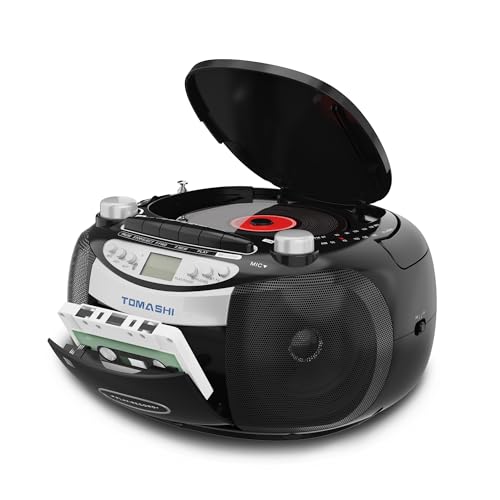
The TOMASHI is a multi-source boombox with cassette recording and playback, rather than a dedicated pitch-control cassette deck. It may suit listeners who want a cassette player alongside Bluetooth, radio, CD, USB, and Micro SD playback. Pitch adjustment is not stated in the supplied features.
- Plays audio through Bluetooth 5.0, CD/CD-R/CD-RW, USB, Micro SD, and AM/FM radio.
- Records to cassette from the radio, CD player, USB, SD card, or built-in microphone, as described in its features.
- Includes remote control and repeat/program functions for supported playback.
- Can operate on AC or DC power, according to the product name.
Best for: Buyers who want a general-purpose audio system and cassette recording in one unit, particularly when they use several digital and physical sources.
Limitation: The supplied description does not list pitch control or adjustable tape speed. It is less suitable than the TEAC W-1200B for a buyer whose main goal is changing cassette playback pitch.
Buying Guide: How to Choose a Cassette Deck With Pitch Control
Is pitch control explicitly listed?
Start with the product specifications, not just the product category or title. For this selection, the TEAC W-1200B lists 12% pitch control. The Jensen product name advertises pitch control, but the supplied details do not explain its range or the playback source it affects. The Pyle, TEAC AD-850, and TOMASHI feature lists do not mention pitch adjustment.
If you need to alter cassette playback speed, verify that the control applies to cassette playback before buying. A pitch control intended for another component would not meet that need. Also check whether the manufacturer describes the adjustment range and how the control operates.
Do you need one cassette mechanism or two?
A dual-deck machine can make copying between tapes more convenient. The TEAC W-1200B supports one-touch dubbing and parallel recording, while the Pyle lists normal- and high-speed dubbing. These functions are not interchangeable with pitch control: dubbing describes copying, while pitch control changes playback speed or pitch.
Choose a single cassette mechanism if your priority is playback or recording and you do not need deck-to-deck copying. A multi-format unit such as the TEAC AD-850 may better suit a household that also uses CDs and USB transfers.
How do you plan to digitize tapes?
Consider whether you want to use a computer or record directly to removable storage. The TEAC W-1200B lists USB output for recording to a PC or Mac at 48 kHz/16-bit PCM. The TEAC AD-850 lists recording to USB flash drives as MP3 files, including transfers from cassette and CD.
These approaches differ: a computer-connected output and direct flash-drive file creation are not the same workflow. Check the specified file format and connection method against your existing equipment and preferred editing process.
Which connections and controls matter?
RCA inputs and outputs are useful when you need line-level connections to other audio equipment. The Pyle lists RCA line connections, and the TEAC W-1200B lists RCA analogue input jacks. The TEAC also includes a headphone output, remote control, tape counters, and a dimmable display with level meters.
Match connections to the equipment you already own rather than assuming a deck will connect directly to every speaker or amplifier. The Pyle description specifically notes that the PT600A amplifier is not included.
Are you shopping for a deck or a complete audio system?
A dedicated deck prioritizes cassette functions and connections. An all-in-one product can add radio, CD playback, Bluetooth, or speakers, but those added features do not establish that it has pitch control. The TOMASHI is a broad-source boombox, while the Jensen combines several formats in a home music system.
For a strict pitch-control requirement, favor a product with clear cassette-specific specifications. For casual listening across formats, an all-in-one unit may be more practical if its listed functions meet your needs.
Frequently Asked Questions
Which product in this selection clearly lists cassette pitch control?
The TEAC W-1200B lists 12% pitch control. The Jensen product name also advertises pitch control, but its supplied details do not clarify the range or the component it affects.
Does high-speed dubbing mean a deck has pitch control?
No. High-speed dubbing describes a tape-copying mode. It does not, by itself, indicate that the deck lets you adjust cassette playback pitch or speed.
Can the TEAC W-1200B digitize cassette audio?
Its listed USB output supports digital recording to a PC or Mac at 48 kHz/16-bit PCM. The supplied information does not describe recording directly to a USB flash drive.
Which option records directly to a USB flash drive?
The TEAC AD-850 lists recording from CDs, cassettes, and external input devices to USB flash drives as MP3 files. Its supplied features do not list pitch control.
Is the Pyle deck a good choice if pitch control is essential?
Not based on the supplied specifications. The Pyle features describe dual-deck dubbing, tape selectors, a counter, and RCA connections, but do not mention pitch control.
What should I verify before buying a product that advertises pitch control?
Confirm that the control adjusts cassette playback, check its adjustment range, and determine whether it affects one or multiple tape mechanisms. The Jensen details provided here do not answer those questions.