
The right choice depends on which direction you need the audio to travel. For a car or stereo with a cassette deck, a cassette-to-aux adapter connects a device through a 3.5 mm cable, while the Arsvita Bluetooth cassette adapter receives wireless audio. For playing tapes on a portable cassette player, the TOMASHI and QFX models are alternatives; check their listed connections carefully because a cassette player is not automatically an aux-input device.
| Product | Best For | Connection Information |
|---|---|---|
| Arsvita Bluetooth Cassette Adapter | Wireless music in a cassette-equipped car or stereo | Bluetooth audio received by cassette deck |
| Arsvita Cassette-to-Aux Adapter | Wired audio through a cassette deck | 3.5 mm auxiliary cable |
| QFX RETRO-39BT | Portable tape playback with additional audio features | Listed with line-in/out and Bluetooth |
| TOMASHI Portable Cassette Player | Compact tape playback and recording | Headphone jack; aux input not specified |
| Portable Cassette Player, Blue | A basic portable tape-player alternative | Connection details are limited |
Arsvita Bluetooth Cassette Adapter

Best for: Sending music from a Bluetooth-equipped phone, tablet, or other device to a car or home stereo that has a working cassette player. This is a cassette-shaped receiver, so it uses the tape deck as the playback connection rather than requiring a conventional 3.5 mm aux input on the stereo.
The listed features specify Bluetooth 5.0 and stereo audio transmission. The product description says it is intended for devices without Bluetooth that can receive audio through a cassette player. It may suit someone who wants to keep a vintage car’s original audio equipment instead of replacing or modifying it.
- Choose this if you want wireless playback from a compatible Bluetooth source.
- Better for: reducing the need for a cable running from the phone to the stereo.
- Limitation: the listing says it does not support phone calls. The cassette deck must also be functional.
This is not a cassette player for listening to tapes. It is an adapter for sending outside audio through an existing cassette player.
Arsvita Cassette-to-Aux Adapter

Best for: A listener who wants a wired connection from an audio device with a 3.5 mm output to a car or stereo cassette deck. The product name identifies it as a cassette-to-aux adapter with a 3.5 mm auxiliary cable, making it the most direct match for someone searching for a cassette player aux input solution.
With this type of adapter, the cassette deck is the destination for the audio: insert the cassette-shaped end into the deck and connect the cable to a compatible 3.5 mm audio output. It can be a practical option for playing audio from a device that has a headphone or auxiliary output, without relying on Bluetooth.
- Choose this if you prefer a straightforward wired connection.
- Better for: setups where the cassette deck works but has no separate aux input.
- Limitation: the provided listing information does not specify cable length, device-specific compatibility, or additional controls. Confirm that your source device provides a compatible 3.5 mm audio output.
This adapter does not turn a standalone cassette player into an aux-input player. It routes audio through a cassette deck that accepts cassette-shaped adapters.
QFX RETRO-39BT Portable Cassette Player
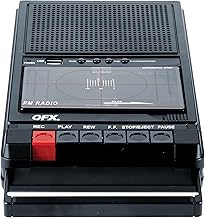
Best for: Buyers looking for a portable cassette player with features beyond tape playback. The listed details include a built-in speaker, Bluetooth, FM radio, MP3 playback, USB-to-cassette recording, a built-in microphone, and line-in/line-out connections. It is a more feature-rich option than a basic personal tape player.
The line-in/out wording makes this model relevant to shoppers comparing cassette equipment with auxiliary connections. However, the listing details provided do not explain the exact purpose or configuration of each port. Check the product page and device labeling to confirm that the input supports the connection you need before purchase.
- Choose this if you want a cassette player and recorder with several listed audio functions.
- Better for: listeners who may also use FM radio, MP3 playback, or recording features.
- Limitation: the product has more functions to consider, and the supplied information does not establish that its line-in connection meets every aux-input use case.
Unlike a cassette adapter, this is a standalone shoebox-style device. It may suit someone building a portable listening or recording setup rather than connecting a phone to a car cassette deck.
TOMASHI Portable Cassette Player

Best for: Someone who needs a compact device for listening to cassette tapes, recording, or language practice. The listing describes a small player measuring 4.57 by 3.54 by 1.38 inches, with a built-in speaker, headphone mode, a built-in microphone, and controls for play, stop, fast-forward, rewind, and record.
The automatic-stop feature is intended to stop the cassette mechanism when a tape reaches its end. That can help avoid leaving the tape running after playback finishes. The built-in speaker offers a way to listen without headphones, while the headphone jack supports private listening.
- Choose this if portable tape playback and basic recording matter more than connecting a phone through aux.
- Better for: a compact, simple cassette player with speaker and microphone functions.
- Limitation: the listed features do not identify an aux input. Do not assume it can accept audio from a phone; check the connection details if that is essential.
This is a tape player, not a cassette adapter for a car stereo. Its selection is based on its portable playback and recording functions, rather than a confirmed auxiliary input.
Portable Cassette Player In Blue
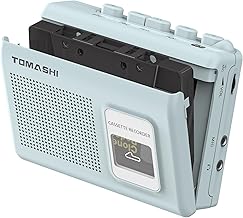
Best for: A buyer comparing a basic portable cassette player with a built-in speaker, microphone, and headphone jack. The supplied product name also lists dimensions of 4.57 by 3.54 by 1.38 inches, making size a useful comparison point for shoppers seeking a compact tape player.
The listed product information is more limited than the feature details available for the TOMASHI model. It identifies the device as a cassette tape recorder and names a built-in speaker, microphone, and headphone jack, but does not provide details here about automatic stop, recording controls, or an auxiliary input.
- Choose this if you want to compare a blue portable cassette-player option with the same general dimensions listed in the product name.
- Better for: basic tape playback through a speaker or headphones, based on the named features.
- Limitation: the available details do not confirm an aux input or explain the full control and recording functions. Verify the listing before buying if those features matter.
This selection is a portable cassette-player alternative, not a confirmed solution for sending phone audio into a cassette deck.
Buying Guide: How To Choose A Cassette Player With Aux
Do you need an aux input, an aux output, or an adapter?
These terms describe different signal directions. An aux input accepts audio from an outside source, such as a phone, so the cassette player or stereo can play that incoming audio. An aux output sends audio from a device to another speaker or amplifier. A cassette-to-aux adapter typically uses a cassette deck to play audio from an external source; it does not necessarily mean the cassette player itself has an aux input.
Before choosing a product, identify the source and destination. If your phone is the source and a vintage car stereo is the destination, a cassette adapter may be the right category. If you want to connect an outside audio source to a portable cassette machine, look for a clearly identified line-in or aux-in port on that machine.
Should you choose a wired adapter or a Bluetooth adapter?
A wired cassette-to-aux adapter is worth considering if your audio source has a compatible 3.5 mm output and you want a direct cable connection. It avoids relying on a wireless connection, but the cable must reach between the source and the cassette deck. Check whether your source device actually has the required output.
A Bluetooth cassette adapter is a better fit if your source supports Bluetooth and you want wireless audio in a cassette-equipped stereo. The Arsvita Bluetooth model is described as a Bluetooth 5.0 receiver for music, but its listing says it does not support phone calls. Choose based on the audio task, not simply the word “Bluetooth” in a product name.
Is your cassette deck working?
Cassette-shaped adapters depend on a functioning tape deck. If the deck cannot load or play a cassette, an adapter may not provide a useful connection. Check basic tape playback first. Also consider whether the deck’s controls and speakers work as expected, since the adapter uses the cassette mechanism as part of the audio path.
If you do not have a working cassette deck and want to play physical tapes, a standalone cassette player is the more relevant category. Portable options such as the TOMASHI model and QFX RETRO-39BT are designed as cassette playback devices, although their listed connections and extra functions differ.
Which features matter in a portable tape player?
For a personal player, consider whether you want a built-in speaker, a headphone jack, recording, or automatic stop. A built-in speaker allows listening without headphones. A headphone jack is useful for private listening. A microphone and record function may help with recording, while automatic stop is a convenience described for the TOMASHI player.
For a larger portable unit, check which additional sources and functions are listed. The QFX RETRO-39BT listing names FM radio, MP3 playback, Bluetooth, USB-to-cassette recording, and line-in/out. More functions can be useful, but verify which ports and modes match your actual setup rather than assuming that every connection works in both directions.
What should you check before ordering?
- Connection direction: Confirm whether the product receives audio, sends audio, or adapts a cassette deck for external playback.
- Source connector: Check whether the phone or audio source has Bluetooth or a compatible 3.5 mm output.
- Destination: Confirm that the car stereo, home stereo, or portable player has the required cassette mechanism or input port.
- Use case: Separate products for playing tapes from adapters for routing phone audio through a cassette deck.
- Listed limitations: Review details such as unsupported calls or unspecified input functions before relying on a feature.
When a listing does not clearly name an aux input, line-in, or supported connection, treat that capability as unconfirmed. Product labels such as “cassette player,” “cassette adapter,” and “Bluetooth receiver” refer to different types of equipment and should not be treated as interchangeable.
Frequently Asked Questions
Can I connect my phone to a cassette player with an aux input?
Yes, if the cassette player has a clearly identified aux or line input and the phone provides a compatible output. The products in this list do not all have a confirmed aux input, so verify the specific connection before choosing one.
How does a cassette-to-aux adapter work?
A cassette-to-aux adapter is inserted into a cassette deck and uses a cable to connect an outside audio source. It is intended for a working cassette deck and should not be confused with a standalone cassette player that has an aux input.
Can a Bluetooth cassette adapter play phone calls?
The listed Arsvita Bluetooth cassette adapter description says it does not support phone calls. Its stated purpose is transmitting stereo audio from Bluetooth-equipped devices.
Which listed option is for playing cassette tapes?
The QFX RETRO-39BT, TOMASHI portable cassette player, and blue portable cassette player are listed as cassette-playing devices. The two Arsvita products are adapters for using a cassette deck with external audio sources.
Is line-in the same as line-out?
No. Line-in generally refers to an input for audio entering a device, while line-out refers to an output carrying audio away from it. Check the exact port labeling and product instructions to confirm the connection direction.