
The best cassette tape boombox depends on whether you prioritize recording, radio, portability, or extra playback options. The QFX J-220BT is a straightforward portable choice with four-band radio and USB/SD playback, while the WISCENT 24W model adds separate bass and treble controls. The KLIM combines a cassette deck with CD playback, and the Aiwa emphasizes 30W sound output. A second WISCENT model adds a built-in microphone and colorful lights.
| Boombox | Best For | Notable Features |
|---|---|---|
| QFX J-220BT | Portable radio and digital playback | AM/FM/SW1/SW2, USB/SD, swivel handle |
| WISCENT 24W Retro Classic | Tone adjustment and recording features | Bass and treble controls, Bluetooth, USB/Micro SD |
| KLIM CD Cassette Player | CD and cassette listening | CD, cassette, Bluetooth 5.1, USB, remote |
| Aiwa BackTrack Jr | Higher stated speaker output | 30W output, cassette recording, handle |
| WISCENT 16W Retro Recorder | Voice recording and radio listening | Built-in microphone, AM/FM/SW radio, headphone jack |
QFX J-220BT Retro Bluetooth Boombox
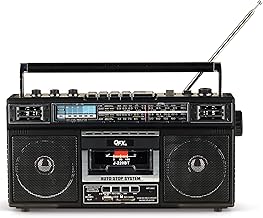
The QFX J-220BT is best for listeners who want a portable cassette boombox with radio and additional digital playback options. Its listed features include a four-band radio with AM, FM, SW1, and SW2, as well as USB and SD music playback. The swivel handle is useful for carrying the unit between rooms or taking it to gatherings.
Choose this model if you want a cassette-focused boombox that can also play files from USB or SD media and tune into several radio bands. The combination gives listeners more than one way to use the device without relying solely on tapes.
- Best for: Portable listening with cassette, radio, USB, and SD playback.
- Why it stands out: Its four-band radio and swivel handle are clearly specified.
- Limitation: The provided product details do not specify speaker output, recording functions, or power options.
For questions or product issues, the listed support contact is QFX at [email protected]. Buyers who need recording features or detailed power information should verify those specifications before choosing.
WISCENT 24W Retro Classic Boombox

This WISCENT model is best for buyers who want extensive playback options and some control over the sound character. It lists a cassette player and recorder, Bluetooth, USB, Micro SD, a headphone jack, and AM/FM/SW1/SW2 radio. Its 24W dual full-range speakers are paired with separate bass and treble controls, giving listeners a way to adjust those tone settings.
The product information also describes recording music played over Bluetooth to USB or a blank tape, and converting cassettes to MP3 files onto USB. Those functions make it a better fit for people interested in preserving or reorganizing music as well as playing tapes.
- Best for: Buyers seeking multiple playback sources, tape recording, and adjustable bass and treble.
- Why it was selected: It combines cassette features with Bluetooth, USB, Micro SD, and four radio bands.
- Limitation: Radio playback is described as mono, unlike stereo playback from tapes, USB, or Bluetooth.
Choose this model if adjustable tone controls and multiple media options matter more than keeping the device simple. The broad feature set may be unnecessary for someone who only wants to play cassette tapes.
KLIM CD Cassette Player Boombox

The KLIM is best for listeners who want a cassette boombox that also plays CDs. Its listed media options include CDs, MP3 and WMA files, USB playback, Bluetooth 5.1, and an auxiliary input. The cassette deck includes recording functionality, while the AM/FM radio adds access to broadcasts.
This model is a better fit for a home listening setup than for someone choosing strictly on speaker output: the product lists 3W dual speakers. It also includes a remote control with operation from up to 20 feet, an LCD screen for tuning, and an extendable antenna for radio reception.
- Best for: Households that want cassette tapes and CDs in one player.
- Why it was selected: It adds CD playback, Bluetooth, USB, and a remote to its cassette and radio functions.
- Limitation: Its stated 3W dual speakers may not suit buyers who prioritize higher listed output.
Choose this boombox if CD compatibility and convenient remote operation matter. Avoid making it your first choice if the main requirement is a higher stated speaker wattage.
Aiwa BackTrack Jr Retro Boombox

The Aiwa BackTrack Jr is best for buyers who place emphasis on its stated 30W sound output and want a handle for carrying the boombox. The product features describe it as a retro Bluetooth speaker with a cassette player and recorder, plus FM/AM radio, USB, and AUX. It is presented for home, outdoor, and travel listening.
The cassette recorder is a useful distinction for people who want to make recordings as well as play tapes. Bluetooth, USB, and AUX provide additional listening options, while the carrying handle supports moving the unit between locations.
- Best for: Buyers prioritizing a higher stated output and a portable, handle-equipped design.
- Why it was selected: It combines a cassette player and recorder with Bluetooth, radio, USB, and AUX.
- Limitation: The provided details do not list the radio bands beyond FM/AM or explain specific USB functions.
Choose this model if its 30W output and recording feature match your priorities. If you need detailed information about radio reception, USB playback, or power options, check those points before purchase.
WISCENT 16W Cassette Recorder Boombox

This WISCENT boombox is best for listeners who want a built-in microphone for voice recording alongside cassette playback. Its listed features include a cassette player and recorder, AM/FM/SW radio, Bluetooth, USB, a headphone jack, and colorful RGB lights. The product also specifies 16W speakers and describes stereo audio from tapes, USB, and Bluetooth.
The headphone jack is useful when private listening is preferred. The radio is described as mono, while the other listed playback sources provide stereo sound. The product supports AC or battery power, according to its feature information.
- Best for: Buyers interested in voice recording, radio, and a headphone connection.
- Why it was selected: The built-in microphone and cassette recorder broaden its use beyond tape playback.
- Limitation: Radio playback is mono, and its stated 16W output is lower than the 30W listed for the Aiwa model.
Choose this model if voice recording and its mix of radio, tape, Bluetooth, and USB features appeal to you. Consider another option if a higher stated output or stereo radio playback is essential.
Buying Guide: How to Choose a Cassette Tape Boombox
Which playback sources do you need?
Start with the media you already use. A basic cassette listener may need only a tape deck and radio, while a household with CDs should consider the KLIM combination player. USB and SD support can add digital playback, and Bluetooth can make it possible to stream audio from another device. Check the specific product description for the media formats and functions that matter to you.
Do not assume that every model’s USB port supports the same tasks. Some product details describe USB playback, while others also mention transferring cassette audio to USB or recording Bluetooth audio. Those are different functions. If digitizing tapes is important, look for an explicit conversion or recording feature rather than relying on the presence of a USB slot alone.
Do you want to record tapes, radio, or your voice?
Recording features vary. The QFX details do not list a recorder, while the WISCENT 24W, Aiwa BackTrack Jr, and WISCENT 16W models specify cassette recording. The WISCENT 16W model also lists a built-in microphone for voice recording. The KLIM describes cassette recording functionality as well.
Before buying, identify the source you want to record and confirm that the product supports it. Cassette recording, voice recording, and converting a tape to a digital file are not interchangeable features. For archive or transfer needs, prioritize a model whose listing specifically describes the desired process.
How important are speakers and sound controls?
Compare stated output carefully, but do not treat wattage alone as a complete measure of sound quality. The Aiwa lists 30W output, the WISCENT Retro Classic lists 24W dual full-range speakers, and the WISCENT recorder lists 16W. The KLIM lists 3W dual speakers. These figures provide a point of comparison, but product descriptions do not provide a consistent, complete basis for judging real-world loudness or sound quality.
For tone adjustment, the WISCENT 24W model specifies separate bass and treble controls. If you mainly listen to radio, note that both WISCENT product descriptions identify radio playback as mono. Buyers who value stereo playback should check which sources use stereo on their chosen model.
Will you carry the boombox or keep it in one place?
A carrying handle is useful if you expect to move a boombox from room to room or take it outdoors. The QFX has an attached swivel handle, and the Aiwa and WISCENT 16W models also describe carrying handles or portable use. For a stationary setup, features such as a remote, LCD screen, or CD playback may matter more.
Power information is not equally detailed across these listings. The WISCENT 16W model is described as AC or battery powered. Do not assume another model has the same power choices unless its product details confirm them. Check power requirements if you plan to listen away from an outlet.
Which radio bands and listening options matter?
If you mainly want local AM/FM stations, a model listing those bands may be sufficient. The QFX and WISCENT 24W models list AM, FM, SW1, and SW2. The WISCENT 16W lists AM/FM/SW radio, while the KLIM and Aiwa details mention AM/FM. Compare the bands you actually use rather than selecting a product based only on the total number of features.
Other convenience features may help narrow the choice. The KLIM lists an extendable antenna, LCD tuning display, and remote control. The QFX lists USB and SD playback, while the WISCENT 16W adds a headphone jack. Select based on practical listening habits, not appearance alone.
What should you verify before ordering?
- Confirm that the product explicitly supports the tapes, discs, or digital media you plan to use.
- Check whether recording means cassette recording, voice recording, or digital conversion.
- Review the listed radio bands and whether radio playback is mono or stereo.
- Verify power options, included controls, and connection types in the product information.
- Consider whether speaker output, tone controls, a handle, or a remote is more important for your setup.
Frequently Asked Questions
Can a cassette tape boombox play music without a cassette?
Many models offer other playback sources, but the available options differ. The products in this guide list features such as Bluetooth, USB, SD, CD, AUX, and radio. Check the individual feature list to confirm which sources are supported.
Which model in this list plays CDs?
The KLIM CD Cassette Player Boombox is the model that specifically lists CD playback. It also supports cassette tapes, USB, Bluetooth, and AM/FM radio.
Which options list cassette recording?
The WISCENT 24W Retro Classic, KLIM, Aiwa BackTrack Jr, and WISCENT 16W models describe cassette recording functionality. The WISCENT 16W also lists a built-in microphone for voice recording.
Which boombox has the highest stated speaker output?
The Aiwa BackTrack Jr lists 30W sound output, the highest figure among the products compared here. Stated wattage alone does not establish overall sound quality.
Do these boomboxes all have the same radio bands?
No. The QFX and WISCENT 24W models list AM, FM, SW1, and SW2; the WISCENT 16W lists AM/FM/SW; and the KLIM and Aiwa list AM/FM. Verify the bands you need before choosing.