
The best center channel speaker cabinet depends on your room, receiver, and front-speaker setup. The Klipsch R-52C is a strong fit for buyers prioritizing a horn-loaded tweeter and dual woofers; the Polk Audio T30 suits a first home theater or Polk T-Series system; and the Saiyin is for buyers who want dual 5-inch woofers and already have an amplifier or receiver. Compare cabinet fit and speaker specifications before choosing.
| Speaker | Best For | Notable Listed Feature |
|---|---|---|
| Klipsch R-52C | Horn-loaded treble and dual woofers | 90-by-90-degree Tractrix horn |
| Polk Blackstone TL1 | Compact-looking TV-area setup | Curved, high-gloss enclosure |
| Saiyin Center Channel | Buyers with a receiver or amplifier | Two custom 5-inch woofers |
| Dayton Audio Classic C40 | Buyers comparing power and impedance specs | 50 watts RMS; 6 ohms |
| Polk Audio T30 | First home theater or Polk T-Series setup | Dual 5.25-inch woofers and rear port |
Klipsch R-52C Center Channel Speaker

The Klipsch R-52C combines two 5.25-inch spun-copper IMG woofers with a 1-inch aluminum LTS tweeter and a 90-by-90-degree square Tractrix horn. Its listed frequency response is 89 Hz to 21 kHz, plus or minus 3 dB.
Best for: Home theater buyers who want a center speaker with dual woofers and a horn-loaded tweeter. The specified driver arrangement and frequency range make it straightforward to compare with other models in this list.
Why it was selected: Its two woofers and horn design give buyers clear hardware details to consider when matching a center channel to a room and existing front speakers.
Check before choosing: The supplied product information does not list cabinet dimensions or impedance. Confirm the available shelf or console space and check the full specifications for receiver matching before buying.
Polk Audio Blackstone TL1 Center Speaker

The Polk Audio Blackstone TL1 has a 1/2-inch silk dome tweeter and two 2.5-inch Dynamic Balance midrange/woofers. Its curved enclosure has a high-gloss finish intended to complement flat-panel TVs. The listed features also describe Time Lens technology for driver alignment and soundstaging.
Best for: Buyers who want a center speaker with a curved, glossy cabinet and smaller listed drivers. It may be a useful candidate when appearance and cabinet form are important parts of a TV-area setup.
Why it was selected: The TL1 offers a distinct enclosure style and a clearly stated driver configuration, making it easy to compare against larger-woofer options such as the T30 and R-52C.
Check before choosing: The supplied information does not specify cabinet dimensions, frequency response, or power handling. Verify those details if you need to fit a precise space or compare output requirements.
Saiyin Center Channel Speaker

This passive Saiyin center channel uses two custom 5-inch woofers and a 20 mm silk-dome horn tweeter. The listed features say the woofers are designed to produce bass and reduce distortion at higher volume, while the horn design supports vocal and high-frequency projection.
Best for: Buyers who already have a compatible receiver or amplifier and want a center speaker with dual 5-inch woofers. The woofer and tweeter details provide useful points of comparison for a home theater system.
Why it was selected: It has a clearly stated driver arrangement and an explicit note about its passive operation, an important distinction for people choosing equipment for a new setup.
Important limitation: A receiver or amplifier is required. Speaker wire is not included, and the speaker does not have Bluetooth, so it is not a standalone wireless speaker.
Dayton Audio Classic C40 Center Speaker
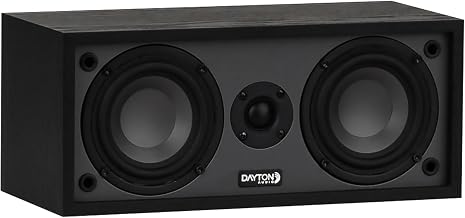
The Dayton Audio Classic C40 is rated for 50 watts RMS and 100 watts maximum, with a listed impedance of 6 ohms and frequency response from 70 Hz to 20 kHz. It uses custom 4-inch poly drivers and a 1-inch silk-dome tweeter in a cabinet described as well built.
Best for: Buyers who want stated power, impedance, and frequency-response figures to compare with their receiver and other speakers. Its listed 6-ohm impedance makes receiver compatibility a key check.
Why it was selected: The C40 provides a useful specification-focused comparison, including both RMS and maximum power handling as well as a defined frequency range.
Check before choosing: Confirm that the receiver supports the speaker’s listed impedance and that its output suits the speaker’s power ratings. The supplied features do not provide cabinet dimensions.
Polk Audio T30 Center Channel Speaker

The Polk Audio T30 features two 5.25-inch woofers and a 1-inch silk-dome tweeter. Its listed features also include Dynamic Balance woofers and a tuned rear port. Polk describes the T30 as timbre matched to the T-Series, which may be relevant when pairing it with speakers from that series.
Best for: People starting a home theater or upgrading a system that includes Polk T-Series speakers. The dual woofers, tweeter, and rear port are the main features to compare with the other options.
Why it was selected: It has a clearly described driver layout and a stated connection to Polk’s T-Series, giving buyers a useful reference when considering front-speaker matching.
Check before choosing: The supplied details do not include impedance, frequency response, or cabinet dimensions. Check those specifications and allow for the rear port when planning placement.
Buying Guide: How To Choose A Center Channel Speaker Cabinet
A center channel carries much of the dialogue and other centrally placed sound in a typical home theater mix. The cabinet is not just a container: its size, shape, and placement affect whether the speaker fits your room and can be positioned appropriately. Compare the complete speaker specifications, not just the cabinet’s appearance or woofer size.
Will the cabinet fit your TV stand or shelf?
Measure the intended space before selecting a model. Check the speaker’s width, height, and depth in its full product specifications, then compare those measurements with the usable shelf area. Leave room for cables and avoid assuming that two speakers with similar driver sizes have similar cabinet dimensions. The product details provided here do not list dimensions for these five models, so verify them before purchasing.
Does the speaker need a receiver or amplifier?
Check whether the speaker is passive and what equipment it requires. The Saiyin listing explicitly states that it needs a receiver or amplifier, that speaker wires are not included, and that it has no Bluetooth. For every model, confirm the required connections and receiver specifications in the complete product information. A center speaker is not automatically a standalone TV speaker.
How should you compare drivers and frequency response?
Driver size and count are useful comparison points, but they do not tell the whole story about a speaker’s sound. The R-52C lists two 5.25-inch woofers and a horn tweeter; the T30 lists two 5.25-inch woofers and a silk-dome tweeter; and the Saiyin lists two 5-inch woofers. The C40 supplies a frequency range of 70 Hz to 20 kHz, while the R-52C lists 89 Hz to 21 kHz, plus or minus 3 dB. Do not treat those figures alone as a complete performance ranking.
Should the cabinet match your other speakers?
Matching a center channel with the left and right speakers can help keep the front soundstage consistent. The Polk T30 is described as timbre matched to Polk T-Series speakers. If you already own front speakers, check whether the manufacturer identifies a matching center model or series. When choosing between brands, compare the complete specifications and consider whether the speaker can be positioned in the same general area as the TV.
What do impedance and power ratings tell you?
Impedance and power handling are receiver-matching details, not simple measures of sound quality. Dayton lists the C40 at 6 ohms, 50 watts RMS, and 100 watts maximum. Compare those ratings with the receiver’s documentation and use the full specifications for the speaker you choose. Do not rely on maximum power alone when checking a system match.
Does a rear port affect placement?
A rear port may make the space behind a speaker relevant to placement. Polk lists a tuned rear port on the T30, so check the manufacturer’s placement guidance and leave suitable clearance rather than pushing the cabinet tightly against a wall by default. Confirm the port location and placement requirements for any other model from its full product details.
Which cabinet style should you choose?
Choose a finish and shape that suit your room, but treat appearance as one consideration among fit, connections, and speaker matching. The Blackstone TL1 is specifically described as having a curved, high-gloss enclosure designed to complement flat-panel TVs. Other listed models have black cabinets, but the supplied information does not give their dimensions or detailed finish specifications.
Frequently Asked Questions
What does a center channel speaker do?
A center channel speaker reproduces the center-channel audio in a surround-sound setup. It is commonly placed near the TV and is used for dialogue and other sounds mixed to the center.
Can I use a center channel speaker without a receiver?
It depends on the speaker. The Saiyin model is explicitly passive and requires an amplifier or receiver. Check the product specifications for any speaker before connecting it to a TV or other equipment.
Can I place a center speaker inside a cabinet?
Only if the speaker fits and the manufacturer’s placement guidance allows it. Check the cabinet opening, available depth, cable space, and any port location. An enclosed space may affect placement, so do not assume every center speaker is suited to every TV cabinet.
Is a larger woofer always better for dialogue?
No. Woofer size is only one specification. Also compare the tweeter, frequency response, cabinet fit, receiver requirements, and whether the speaker matches your existing front speakers.
What should I check before buying a center channel speaker?
Confirm cabinet dimensions, receiver or amplifier requirements, impedance, power ratings, connections, placement needs, and compatibility with your other speakers. The listed product features do not include every specification for every model, so consult the complete product details before making a final choice.