
Best Center in-Wall Speakers for Immersive Home Theater
Answering the search intent for a reliable center speaker that blends into your walls while delivering clear dialogue and robust bass. This guide highlights five in-wall center channels ideal for 3.1 to 7.1 setups, clarifying who each product suits best, and where to choose one over another. Suitable buyers include: new home theater builders seeking invisible centers, multi-room audio enthusiasts needing seamless integration, and sound-conscious shoppers prioritizing clarity and ease of installation. A quick reference table is provided below for quick comparison.
Quick Reference Buying Table
| Product | Best For | Key Benefit | Notable Limitation |
|---|---|---|---|
| Polk Audio 255c-RT | Large rooms with 3.1–7.1 systems | Rotating CAM system for secure install | Two-way design may be less EF bass emphasis than three-way models |
| Micca M-CS Dual 5.25-Inch | Budget-friendly, unobtrusive aesthetics | Slim build with easy mounting | May lack extra low-end warmth vs larger woofers |
| Polk Audio 255c-LS Vanishing | Ultra-discreet centers | Near-invisible 7mm grille profile | Smaller footprint; bass depends on room size |
| Polk Audio 265-RT 3-way | High-performance home theaters | Three-way design with larger woofers | Higher price vs two-way models |
| Klipsch R-5502-W II | Bright, detailed dialogue | Tractrix horn tech for wide dispersion | Two-way design, may need matching with other Klipsch subs |
Polk Audio 255c-RT In-Wall Center Speaker

The Polk 255c-RT is a two-way center channel designed for rooms where wall space is at a premium. It uses Dynamic Balance technology, a Power Port, and a swiveling 1″ Silk Dome Tweeter to deliver clear dialogue with extended bass. Best for users building 3.1 to 7.1 systems who want robust center-channel performance without a visible speaker footprint. The 2×5.25″ mid/woofers support natural midrange and solid lower frequencies, while the rotating CAM system aids secure, vibration-free installation. Caution: two-way design may be less bass-dense than three-way centers in very large rooms.
Micca M-CS Dual 5.25-Inch In-Wall Center Speaker

Micca’s M-CS centers emphasize uncompromising audio quality at a friendly price. The dual 5.25″ woofers provide solid bass and a smooth midrange, while the simple mounting tabs simplify drywall installation. Best for apartments, bedrooms, or smaller living spaces where invisible speakers still need to deliver clear dialog in a surround setup. It’s a good choice when budget is a critical constraint and a low-profile aesthetic is desired. Limitation: may not match the sub-bass extension of larger, higher-powered centers.
Polk Audio 255c-LS Vanishing In-Wall Center

The Polk 255c-LS centers on invisibility without compromising clarity. It features dual 5.25″ Dynamic Balance drivers and a 1″ Ring-Radiator Tweeter, complemented by Polk’s PowerPort bass venting for fuller dialogue and film sound. The nearly invisible 7mm grille helps it disappear into most walls, while still delivering room-filling sound. Best for users who want a high-performing center that remains visually unobtrusive. Caution: unusual room shapes or heavy wall materials may affect perceived bass depth.
Polk Audio 265-RT 3-Way In-Wall Speaker

The 265-RT is a higher-performance center option with a 3-way design and larger woofers (2×6.5″). It’s designed to offset reflective surfaces and handle complex surround setups from 3.1 through 7.1 channels. Best for dedicated home theaters or rooms where ceiling and wall integration must still deliver expansive, cinematic sound. Caution: larger footprint and higher price; ensure proper enclosure and mounting space in your walls.
Klipsch R-5502-W II In-Wall Center
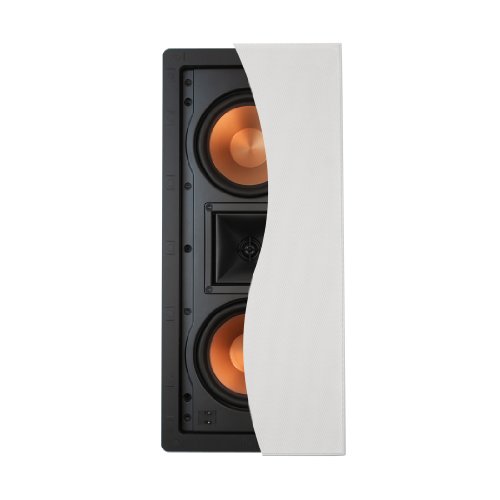
The Klipsch R-5502-W II combines a 1″ titanium diaphragm compression driver with dual 5.25″ Cerametallic cone woofers, delivering detailed highs and substantial midbass. This two-way center is well-suited for bright, articulate dialogue in modern systems. Best for listeners who favor precise imaging and wide listening angles. Limitation: two-way design may require careful matching with subwoofers to achieve the deepest bass in large rooms.
Herdio 5.25 Inch In-Wall Center Channel

Herdio’s center channel is built for whole-house audio and home theater systems. It uses a 5.25″ woofer and a 1″ Silk Dome Tweeter, with a 45Hz-20kHz range and 8-ohm impedance. The magnetic, paintable grille enables seamless wall integration, making it a solid choice for visually minimal setups. Best for multi-room enthusiasts seeking a uniform look with capable dialogue clarity. Caution: high-widelity performance is most noticeable when paired with compatible Herdio HCS components.
PYLE PDIWCS56 Center In-Wall Speaker

Pyle’s PDIWCS56 is a flush-mount center designed for custom installations. It includes dual 5.25″ woofers and a 1″ titanium dome tweeter, rated at 300 watts peak. The eight-ohm impedance and center-left-right channel suitability make it a straightforward choice for new builds. Best for DIY installers prioritizing a simple, economical center channel. Limitation: no advanced damping or proprietary porting features may reduce deep-bass presence in larger rooms.
STUDIOFINIX In-Wall Center Channel

STUDIOFINIX centers emphasize immersive Hi-Fi audio with dual 5.25″ poly woofers and a 1″ pivoting silk tweeter. The 160W peak and 45Hz-20kHz response deliver rich bass and clear dialogue for movies, music, and gaming. Best for budget-conscious builders who still want theater-grade presence. The paintable grille and easy installation kit help achieve a seamless look. Caution: rely on matching with appropriate subwoofers and other STUDIOFINIX speakers for balanced multi-channel output.
Buying Guide: Center In-Wall Speaker Considerations
What room size and seating distance matter?
larger rooms benefit from three-way centers or models with larger woofers to maintain even bass, while smaller spaces can rely on two-way centers for crisp dialogue without overpowering the room.
How important is invisibility?
If visual integration is a priority, look for minimal flange depth, magnetically paintable grilles, and narrow footprints. Models like Polk 255c-LS emphasize near-invisibility with 7mm grilles, while others balance that with more robust bass.
Which features improve dialogue clarity?
A dedicated tweeter for highs, ported low-frequency control (Power Port or similar), and a well-timed crossover all help dialogue stay crisp even with dynamic soundtrack effects.
Installation considerations
Check for pre-construction brackets, rotatable cam mounting, and templates. Some models ship with tools or brackets designed to reduce installation time and ensure vibration-free performance.
Budget vs. performance
Two-way centers tend to cost less but may require careful subwoofer pairing for deep bass. Three-way centers deliver fuller sound but at a higher price. Choose based on room size, listening goals, and system complexity.
FAQ
- What is an in-wall center speaker best for?
- Yes, it blends with walls while providing clear dialogue in surround setups.
- Do two-way centers work well for home theaters?
- They can, especially in smaller rooms or with subwoofers, but may lack deep bass compared to three-way centers.
- Are magnetically paintable grilles important?
- They help achieve a seamless look, especially in modern decors.
- Should I choose a larger woofer for bass in-wall centers?
- In larger rooms or multi-seat setups, larger woofers and a robust port system help maintain impact and dialogue clarity.