
Best Car Power Inverters and USB Car Chargers for in-Vehicle Charging
If you need reliable charging options in a vehicle, this guide compares top car charging outlets and inverters to help you pick the right one. These choices are ideal for road trips, commuting, camping, and mobile offices. The top picks cover high wattage inverters for laptops, multi-port USB-C and USB-A chargers, and compact models for everyday use. Whether you want quiet operation, better heat management, or multiple outlets, there’s a fit for every traveler and commuter.
Summary table of selected products:
- PiSFAU 200W Car Power Inverter — 2 AC outlets, 4 USB ports; best for compact laptops and multiple devices.
- YSOLX 300W Portable Charger Inverter — 4 USB ports plus 2 AC outlets; best for camping and extended trips.
- JUNVANG USB C Car Charger 4-Port — 90W total power; best for quick charging of phones and tablets at once.
- BESTEK 300W Car Inverter — 2 AC outlets, 2 USB ports; best for larger devices on road trips.
- PiSFAU 150W Power Inverter — 2 USB ports, 110V outlet; best for lighter daily use.
PiSFAU 200W Car Power Inverter — 12V to 110V

This inverter converts 12V DC to 110V AC with two standard outlets and four USB ports. It’s designed for charging laptops, tablets, phones, and small appliances while driving. Best for users who need multiple USB ports alongside traditional AC outlets in a compact form. The device emphasizes quiet operation and high efficiency to reduce heat and energy waste. A potential limitation is its 200W continuous rating, which may not run power-hungry devices for long periods. Choose this if you want a compact, quiet inverter for everyday travel and light office uses.
YSOLX 300W Portable Car Power Inverter

This model provides 300W continuous power with four USB ports and dual 110V AC outlets. It targets travelers who need to power multiple devices, including laptops, cameras, game consoles, and camping gear. It’s well-suited for road trips and outdoor activities where a vehicle battery can serve as a power source. A notable caveat is that higher loads can increase fan activity; plan for moderate use to keep noise and heat down. Choose this if you want robust multi-device support for long drives or camping.
JUNVANG USB C Car Charger — 4-Port 90W

This 4-port car charger package includes two USB-C ports and two USB-A ports with a combined 90W output. It supports PD and QC fast charging, making it ideal for quickly topping up iPhones, iPads, and many Android devices while on the road. It’s best for users who want fast charging for multiple devices simultaneously without occupying much dashboard space. A limitation is that higher-speed charging may be uneven if several devices demand peak power at the same time. Choose this if you want fast, flexible charging for a mix of devices during travel.
BESTEK Power Inverter 300W
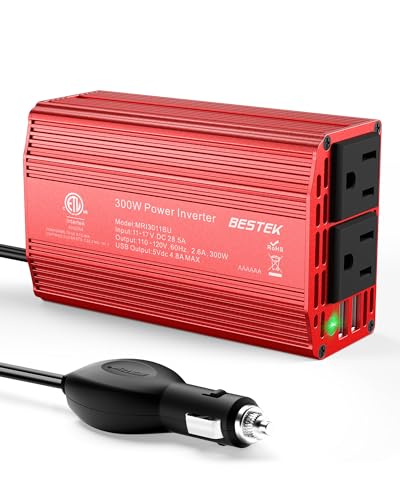
Bestek’s 300W inverter offers two 110V outlets plus two USB ports. It’s pitched as a solid option for larger devices like laptops and tablets, especially on vacations or camping trips where more power is needed. The unit’s compact, iPhone-sized design makes it easy to install in most vehicles. It includes a 32-inch cigarette lighter plug for broad compatibility. Best for travelers needing dependable, straightforward AC access and USB charging in one compact package. A caution is that peak load should stay within rated limits to avoid tripping the inverter.
PiSFAU 150W Power Inverter

This PiSFAU model delivers 150W continuous power with two USB ports and a 110V outlet. It’s described as a premium, lightweight option suitable for charging essential devices like laptops, tablets, and streaming gear. It also features a smart chip with built-in fuse protection to automatically cut output if a fault is detected. Choose this if you want a lightweight, straightforward inverter for lighter daily needs and occasional laptop use. A limitation is the lower continuous wattage compared with higher-capacity rivals.
Buying Guide
What should you consider when choosing a car charging outlet or inverter?
- Wattage needs: For laptops and multiple devices, look for 150W–300W continuous power or higher for heavy use. If you mostly charge phones and tablets, 60W–90W USB-C/USB-A setups are often enough.
- Outlets and ports: Decide how many AC outlets and USB ports you need. If you rely mainly on USB-C PD, a multi-port charger with PD can simplify wiring and reduce heat.
- Heat and noise: Models with built-in cooling fans can be louder. Quiet designs help in small cabins or during night drives.
- Protection features: Overload, over-voltage, over-temperature, and short-circuit protections protect both the inverter and connected devices.
- Portability and fit: For smaller vehicles or limited space, compact inverters with a lightweight design are easier to carry and install.
- Vehicle compatibility: Check whether your vehicle’s cigarette lighter socket supports the inverter’s plug size and continuous draw.
FAQ
- What is a car power inverter used for?
A car power inverter converts DC power from a vehicle into AC power to run laptops, cameras, game consoles, and small appliances while traveling.
- How many devices should I charge at once?
Choose a model with enough ports for your typical needs. If you use many devices, consider a multi-port USB-C/USB-A setup plus at least one AC outlet for laptops.
- Is higher wattage better for all users?
Higher wattage supports more devices and higher-power laptops, but it can be larger and draw more from the vehicle’s battery. Select wattage based on your main devices’ requirements.
- Do car inverters consume power when not in use?
Most models draw minimal standby power, but unplugging them avoids any drain when the vehicle is off for extended periods.
- What safety features matter most?
Over-current, over-voltage, overheating, and short-circuit protection are essential for safeguarding electronics and vehicle electrical systems.
- Can these devices power high-wattage appliances?
Only models rated for higher continuous wattage (e.g., 300W–500W) can handle larger devices like some laptops; check device wattage and inverter rating before use.