
The best budget amp for a subwoofer is one that matches the sub’s RMS power rating and final impedance without relying on peak-watt claims. The Taramps BASS 400 is best for a modest 2-ohm setup, while the AUDIOZERONE ZE1000.1 suits higher-power subs wired to 1 ohm. The BOSS R1100M offers useful controls but lists maximum rather than RMS output in the supplied specifications. Compare the key figures below before choosing.
| Amplifier | Best suited for | Key listed output or feature |
|---|---|---|
| Taramps BASS 400 | A 2-ohm sub needing moderate power | 400W RMS at 2 ohms |
| BOSS Audio R1100M | Buyers who want bass controls and protection features | 2-ohm stable; maximum output listed |
| AUDIOZERONE ZE1000.1 | A subwoofer system wired to 1 ohm | 1000W RMS at 1 ohm |
| Audiobank P1601 | A dedicated subwoofer setup needing remote level adjustment | 800W RMS listed |
| DBASSO Mono Amplifier | A 1-ohm subwoofer setup seeking Class D efficiency | 700W RMS continuous listed in the name |
Taramps BASS 400

The Taramps BASS 400 is best for a daily-use car audio system with a subwoofer rated for 400 watts RMS at 2 ohms. Its stated output is specific, making it easier to compare with a subwoofer’s continuous power rating than an amplifier specification that gives only peak or maximum watts.
The listed frequency range is 8Hz to 250Hz. A parametric bass boost from 35Hz to 55Hz offers up to 12dB of adjustment, which gives the user a way to shape bass in that band. These features make this a straightforward choice for a buyer who wants moderate power and some low-frequency tuning.
Best for: A 2-ohm subwoofer setup whose RMS requirements align with the amplifier’s 400W RMS rating. Choose this if a clearly stated RMS figure matters more than a high maximum-watt number.
Limitation: The listed 400W RMS output is specified at 2 ohms. The supplied product information does not state output at other impedances, so confirm the final subwoofer load and amplifier requirements before purchase.
BOSS Audio Systems R1100M

The BOSS Audio Systems R1100M is best for buyers who want a monoblock amplifier with bass adjustment features, remote subwoofer control, and listed protection circuits. It is rated stable at 2 ohms. The product information lists 1100 maximum watts at 2 ohms and 550 maximum watts at 4 ohms.
Its listed features include a low-pass filter, bass boost, input sensitivity adjustment, a MOSFET power supply, and thermal, short, and overload protection circuits. The stated dimensions are 10.43 by 9.21 by 2.25 inches, and the listed weight is 4.37 pounds. Check those measurements against the space available in the vehicle.
Best for: Buyers who value onboard bass controls and a remote subwoofer control. Choose this if those adjustments are a priority and the subwoofer’s impedance is compatible with a 2-ohm-stable amplifier.
Limitation: The supplied output figures are maximum ratings, not RMS ratings. Do not treat 1100 maximum watts as 1100W RMS; verify reliable RMS output information and compare it with the subwoofer’s RMS rating before buying.
AUDIOZERONE ZE1000.1
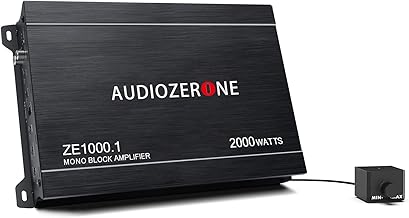
The AUDIOZERONE ZE1000.1 is best for a subwoofer system that needs substantial power and is designed to operate at a 1-ohm final load. The listed output is 1000W RMS at 1 ohm, 650W RMS at 2 ohms, and 400W RMS at 4 ohms. These separate ratings help buyers compare output across different subwoofer wiring configurations.
This is a Class D monoblock with a MOSFET power supply. The product details describe Class D operation as reducing power loss and heat compared with less efficient designs. It is listed as stable from 1 to 4 ohms and includes a low-pass crossover. Its range of RMS figures gives it more flexibility than an amplifier with output specified at only one impedance.
Best for: A higher-power subwoofer setup with a final impedance that matches one of the listed output ratings. Choose this if the system needs up to 1000W RMS at 1 ohm or the stated lower output at 2 or 4 ohms.
Limitation: The 2000W figure in the product name is maximum power, not the listed RMS output. Match the subwoofer to the RMS rating for its actual final load, and confirm that the vehicle’s electrical system and wiring are appropriate for the installation.
Audiobank P1601

The Audiobank P1601 is best for a dedicated subwoofer installation where a driver wants to adjust bass level from the listening position. Its listed output is 800W RMS, with a maximum rating of 1600 watts. The remote subwoofer level control is the clearest practical distinction in the supplied feature list.
This monoblock uses a Class AB design and a MOSFET power stage. The product description says the design combines musical output with controlled operation and responsive power delivery during demanding bass passages. The remote control can make it easier to change subwoofer level for different music or road conditions without adjusting the amplifier itself.
Best for: A buyer whose subwoofer requires an output near the listed 800W RMS and who wants a remote level control. Better for users who prioritize adjustment from the driver’s seat over a compact Class D design.
Limitation: The supplied details do not state the impedance at which the 800W RMS rating applies. Check the amplifier’s full specifications and confirm that its output at the intended load matches the subwoofer before selecting it.
DBASSO Mono Amplifier

The DBASSO Mono Amplifier is best for buyers looking for a 1-ohm-stable Class D amp with protection features. Its product name states 700W RMS continuous power, while the feature information describes 1000W peak power. Keep these figures distinct: RMS is the more useful rating for matching continuous amplifier output to a subwoofer.
The listed features include a digital Class D design, a MOSFET switching power supply, and protection against thermal issues, over-voltage, short circuits, and speaker DC. The product information also claims efficiency above 90% and describes the amplifier as compact and cool-running. It is specifically described as stable at a 1-ohm subwoofer load.
Best for: A 1-ohm subwoofer setup where the listed continuous rating and protection features suit the system. Choose this if 1-ohm stability is essential and the subwoofer’s RMS needs are compatible.
Limitation: The supplied details do not specify the impedance associated with the 700W RMS figure. Confirm the rated RMS output at the system’s final load; do not use the 1000W peak figure as a substitute.
Buying Guide: How To Choose A Budget Amp For Subs
A low-cost amplifier is only a good match when its output, impedance rating, and features suit the subwoofer and vehicle. Compare the specifications that affect safe system matching first. A large maximum-watt number alone does not show how much continuous power an amplifier can deliver.
How much RMS power does the sub need?
Check the subwoofer’s RMS power handling, then compare it with the amplifier’s RMS output at the intended impedance. RMS ratings are more useful for this comparison than maximum or peak ratings. For example, the BOSS R1100M listing provides maximum figures, so its stated 1100 watts should not be compared as though it were 1100W RMS.
An amplifier does not need to have the same RMS number as the subwoofer in every situation, but the two must be selected as a system. Follow the equipment makers’ guidance and avoid assuming that a higher advertised wattage means better sound or safer operation. Gain controls are used to set signal level; they are not a substitute for correct power matching.
What impedance will the subwoofer present?
Impedance is the electrical load the amplifier sees from the connected subwoofer or subwoofers. Check the final load after wiring, not just the impedance printed on one voice coil. The amplifier must be rated for that final load. A model that is 1-ohm stable can support a 1-ohm load according to its stated specification, but that does not mean every subwoofer can be wired safely to 1 ohm.
Compare output ratings at the exact load you plan to use. The AUDIOZERONE listing provides separate RMS figures at 1, 2, and 4 ohms. Other listings may give only one rating or omit the impedance tied to an RMS figure, which makes checking the full manufacturer specification especially important.
Should you choose Class D or Class AB?
Class D designs are often selected for subwoofer systems where efficiency and a compact amplifier are priorities. The AUDIOZERONE and DBASSO product details describe Class D designs and emphasize reduced power loss or efficient operation. The Audiobank P1601 uses a Class AB design. The supplied details do not establish that one model will sound better than another, so compare actual output, load compatibility, installation needs, and controls instead of choosing by class alone.
Which controls and protections matter?
A low-pass filter helps limit the frequencies sent to a subwoofer, while bass boost changes output around a selected low-frequency range when that feature is provided. Remote level controls let the driver adjust subwoofer level from the listening position. The Taramps listing specifies adjustable bass boost; the BOSS lists bass boost, a low-pass filter, and a remote subwoofer control; and the Audiobank includes a remote subwoofer level control.
Protection features can also be relevant. The BOSS listing names thermal, short, and overload protection. The DBASSO listing names thermal, over-voltage, short-circuit, and speaker DC protection. These feature lists are not a guarantee against problems caused by incorrect wiring, poor installation, or an unsuitable load.
Will the amplifier fit and work with the vehicle?
Measure the installation location and allow space for the connections and ventilation required by the manufacturer. The BOSS listing supplies dimensions and weight; the other product details provided here do not include equivalent measurements. Confirm the amplifier’s power and signal connections, the vehicle’s electrical capacity, and any installation requirements using the complete product documentation.
Plan for suitable wiring and a secure installation. Higher-power systems can place greater demands on a vehicle’s electrical system. Do not select an amplifier based only on its advertised wattage or physical size, and consult a qualified installer if the wiring, load calculation, or installation location is uncertain.
How should you compare budget options?
- For a moderate 2-ohm setup: Compare the Taramps BASS 400’s stated 400W RMS output with the subwoofer’s RMS needs.
- For a 1-ohm setup: Compare the AUDIOZERONE and DBASSO ratings at the intended load and verify the exact RMS output.
- For remote bass adjustment: Consider the BOSS R1100M or Audiobank P1601, while checking the full RMS specifications.
- For simpler power matching: Prefer specifications that state RMS output at the relevant impedance rather than relying on peak or maximum ratings.
Frequently Asked Questions
What does RMS mean on a subwoofer amplifier?
RMS is a continuous power rating used to compare amplifier output with a subwoofer’s power-handling specification. It is generally more useful for system matching than a maximum or peak-watt number.
Can I use a 1-ohm-stable amp with a 2-ohm subwoofer?
Often, an amplifier rated for a 1-ohm minimum load can operate at a 2-ohm load, but check its output at 2 ohms and follow the full product specifications. Confirm the final load created by all connected voice coils and subwoofers.
Is a higher wattage number always better?
No. A high maximum-watt figure does not necessarily indicate high RMS output. Compare RMS output at the actual impedance with the subwoofer’s RMS rating, then consider controls, protection features, and installation requirements.
Do I need a monoblock amp for a subwoofer?
A monoblock amplifier has one amplifier channel and is commonly used to power a subwoofer. The models in this comparison are monoblock designs. Select one based on the subwoofer’s load and power needs rather than channel count alone.
Which amp is best for a 400W RMS subwoofer?
The Taramps BASS 400 is a direct candidate if the subwoofer’s final load is 2 ohms and its requirements match 400W RMS. Verify the subwoofer’s impedance and the amplifier’s complete specifications before purchase.